AI developer tools in Kenya: What actually works in 2026
A practical guide to AI coding tools for Kenyan developers, covering GitHub Copilot, Cursor, Claude Code, and ChatGPT. Learn about real-world performance, cost implications with KES salaries, and connectivity challenges on 4G networks.
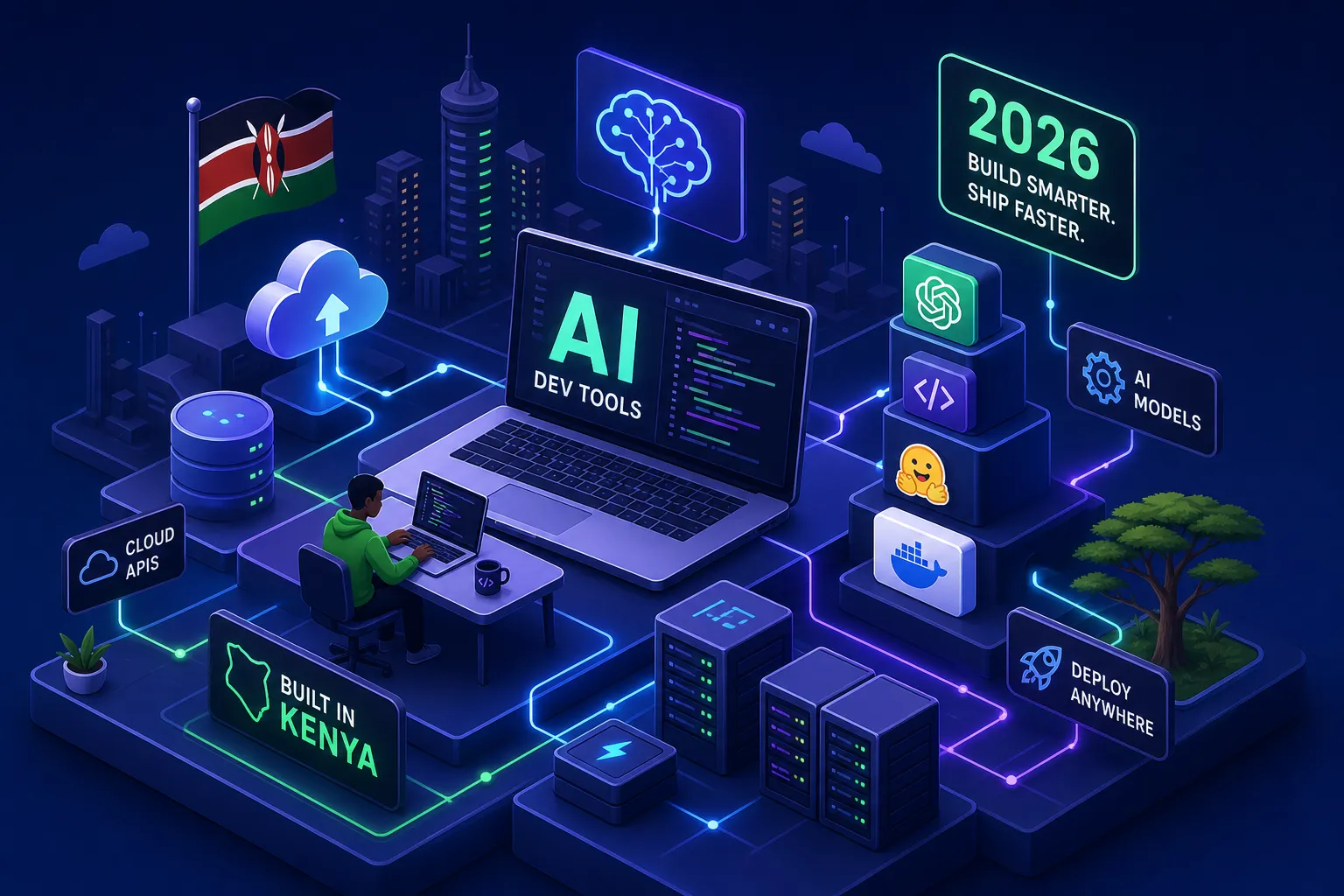
AI developer tools in Kenya have reached a point where local engineers can access the same AI coding assistants used by developers at Google and Stripe. The tools are real, the capabilities are significant, and the access barrier is lower than most people assume. But the global reviews rarely cover the parts that actually matter here: dollar-denominated billing on a KES salary, inconsistent 4G connections that break long-context sessions, and a local training market that ranges from one-day workshops to 27-week bootcamps. This guide cuts through all of that.
This article draws from hands-on production experience building WhatsApp bots and workflow automation systems for Kenyan businesses, the kind of work that involves live integrations, real payment flows, and actual user traffic. The tools covered below are the ones in active use on live projects right now, not theoretical picks from a benchmark report.
The top AI coding tools Kenyan developers are using in 2026
Four tools dominate active developer adoption globally, and they are the same AI developer platforms Kenyan engineers use in production: GitHub Copilot, Cursor, Claude Code, and ChatGPT. Understanding the distinction between them saves you from paying for two tools that do the same thing, or worse, picking the wrong one for your project type.
GitHub Copilot vs Cursor: your everyday coding companion
GitHub Copilot integrates directly into VS Code and suits developers already working within a Microsoft or enterprise stack. It is the safer, more conservative pick, with over 15 million users globally and strong adoption in team environments where code security and auditability matter.
Cursor, a VS Code fork, wins on individual speed. Its tab-to-complete refactoring and multi-file context awareness make it the preferred tool for developers who want to move fast on a solo build. Reported adoption figures place Cursor's acceptance rate among individual developers at around 70%, meaning most of what it suggests is genuinely usable. On inline code speed for Python and JavaScript, Cursor is measurably faster on multi-line suggestions and refactoring tasks, though exact figures vary depending on project type and connection quality.
Claude Code and ChatGPT: when reasoning beats raw autocomplete
These two LLMs for developers serve a different function. Claude Code handles large codebases and multi-file logic with methodical, step-by-step reasoning. It is well-suited for debugging complex edge cases, particularly around webhook flows, API error handling, and integration logic. ChatGPT (OpenAI) offers the widest flexibility: explaining errors, writing tests, brainstorming architecture, and generating boilerplate across a range of frameworks.
The distinction worth remembering is that Cursor writes code faster, while Claude Code thinks through it more carefully. For building a WhatsApp bot integration with multiple API dependencies, that difference matters enormously.
Cost of AI developer tools in Kenya: what each tool actually demands
The two friction points most global reviews skip entirely are the ones Kenyan developers deal with every day: pricing in USD and connectivity that is not always stable. Both are manageable once you understand the numbers.
Pricing reality when you are billing in USD from Kenya
The confirmed USD prices break down as follows, with approximate KES equivalents based on mid-2026 exchange rates (verify current rates via CBK or a reliable FX source before budgeting): GitHub Copilot Pro runs approximately KES 1,300 per month ($10 USD), while Cursor Pro, Claude Pro, and ChatGPT Plus each sit at roughly KES 2,600 per month ($20 USD each). These are individual plan rates.
For payment, Visa cards such as Equity Virtual Visa and KCB Visa are generally accepted on most of these platforms, provided international transactions are enabled, though success can vary by merchant and card issuer. M-Pesa Global Pay support is inconsistent; run a small test transaction first and check recent reports from the local developer community before committing to a monthly subscription. The OpenAI API is worth a separate mention: it is consumption-based rather than subscription-based, and spending caps give you direct control over monthly outgoings. For automation builders watching costs, this is often a smarter structure than a flat subscription.
Which AI dev tools for Kenyan developers hold up on 4G and shared office Wi-Fi
Bandwidth matters differently depending on the tool. Cursor and GitHub Copilot are IDE-integrated and relatively lightweight for basic inline autocomplete. The problem appears when you start using Cursor's agentic features or Claude Code's full codebase uploads: these require sustained connections and low latency.
In practice, the usable threshold sits at under 800ms latency and at least 15 Mbps download for a comfortable Cursor experience, with Claude Code needing closer to 20 Mbps for long-context sessions. A practical rule: if you are on a mobile hotspot, stay with GitHub Copilot for inline suggestions. On stable fibre, Claude Code becomes far more useful for complex debugging tasks. Packet loss is also a bigger issue than raw speed, even 5% packet loss breaks agent sessions on Cursor and interrupts Claude Code's reasoning chains.
How AI developer tools in Kenya perform on real projects
This section is based on direct production experience, not benchmark reports. The context is WhatsApp bot development and business automation: work that involves live integrations, real payment flows, and actual user traffic.
Building WhatsApp bots and automation flows with AI assistance
The daily workflow looks like this: Cursor handles the core code writing for WhatsApp Cloud API integrations and Next.js webhook endpoints. The OpenAI API sits inside the bot logic for natural language understanding and response generation. n8n connects the moving parts and manages automation flows between services.
AI coding assistants in this setup do not replace developer judgement. They compress the time between an idea and working, testable code. In practice, a bot that once took two weeks to scaffold can reach a testable state in two to three days, with every generated line reviewed before it touches production. The speed gain is real; the human review step is non-negotiable.
Lessons from production-scale bot development
Across live WhatsApp bot projects handling significant event volumes, one finding is consistent: AI-generated code moves fast but needs human review at every integration point. The risk areas are M-Pesa Daraja API responses, error handling on failed webhook deliveries, and rate limit logic for high-volume messaging.
For these edge cases, Claude Code has proven more reliable in practice, its step-by-step reasoning approach handles ambiguous API responses better than autocomplete-style tools. Cursor is faster for building fresh features where the integration surface is clean and well-defined. The combination of both tools is what makes AI-assisted development reliable, not just fast. Using one without the other leaves gaps that only surface under production load.
AI upskilling courses Kenya: where to get trained in AI-assisted coding
The local training market has moved past generic coding bootcamps. You can now match your commitment level to your situation, from a single workshop day to a multi-month engineering programme.
Short courses that target AI coding tools directly
NobleProg Nairobi offers the most targeted course catalogue for working developers who want focused, tool-specific training. Their offerings include AI-Assisted Development with Cursor (21 hours), Introduction to GitHub Copilot (7 hours), Advanced GitHub Copilot (14 hours), Tabnine for AI coding (21 hours), and Claude for Coding (21 hours). These are typically one- to three-day workshops, and pricing requires a direct quote, which suits companies booking team training rather than individual sign-ups.
The Knowledge Academy offers a one-day AI Automation for Software Development course covering VS Code and Codex. ODSAI Tech runs a single-day practical workshop focused on building working AI tools by end of day. For developers who already write code and want to integrate AI tools faster without committing to a months-long programme, this short-course route is both practical and affordable.
Full bootcamps for developers wanting a structured AI engineering path
Three bootcamps stand out for structured career development. Moringa School's Applied AI Engineering programme runs 14 weeks and costs KES 150,000; it is delivered fully online and is an NVIDIA partner programme, which carries meaningful industry recognition. Zindua School's Software Engineering Core Immersive runs 27 weeks at KES 200,000 and explicitly integrates AI-assisted coding modules alongside cloud computing and systems design. Inceptor Institute of Technology offers a 24-week programme at approximately KES 90,000 total, making it the most affordable structured option.
The decision framework is straightforward: if you already build software and want to accelerate your workflow with AI tools, the NobleProg short-course route is more immediately applicable. If you are making a deliberate career move into AI engineering, Moringa or Zindua provides a structured path with recognised outcomes.
Hiring AI developers in Kenya: where to look and what to pay
This section is useful for business owners looking to hire and for developers understanding how to position their rates in a market that is increasingly paying for specialisation.
Where to find and vet AI developers locally
LinkedIn Kenya is the most active channel, with 52 or more AI developer roles listed at any given time. BrighterMonday covers local full-time positions at mid-to-senior level. Andela remains a well-established platform for pre-vetted senior engineers on USD contracts, and the Kenya AI job board at kenyaai.co.ke serves niche ML and AI roles within the community. For freelance work, Upwork and Contra both work well for sourcing Kenyan AI developers on project-based terms.
For WhatsApp bot development and workflow automation specifically, the talent pool is considerably smaller than general software development. Vetting should focus on live, production products with measurable usage metrics, not just portfolio screenshots. Anyone can show a demo; ask for the deployment environment and concrete indicators of production traffic instead. Useful questions include: What is the average monthly event or transaction volume? What is the uptime track record? How are errors and failed webhook deliveries handled?
Rate expectations for freelance and full-time engagements
Local full-time AI developer roles currently run KES 150,000 to KES 500,000 per month at mid-level, reaching KES 1,000,000 or more for senior engineers at organisations like the Microsoft Africa Development Centre in Nairobi. Freelance hourly rates on Upwork range from USD 20 to USD 50, with specialists in LLM integrations and WhatsApp API development at the higher end of that range; highly specialised AI and ML developers charge USD 75 to USD 100 or more.
Remote contracts through Andela or Turing targeting USD-paying clients can reach KES 250,000 to KES 1,000,000 or more per month, a significant premium over locally denominated contracts for the same level of work. The rate gap between KES-paying local roles and USD-paying remote contracts is the most important pricing signal in the current Kenyan market.
Choosing your first tool and launching a small pilot
The goal at this stage is not to find the perfect tool. It is to pick one and start shipping. A one-week pilot with a single tool teaches you more than a month of reading comparisons.
Matching the right tool to your project type
Three common project scenarios illustrate the best tool fit for Kenyan developers:
- Building a customer-facing WhatsApp bot: start with Cursor for the code layer and the OpenAI API for the intelligence layer.
- Automating internal business workflows: use n8n for the automation logic, with Claude Code for designing and debugging complex flows.
- Building a web platform or e-commerce site: GitHub Copilot paired with Next.js or WordPress, depending on the complexity of the front end.
The key principle is not picking the most advanced tool available. It is picking the one that fits your project's complexity, your bandwidth reality, and your monthly budget in KES, without stretching any of the three.
A first-week plan to test AI-assisted development without overcommitting
Day 1: Set up a free tier on one tool. The ChatGPT free plan is available to all users; GitHub Copilot offers a free tier for verified students and open-source maintainers, or a paid trial for others. Run it against a real bug or feature you are already working on. Use a real project, not a toy one.
Days 2 to 3: Review every suggestion before accepting it and take notes on where the AI is accurate and where it misses context.
By Day 5: You have enough data to assess whether the time saved justifies upgrading to a paid plan. This approach removes the fear of switching tools mid-project and gives any developer a concrete starting point regardless of experience level or budget.
What to do next with AI developer tools in Kenya
The tools exist, they are accessible, and the main variables are cost in KES, your connectivity situation, and the type of project in front of you. Cursor and GitHub Copilot lead for daily coding. Claude Code and ChatGPT handle the harder reasoning and debugging problems. Local AI upskilling courses in Kenya range from a one-day ODSAI workshop to a 27-week Zindua bootcamp. Hiring rates reflect a market that is increasingly rewarding specialisation over general software development skills.
The fastest way to close the gap between knowing about AI developer tools in Kenya and actually shipping with them is to start with one, on one real project, this week. Every day spent comparing tools is a day not spent building. If you would rather skip the setup and work directly with a developer who already has these tools integrated into a tested production workflow, Alvine Otieno builds exactly that for Kenyan businesses: WhatsApp bots, automation flows, and web platforms. AI-assisted development speed is backed by human review discipline at every integration point. Reach out to start with a scoped pilot.
Software engineer writing about the craft of building products on the web.