AI event assistant: features, costs and how to choose
Discover how AI event assistants, especially WhatsApp-based solutions, are transforming event management in Kenya by automating registrations, reminders, FAQs, and check-ins, saving time and resources.
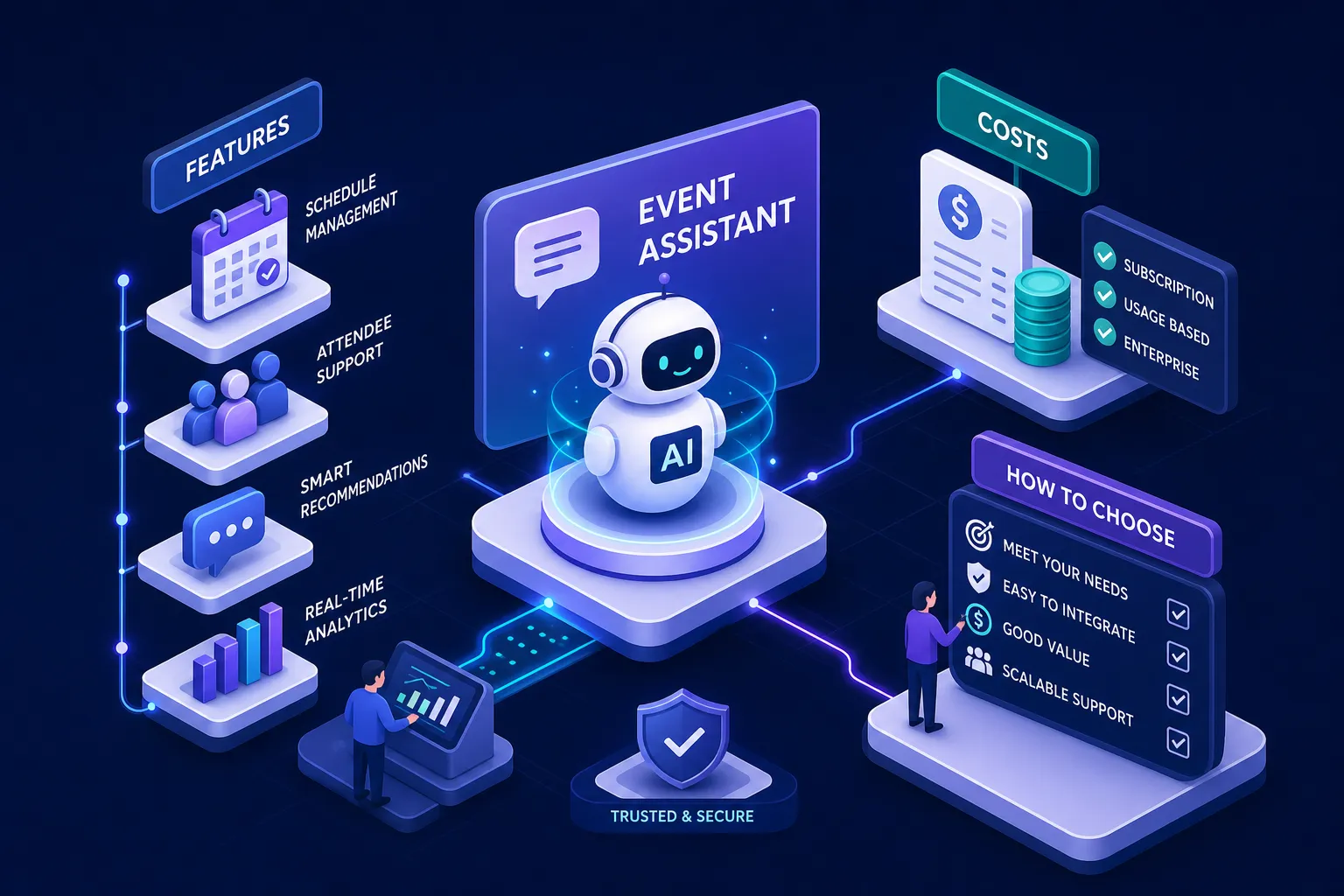
An AI event assistant can prevent the kind of registration chaos that derails Kenyan events before they even begin. Picture this: it is 7:45 a.m., doors open at 8:00, and your 500-person NGO summit registration spreadsheet has just crashed. Three staff members are fielding the same WhatsApp questions on repeat. The check-in queue is already out the door. This is not a logistics failure. It is an automation gap, and it happens at Kenyan events frequently.
An AI-powered event assistant fills that gap by handling the repetitive, high-volume communication that bogs down event teams: registrations, reminders, FAQs, check-ins, and post-event follow-ups, without adding a single person to your payroll. A WhatsApp-based event assistant built by Alvine Otieno has already processed over 50,000 events for real clients in Kenya. This is not experimental technology. It works in production, right now.
By the end of this article, you will know exactly what an AI event assistant does, which features to insist on, what results to expect, and whether to buy an off-the-shelf platform or build something that actually fits your workflow.
What an AI event assistant actually does
An AI event assistant is not a fancier autoresponder or a static FAQ page. It is a conversational system that manages the full attendee journey from first registration to post-event feedback, without a human touching every interaction. The system understands context, handles follow-up questions, and hands off to a human only when the situation genuinely requires it.
Registrations, reminders and FAQs on autopilot
The registration workflow is straightforward: an attendee sends a message, the bot collects their details, confirms their spot, and issues a ticket or confirmation code, all within seconds. Automated reminders follow a typical cadence used across production deployments, 48 hours before the event, the morning of, and one hour before. FAQs about the venue, parking, agenda, and speakers are answered instantly at any hour of the day or night.
In practical terms, this replaces three staff members fielding 200 identical questions. At most medium-to-large Kenyan events, a significant portion of pre-event staff time disappears into answering the same five questions repeatedly. An AI event coordination agent can drastically reduce or near-eliminate that burden, case studies from comparable deployments show deflection rates above 90% for routine pre-event enquiries.
Real-time check-in and post-event follow-up
Check-in automation works simply: attendees send a confirmation code; the system validates it against the registration database, marks them as arrived, and updates the live count in real time. According to documented deployment data from Eventico, AI-assisted check-in cut check-in times by 70%, making this one of the highest-ROI features for large events. The queue that stretched out the door in the opening scenario becomes a five-minute process.
After the event, the same system sends feedback forms, resource links, or next-step messages without any manual scheduling. The Society of Women Engineers documented savings of 63.4 staff hours by deploying an AI concierge for end-to-end attendee communication, reducing support cases by 19% in the process (SWE internal case study).
Why Kenyan events are a perfect use case for this technology
Kenya runs on WhatsApp. Businesses, NGOs, churches, and community groups all coordinate on it daily. According to DataReportal, over 95% of Kenyan mobile users are on the platform, and WhatsApp messages achieve an open rate of approximately 98% compared to the far lower figures typical of email. This is not a preference; it is infrastructure. An AI event assistant that lives on WhatsApp meets attendees exactly where they already are, without asking them to download a new app or remember a web portal URL.
WhatsApp as the dominant event communication channel
Kenyan attendees are far more likely to respond to a WhatsApp message than an email. For NGOs managing beneficiary programmes or businesses hosting trade events, this channel advantage is significant. A WhatsApp-based event chatbot removes the friction of getting attendees to engage with registration and check-in processes, because it sits in the same app where they are already having conversations.
The technical reality supports this too. WhatsApp AI responses consume substantially less bandwidth than loading a web page, research benchmarks put the difference at roughly 98% less data transferred, which matters enormously for events hosted in venues with inconsistent connectivity. A well-built WhatsApp assistant works reliably on a 3G connection. A web-based registration portal, unless specifically optimised for low-bandwidth conditions, often struggles under the same constraints.
Scale without adding headcount
Scaling from 100 attendees to 1,000 can avoid roughly linear increases in staffing when the communication layer is automated. For NGOs running programmes across multiple counties, this is the difference between a manageable operation and a logistical crisis. The WhatsApp AI assistant built by Alvine Otieno has processed over 50,000 events, handling registrations, reminders, and FAQs at scale for real clients in Kenya. That volume is not a marketing claim; it is evidence of a system that has been stress-tested under real event-day conditions.
Features of an AI event assistant that actually matter
Not all AI event assistants are built equally. Some are glorified FAQ bots with a conversational veneer; others are full event management AI systems with real integrations that hold up under pressure. Knowing which features actually matter helps you avoid paying for capability that sounds impressive in a demo but breaks on event day.
A single linking point before diving in: knowing why the Kenyan context demands specific features is straightforward. Knowing which features reliably deliver on that context is where most buying decisions go wrong.
Non-negotiable core capabilities
Any credible virtual event assistant must cover five areas:
- A conversational registration flow that captures attendee details without friction
- Automated reminder sequences tied to configurable pre-event intervals
- Live FAQ handling with a clean human escalation path for edge cases
- Check-in validation with real-time attendance tracking
- Post-event analytics and feedback collection
Human escalation is non-negotiable. A system that gets stuck on an edge case and leaves the attendee with no path forward is worse than no system at all. The escalation must hand off context cleanly so the human agent does not start the conversation from scratch. Scheduling features for breakout sessions or one-on-one meetings add significant value for professional conferences, and the most useful assistants also connect to tools like Google Calendar and Zoom, while enterprise options reach CRMs like Salesforce and HubSpot via automation bridges built on platforms like n8n or Zapier.
Kenya-specific integrations and technical realities
This is where generic global tools most often fall short. For Kenyan events, the assistant must handle M-Pesa payments for paid registrations, operate reliably on low-bandwidth connections, and communicate naturally in the mix of English and Swahili that Kenyan attendees use. A review of mainstream event assistant software platforms finds no off-the-shelf option with native M-Pesa Daraja API integration at the time of writing. That gap is significant for any event that charges an entry fee.
There is also a meaningful technical trade-off to understand around connectivity. Cloud-based assistants from leading providers handle multiple languages with sub-1.5-second response times under typical conditions. Fully offline systems can take 8 to 10 seconds per response, which is a noticeable delay in a busy check-in queue. For most Kenyan event venues with at least 3G coverage, a well-optimised cloud-based WhatsApp system is the better choice.
Real numbers: what to expect from time savings and cost reductions
The documented outcomes from real deployments tell a clearer story than vendor brochures. The figures below come from named production deployments, not projected estimates.
Published metrics from real deployments
The strongest case study figures come from organisations that have been running AI event management systems in production. Eventico reported a 40% increase in attendee engagement and a 70% reduction in check-in times. EventPro Solutions achieved 96% client satisfaction and 85% guest engagement within three months of AI implementation. A WhatsApp assistant deployed at the Disaronno global event achieved a 95% adoption rate, with 190 out of 199 participants actively using it.
The time savings stack up quickly. MIT saved over 500 student hours by deploying AI assistants for support work. COTA saved 21 staff hours while reducing deployment time to three weeks. EventPro Solutions reduced event planning time by 70% through AI-powered vendor coordination and automated scheduling.
Realistic cost estimates for Kenyan events
Off-the-shelf mid-tier SaaS platforms typically run $30 to $150 per month (USD, excluding applicable taxes), while basic per-event AI tool packages start around $1,000 to $5,000. Full-scale enterprise platforms like Cvent and Bizzabo quote custom pricing that frequently reaches tens of thousands of dollars annually, rarely appropriate for most Kenyan organisations.
Custom-built WhatsApp bots from a Kenyan developer typically range from KES 150,000 to KES 300,000 for a standard build with M-Pesa integration, AI conversation handling, and full event workflow automation. Monthly operating costs for roughly 10,000 conversations run around KES 42,000, covering WhatsApp API fees, server hosting, and maintenance. For NGOs and SMEs hosting recurring events, a custom build frequently pays for itself within the first year by eliminating the per-event platform fees that compound quickly at scale.
How to choose an AI event assistant: build vs. buy
The default assumption is that buying an existing platform is faster and cheaper. That assumption holds for one-off events with standard formats. It breaks down for most Kenyan businesses and NGOs, because the off-the-shelf options are built for Western event formats and Western payment systems.
When a SaaS platform makes sense
Pre-built platforms win in specific scenarios: one-off events with standard formats, organisations with no developer access, or teams that need to be operational within 48 hours. Platforms like Whova (which publishes a free starter tier on its pricing page), Luma, and Eventbrite for ticketed events are reasonable starting points. The limitations are real, though. These platforms rarely offer native M-Pesa integration, often require stable internet, and charge per-event fees that compound quickly for high-frequency organisers.
When a custom WhatsApp bot is the smarter move
For businesses and NGOs running events regularly on WhatsApp, a custom-built AI event assistant is the better long-term investment. Alvine Otieno builds exactly this type of system: WhatsApp AI bots using the Meta WhatsApp Cloud API, OpenAI for intelligent conversation handling, and n8n for workflow automation, with full M-Pesa Daraja API integration for paid registrations. The 50,000+ events already processed through Alvine's production bot reflect a system that has encountered and resolved the full range of failure modes typical at scale, from duplicate registrations to payment timeouts to mid-conversation drop-offs.
The recommendation is direct: if your organisation runs three or more events per year and your attendees are on WhatsApp, a custom build fits your workflow. A generic platform forces your workflow to fit a product designed for a different market.
How to shortlist and choose the right AI event solution
Whether you are evaluating SaaS platforms or briefing a developer, a practical set of questions will filter out the tools that look good in demos but break under real event conditions.
Questions to ask before you commit
Run every option through these questions before signing anything:
- Does it integrate natively with WhatsApp, or does it require a separate app?
- Can it process M-Pesa payments directly, or does that require custom development?
- What happens when the internet drops at the venue mid-event?
- What is the human escalation path when the bot cannot answer a question?
- How does it handle conversations that mix English and Swahili?
- Can it scale from 50 to 5,000 attendees without a pricing cliff?
What production-ready looks like in practice
There is a meaningful difference between a working prototype and a production-ready system. A production-ready AI event assistant has been tested under load, has error-handling for edge cases, logs every interaction for audit purposes, and has a clear support pathway when something goes wrong. Ask any vendor or developer for evidence of live deployments at scale, not screenshots of a polished UI.
The 50,000+ events processed through Alvine's WhatsApp bot is a useful reference point for this conversation. That volume surfaces the full range of failure modes typical at scale, duplicate registrations, payment timeouts, mid-conversation drop-offs. A system that has handled that volume and is still running in production has been genuinely stress-tested.
The practical decision
An AI event assistant is not a luxury for large conference organisers with enterprise budgets. It is a practical tool for any Kenyan business or NGO that runs events regularly and wants to stop losing staff hours to repetitive communication that a well-built system can handle automatically.
Understand what the tool does across the full attendee journey. Insist on features built for the Kenyan context, including WhatsApp-native operation and M-Pesa integration. Use the published metrics above as your ROI benchmark. Choose between SaaS and a custom build based on your event frequency and workflow requirements.
If your events run on WhatsApp and you want a system built for that reality, Alvine Otieno builds WhatsApp AI assistants for exactly this purpose, from first registration through to post-event follow-up, with M-Pesa integration and the reliability that comes from 50,000+ events already processed. Get in touch to discuss what a production-ready event bot looks like for your organisation.
Software engineer writing about the craft of building products on the web.