Alvine Otieno Website Design: Portfolio & Services
Explore the portfolio of Alvine Otieno, a Kisumu-based freelance developer specializing in high-performance websites and web platforms for Kenyan businesses. Featuring Next.js, WordPress, and React projects with M-Pesa integration.
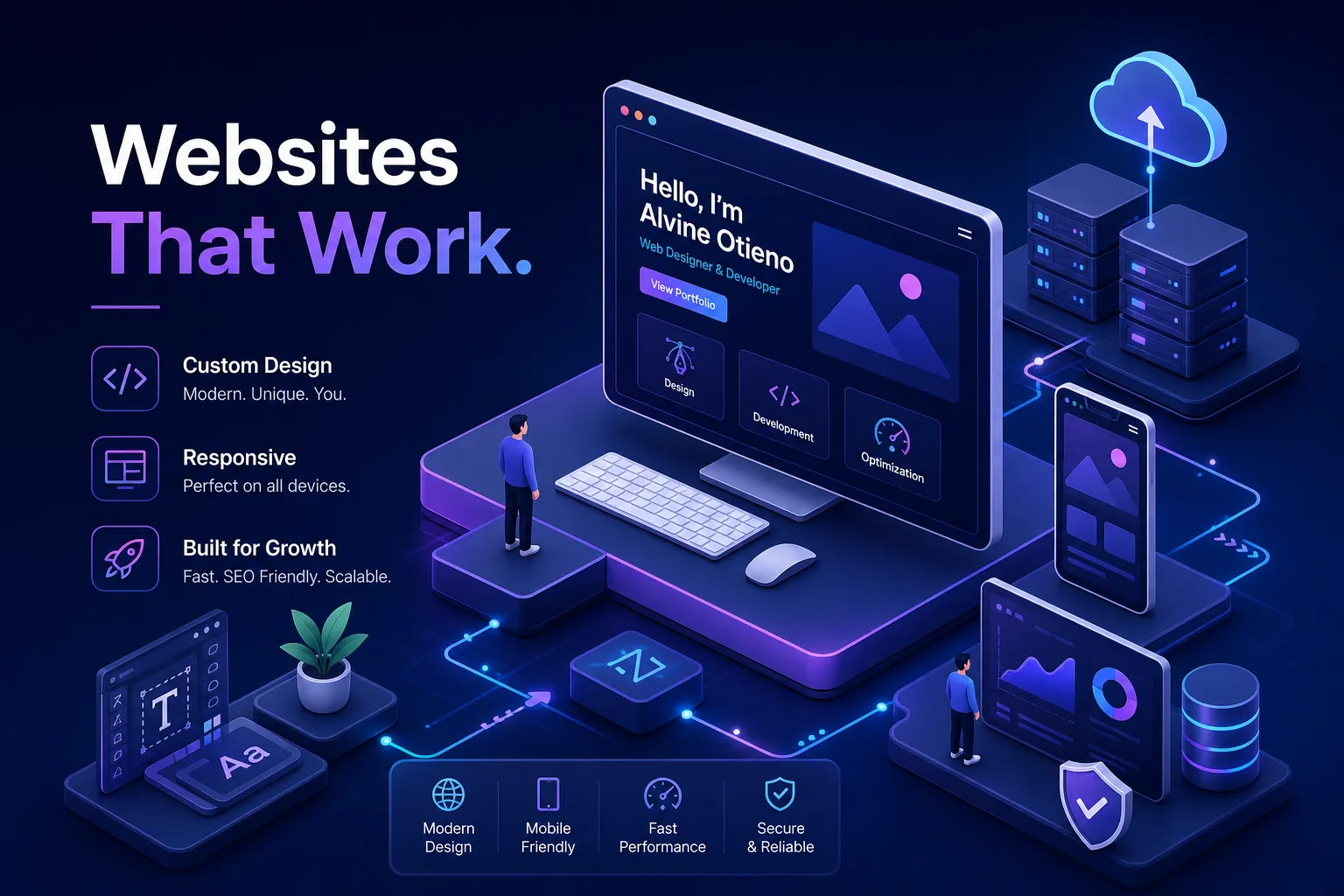
This is the portfolio and services page for Alvine Otieno website design, a Kisumu-based freelance developer who builds websites and web platforms for businesses that need more than a good-looking page. The work showcased here spans Next.js, WordPress, and React, with every project designed to solve a real business problem rather than win a design award. If you've landed here looking for a developer who understands both the Kenyan market and modern web standards, you're in the right place. By the time you finish reading, you'll understand the approach, see the outcomes, and know exactly what the next step looks like.
There is increasing demand for functional web platforms in Kenya. Businesses are no longer satisfied with a five-page brochure site that loads slowly on a Safaricom connection and never generates a single enquiry. The demand now is for sites that capture leads, process M-Pesa payments, connect to WhatsApp bots, and perform well on a Tecno or Infinix device. That's the standard this Alvine Otieno website design portfolio is built to.
What gets built here and who it's for
Every site built at Alvine Otieno starts with a business question, not a visual brief. The first conversation is never about colours or fonts, it's about what the site needs to do: capture leads, sell products, deliver content at speed, or feed into an automated workflow. Aesthetics matter, but they follow function. A beautiful site that doesn't convert is just an expensive digital brochure.
The target client profile is broad but consistent. It includes SMEs across Kenya who need a professional web presence with M-Pesa integrated into the checkout. It includes diaspora entrepreneurs based in the US who are building or scaling businesses back home and need a developer who understands both markets. It also includes NGOs that need lightweight platforms for beneficiary engagement, and US-based solopreneurs who want to outsource quality web builds without sacrificing communication or code standards. If any of those describe you, the work on this portfolio was built with your context in mind.
Alvine Otieno website design: the tech stack
When Next.js is the right call
Next.js is the default choice for performance-critical builds. It offers server-side rendering and static site generation, which translates directly to faster LCP scores for users on 3G or 4G networks. For a Kenyan business where a significant portion of your audience is browsing on mobile data, the difference between a 1.5-second load and a 4-second load is the difference between a customer who enquires and one who bounces, research consistently shows users abandon pages that take longer than three seconds to load. Next.js also fits naturally with API integrations, including M-Pesa Daraja and WhatsApp Cloud API callbacks.
When WordPress still makes sense
WordPress is not a legacy option. It remains the right tool for content-heavy sites where the client needs to manage their own blog, service pages, or product listings without relying on a developer for every update. The WordPress builds produced here favour custom themes and clean code over bloated page builders that slow the site down and make future edits a headache. If your business needs a CMS your team can actually use, WordPress done properly is still one of the best decisions you can make.
React for dynamic, interactive platforms
React comes into play for dashboards, web applications, and platforms that involve real-time data or complex front-end logic. This is not template assembly, it's full-stack capability: a React front-end connecting to a backend API, with authentication and data persistence. The user experience is designed around what the end user actually needs to do. If your idea behaves more like an app than a website, React is likely the right foundation.
Real projects, real business outcomes
E-commerce with M-Pesa built into the checkout
One of the most common and highest-impact project types here is Kenyan e-commerce with M-Pesa Daraja API integrated directly into the checkout flow. A buyer completes a purchase via mobile money without leaving the site or switching between apps. This removes the friction that causes checkout abandonment, and the business impact is measurable. One client saw order volumes increase by over 40% within three months of launching the integrated checkout, the kind of result that pays for the build many times over.
Business platforms connected to WhatsApp
Some of the most interesting builds here are not standalone websites. They're platforms where the site and a WhatsApp bot work together as a single system. A lead capture form on the site triggers a WhatsApp follow-up sequence via n8n automation. A payment confirmation sends a WhatsApp receipt and updates the customer's order status in real time. This cross-product thinking, where the website is one component of a larger automated workflow, is what separates this Alvine Otieno website design work from what a generic developer delivers.
Landing pages built to convert
Not every project is a complex platform. Some of the highest-ROI builds are focused landing pages for service-based businesses: a single page with a clear hierarchy, fast load speed, a mobile-first layout, and one strong call to action. These pages are built with the same performance discipline as a full platform, a clear headline, supporting copy that addresses the visitor's specific problem, and a contact form that actually works. For one Nairobi consulting firm, this kind of focused page drove a measurable increase in enquiry volume within the first 90 days of launch.
What makes this approach different from a generic web developer
Mobile-first is the default, not the afterthought
Every build here is designed for a Kenyan mobile user first. That means practical decisions at the code level: images compressed to WebP format, lazy loading enabled natively, and lightweight scripts. LCP targets sit under 2.5 seconds, with a competitive target of under 1.5 seconds for performance-critical pages. Hero images are kept under 500KB; body images stay under 200KB. Cloudflare CDN reduces time to first byte, and builds are tested on common Kenyan devices, including Tecno and Infinix handsets, before going live. These are not optional extras. They're part of the standard build process.
On-page SEO built into the architecture
SEO is not something added at the end of a build. It's structured into the site from the very beginning, schema markup for local business and person entities, descriptive URL structures, optimised meta titles with location-specific keywords, proper heading hierarchy, and descriptive alt text on every meaningful image. For a Kenyan business, the goal is straightforward: show up when a local customer searches for what you offer. A site that isn't discoverable is a site that isn't working.
From first conversation to live site: how the process works
Discovery, scoping, and honest timelines
The engagement starts with a discovery call. The goal is to understand the business, the audience, and what the site needs to achieve before a single line of code is written. Scoping happens before the build starts, so you know the cost, the timeline, and exactly what you're getting before you commit. For a portfolio or freelancer-tier site, expect a timeline of one to two weeks. For a more complex platform with payment integrations, WhatsApp connectivity, or custom functionality, the realistic window is three to four weeks.
Build, review, and handover
The build process uses AI-assisted development for speed, combined with human review for quality. Every line of generated code is reviewed before it goes anywhere near production. Client review rounds are built into the timeline rather than added as an afterthought. The handover includes documentation so you actually understand how to manage your own platform, you won't be left with a site you can't touch or a system that requires a developer on call to maintain.
Ready to build? Here's how to get started
What happens in the first call
The consultation is typically a 30-minute conversation, not a sales pitch. The goal is to understand your business, identify what kind of site fits your specific need, and give you a realistic scope and cost estimate. You can come with a detailed brief, a reference site you like, or simply a problem you need solved. There's no obligation to proceed after the call, and you'll leave with a clear picture of what's possible and what it would cost.
Realistic cost benchmarks for Kenya: a simple portfolio or landing page runs in the range of KSh 20,000 to 50,000 for a professionally delivered result. A more complex business platform with payment integration and automation connectivity sits higher, but the scope is always agreed upfront so there are no surprises. The builds here are designed to generate a return on that investment within the first 90 days.
Alvine Otieno website design portfolio: view live demos before you decide
The strongest trust signal for any web developer is not a description of their work, it's a working URL you can click, test on your phone, and evaluate for yourself. Live project demos are provided on this site, and they're the most direct way to see the quality of what gets built here. Before booking a consultation, take five minutes to click through a live project and test it on your mobile device. That experience will tell you more than any portfolio write-up can.
You'll find live project links and the booking form for a free consultation on this site. Clicking through takes seconds, and what you see will make the decision straightforward.
The work is proven. The next step is simple.
Alvine Otieno website design covers websites and web platforms that work for businesses operating in Kenya and beyond, using Next.js, WordPress, and React as the core stack, with a process that prioritises outcomes over aesthetics from the very first conversation. The portfolio includes e-commerce sites with M-Pesa checkout flows that convert, business platforms integrated with WhatsApp automation, and landing pages generating enquiries for service businesses that previously had none.
The process is clear, the timelines are honest, and the next step is straightforward. If you have a business that needs a site that actually does something, book a free consultation or explore the live portfolio. One conversation is all it takes to find out whether this is the right fit.
Software engineer writing about the craft of building products on the web.