Best AI customer service tools for Kenyan businesses 2026
Discover the best AI customer service tools for Kenyan businesses in 2026. This guide evaluates platforms based on deployment, channel compatibility (especially WhatsApp), pricing, and local operational needs.
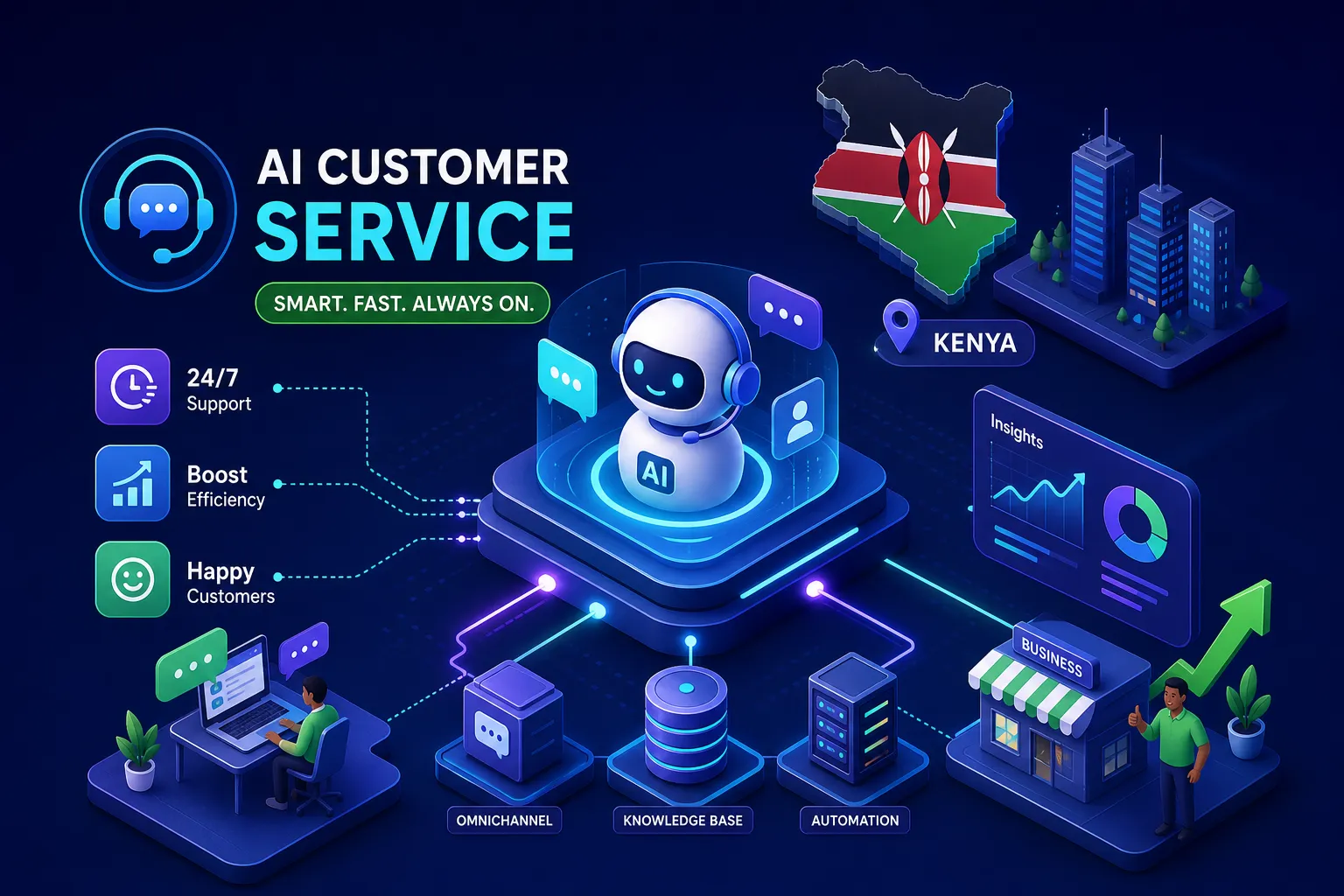
Kenyan customers now expect a reply within minutes. Not hours, not the next business day, minutes. For most small businesses, staffing that expectation around the clock is simply not feasible. One person finds it difficult to monitor WhatsApp, email, and social channels simultaneously while also running operations. This is precisely the gap that AI customer service tools are designed to close.
The performance data from 2026 benchmarks is striking: AI-handled chats now resolve in under two minutes on average, at a cost of around $0.62 per interaction compared to $7.40 for a human agent. That is a 91% cost reduction, not a rounding error. But not every platform on the market is built for how Kenyan businesses actually operate, with WhatsApp as the primary channel, with M-Pesa at the centre of payment flows, and with a customer base that switches between English and Swahili mid-sentence.
This evaluation is based on a combination of hands-on experience building and deploying conversational AI systems for businesses operating in Kenya, alongside current industry documentation and 2026 platform research. The goal is to help you shortlist three or four AI customer service tools that match your team size, your channels, and your budget, and to flag the compliance obligations that most SaaS vendors will not bring up unless you ask.
What to look for before choosing AI customer service tools
Deployment model and channel compatibility
The first decision is about deployment model. There are two broad categories: AI-first platforms with a built-in helpdesk, such as Intercom Fin or Enjo AI, and established resolution platforms like Zendesk or Salesforce that layer AI capabilities on top of their existing helpdesk infrastructure. For a small Kenyan team without dedicated IT staff, this distinction is critical. The first model gets you live in days. The second requires integration work upfront, which means time, cost, and a developer.
After deployment model, evaluate channel compatibility. A platform that handles email brilliantly but has no support for the WhatsApp Business API is solving the wrong problem for most businesses here. WhatsApp reaches 97% of Kenyan smartphone users, with open rates above 98% and response rates five to ten times higher than email. If your customers are not on WhatsApp already, your competitors' customers are. Any AI customer service tool you shortlist must support the WhatsApp Business API natively, not through an unofficial workaround that risks your account being banned.
Pricing models and realistic deflection rates
Three pricing models dominate: per-agent seat, per-conversation, and per-resolution. Enjo AI charges $0.40 per ticket; Intercom Fin charges $0.99 per resolved conversation. Seat-based pricing makes more sense once your volume is high enough that paying per interaction becomes more expensive than a flat monthly rate. One honest caveat: vendors routinely claim automation rates of 70 or 90%. Independent 2026 benchmarks put the median deflection rate closer to 41%. Plan your ROI calculations around realistic numbers, not marketing copy.
Helpdesk-first platforms compared: Zendesk, Freshdesk, and Intercom Fin
Zendesk has repositioned itself as a "Resolution Platform" following its acquisition of Forethought in early 2026. Its AI layer now includes Zendesk Copilot (suggested replies, ticket summarisation, macro recommendations), autonomous AI agents, and intelligent triage. It supports the WhatsApp Business API natively and connects to Salesforce, email, SMS, and social channels in a unified inbox. The trade-off is cost and complexity: Zendesk is the most enterprise-oriented option in this list, and the licensing and setup investment will feel significant for a Kenyan SME operating on a lean budget.
Freshdesk's Freddy AI is a more accessible entry point for growing teams. It supports 60+ languages, including Kiswahili, and its omnichannel inbox is considerably easier to configure than Zendesk's. Freshdesk-published case studies from 2026 show teams cutting their average first response time from several hours to under a minute after deploying Freddy. Pricing requires the Pro plan at $55 per agent per month, with Freddy AI Copilot available as a $29 add-on. The first 500 AI agent sessions are free for new paid accounts, which makes it practical to test before committing to full deployment.
Intercom Fin is the cleanest entry point for businesses starting fresh with no existing helpdesk. Its $0.99 per resolution pricing is transparent, it handles 45+ languages with real-time translation, and it requires no separate helpdesk software. For Kenyan businesses with primarily English-language support queues, Fin is one of the lowest-friction AI customer service tools to trial. You can be handling real conversations within a day of sign-up.
WhatsApp automation tools built for Kenya's messaging habits
Wati and AiSensy offer no-code WhatsApp chatbot builders that require no engineering input. If your team has no developer and you need a functional FAQ bot on WhatsApp within a week, these are realistic options. Respond.io provides a more capable shared inbox with native Salesforce integration, making it a better fit for teams that need to sync WhatsApp conversations into a CRM automatically. Tidio's Lyro AI is worth noting for its speed improvement data: one documented case study shows average response time dropping from four hours to 30 seconds, with satisfaction scores rising from 62% to 89%.
Before committing to any WhatsApp tool, verify one thing clearly: does it connect through an official Meta Business Solution Provider (BSP)? Official BSP status means the platform can send message templates, run broadcasts, and build automated flows without violating Meta's terms. Respond.io, Wati, Infobip, and 360dialog are confirmed Meta BSPs as of 2026. Some cheaper no-code tools use unofficial API connections that bypass this process, and when Meta detects it, the account gets banned. For most Kenyan businesses, WhatsApp is the primary customer channel. Losing it, even temporarily, is not a recoverable situation.
Multilingual support and the Swahili gap
Most platforms advertise Swahili support. The honest evaluation is more nuanced. Freshdesk Freddy and Zendesk AI both claim Swahili capability, but their handling of Swahili-English code-switching, the way most Nairobi customers actually communicate, is inconsistent. A customer sending "Nisaidie na order yangu, it's been two days" will be misread by systems that process Swahili and English as separate language contexts. Specialised conversational AI tools like Zudu.ai and JuaFlow are built specifically for East African linguistic patterns, including Kenyan and Tanzanian Swahili variations, code-switching, and regional accents. For businesses with a significant Swahili-speaking customer base, this is a non-negotiable evaluation point.
Sheng is a separate question entirely. No off-the-shelf platform currently handles it reliably. For businesses with a young, urban Kenyan customer base in Nairobi, this means the AI will occasionally misread intent or tone when a customer writes in Sheng. The practical workaround is straightforward: train the bot on a curated FAQ set written in plain Swahili and English, and configure escalation to a human agent for any query the bot marks as ambiguous. Do not let the bot guess; it will frustrate customers when it gets it wrong.
Data privacy and the compliance layer Kenyan businesses cannot skip
The Kenya Data Protection Act 2019 requires that personal data be stored within Kenya or transferred only to countries with adequate protection, with explicit ODPC approval for cross-border transfers. Fines for non-compliance reach KES 5 million or 1% of annual revenue. Most global SaaS platforms default to US or EU data storage unless you specifically configure otherwise, and the vast majority of small businesses never check this setting during onboarding.
For businesses handling financial data, the Central Bank of Kenya's local storage requirements add a second compliance layer that eliminates some global-only platforms entirely. The vendors with genuinely configurable data residency for Kenya include Google Cloud (Nairobi region), Microsoft Azure (building an East Africa region in partnership with G42), and Atlancis Technologies, which partnered with EverseTech on the launch of Kenya's first sovereign AI cloud in March 2026, keeping AI workloads and all sensitive data entirely within Kenyan borders. Before signing any SaaS contract, ask the vendor explicitly where your customer data will be stored and request written confirmation. If the answer is vague, that is your answer.
When a custom-built WhatsApp bot outperforms off-the-shelf AI customer service tools
Off-the-shelf AI customer service tools handle standard FAQ deflection, ticket routing, and follow-up sequences very well. They reach their limits when a business has a workflow that does not match the template. Confirming an M-Pesa payment inside the same WhatsApp thread, routing queries based on a customer's subscription tier stored in a bespoke database, or triggering a fulfilment event the moment a Daraja API payment clears, most generic platforms do not provide these flows out of the box and will require meaningful integration work. Some local providers do offer native payment integrations, but even then, the configuration effort is substantial. You can spend months trying to patch workarounds, paying for integrations that almost work.
A purpose-built solution using the Meta WhatsApp Cloud API, OpenAI, and n8n can handle all of these scenarios inside a single automated flow. The bot reads the M-Pesa confirmation, updates the CRM, sends a personalised reply, and escalates to a human agent if the payment amount falls outside an expected range, without any manual intervention.
At Alvine Otieno, this type of system has been built and deployed for live businesses. The upfront investment is higher than a monthly SaaS subscription, but the result is a system engineered around your exact workflow, with no per-resolution fees compounding as volume grows. If your business involves complex M-Pesa flows or bespoke escalation logic, that conversation is worth having sooner rather than later.
Building your shortlist: the three-question framework
Start with your primary channel
If your customers are on WhatsApp and that is where most support queries arrive, prioritise AI customer service tools with native WhatsApp Business API integration and confirmed Meta BSP status. If you run email support alongside WhatsApp, a helpdesk-first platform like Freshdesk or Zendesk gives you the unified inbox you need.
Match your team size to a pricing model
Per-resolution pricing, Intercom Fin at $0.99, Enjo AI at $0.40, makes sense for lower-volume businesses where the maths works out cheaper than seat-based licensing. As your volume scales, seat-based pricing typically becomes more cost-effective. Run the numbers on your actual monthly ticket volume before committing.
Verify data residency before signing anything
For standard FAQ deflection and shared inbox management, Intercom Fin, Freshdesk Freddy, or Tidio will serve most Kenyan SMEs well. If your business involves M-Pesa payment flows, complex escalation logic, or Swahili-heavy conversations with specific dialect requirements, a custom-built solution on the WhatsApp Cloud API is the stronger choice. The right AI customer service tools are the ones that fit your workflow, not those with the largest marketing budget.
Software engineer writing about the craft of building products on the web.