Business messaging in Kenya: WhatsApp, SMS or email?
Discover the most effective business messaging channels in Kenya. Compare WhatsApp, SMS, email, and social DMs based on open rates, customer engagement, costs, and compliance to choose the best option for your business.
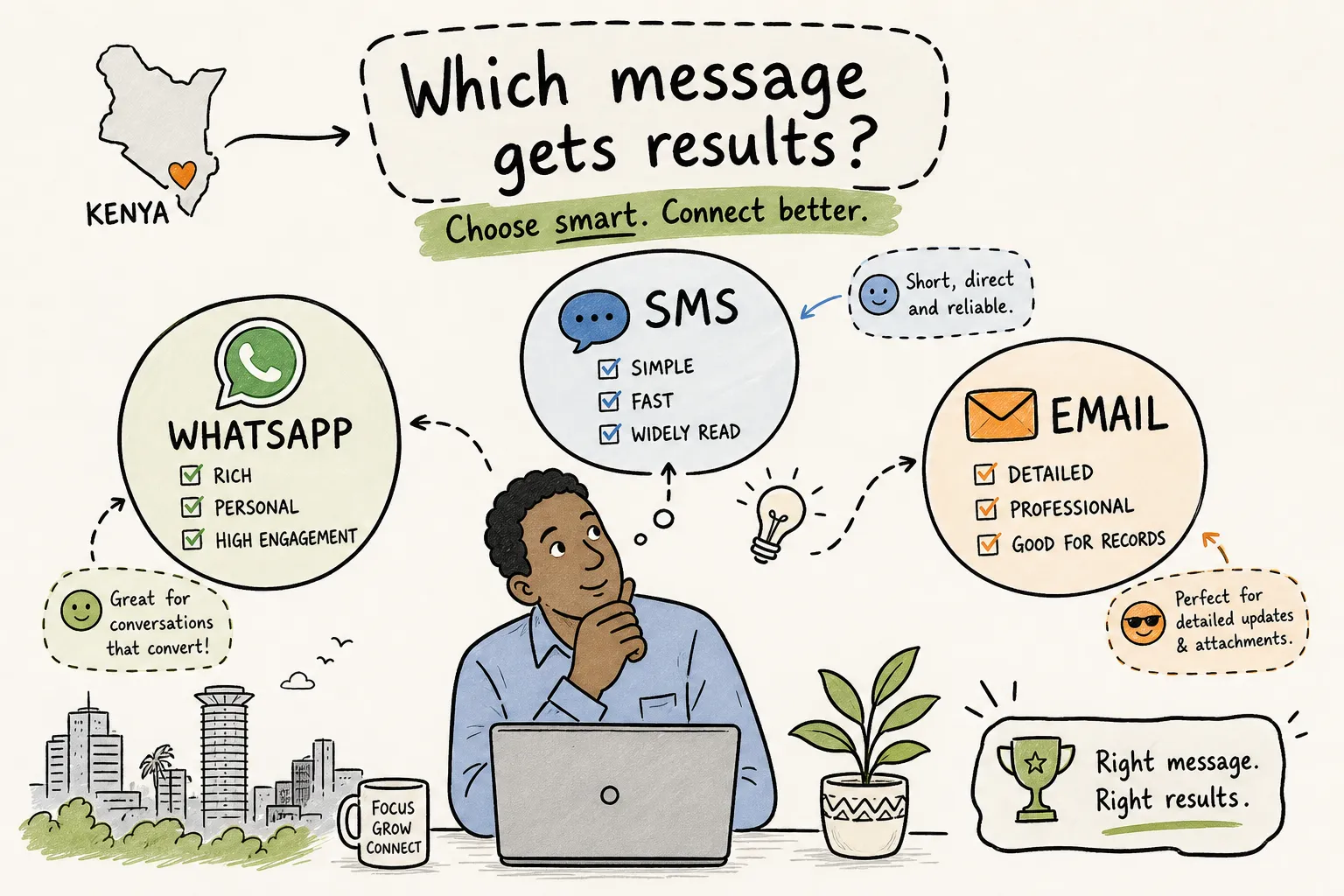
Business messaging in Kenya is a decision that costs real money when you get it wrong. Every Kenyan business owner has sent a bulk message campaign and watched the silence that follows. The problem is rarely the offer. It is almost always the channel. Picking the wrong one means paying per message for content that sits unopened, flagged as spam, or never delivered at all.
Kenya's business messaging market is genuinely fragmented. There are over 50 SMS gateways operating locally, multiple WhatsApp Business API partners, and email platforms all competing for the same marketing budgets. Most businesses default to whatever tool they first encountered rather than what actually performs for their customer base and use case. This article compares the four channels Kenyan businesses actually use: WhatsApp, SMS, email, and social DMs. By the end, you will have a clear shortlist, a realistic picture of costs, and the compliance requirements you cannot afford to ignore.
How Kenyan customers actually engage with business messages
Open rates by channel: what the data shows
WhatsApp open rates sit between 75 and 90% in Kenya, with opted-in contact lists pushing closer to the top of that range. SMS open rates reach 95 to 98% within the first hour, though the channel has developed a spam fatigue problem as businesses abuse it with irrelevant blasts. Email open rates sit between 15 and 25% for Kenyan business audiences, making it the weakest performer for top-of-funnel outreach. Social DMs vary too wildly by platform and audience to assign a single benchmark.
These figures matter differently depending on what you are sending. Transactional messages, OTPs and order confirmations, need delivery speed and certainty above all else. Promotional content like offers and event reminders needs engagement; a delivered message that no one opens is money wasted regardless of how cheap the send cost was.
Why mobile-first behaviour shapes channel performance in Kenya
Kenya's messaging landscape is shaped by two realities: near-universal mobile penetration and WhatsApp's status as the country's default communication layer. WhatsApp has approximately 97% adoption among Kenyan smartphone users, and surveys of Kenyan B2B buyers consistently show a strong preference for WhatsApp in vendor communication and support. SMS still reaches every phone, including feature phones with no internet access, which remains a meaningful advantage in counties where data connectivity is unreliable.
Kenyan consumers increasingly expect two-way conversations rather than one-way blasts. A promotional SMS that can only be received and never replied to feels increasingly out of place compared to a WhatsApp thread where a customer can ask a question and receive an instant, contextual response. This shift in expectation gives WhatsApp a structural advantage for engagement-heavy use cases.
Business messaging in Kenya: WhatsApp vs SMS compared
Where WhatsApp Business API pulls ahead
The WhatsApp Business API unlocks capabilities that SMS simply does not have: rich media including PDFs, images, and interactive buttons; verified business profiles that build sender trust; and threaded conversations with read receipts. The result is a conversational experience that makes support, order tracking, and appointment reminders feel natural rather than intrusive. WhatsApp reply rates are five to ten times higher than SMS, which makes it the stronger channel for any use case that requires action from the customer, not just awareness.
Delivery performance is strong. WhatsApp messages reach smartphones instantly over data, with no carrier routing delays of the kind that can affect SMS in cross-network scenarios. Local platforms such as Celcom Africa and MSpace offer WhatsApp Business API onboarding in Kenya, with setup costs starting at approximately KES 15,000 per number. Monthly platform plans run from KES 15,000 at the basic tier to KES 60,000 for enterprise access, covering higher message volumes and additional team seats.
When bulk SMS still makes more sense
SMS wins on raw reach. It delivers to any phone on any network, requires no internet connection, and performs reliably in low-connectivity areas across western Kenya and rural counties. For OTPs and time-critical alerts, providers like Celcom Africa and Africa's Talking guarantee delivery in under two seconds with 99% or better delivery rates, backed by direct carrier connections to Safaricom, Airtel, and Telkom. Branded SMS with alphanumeric sender IDs also gives businesses a recognisable, trusted identity in the recipient's inbox rather than an anonymous number.
For businesses serving a customer base that mixes smartphone and feature phone users, or for any scenario where guaranteed delivery regardless of data availability is non-negotiable, SMS remains the more dependable backbone. It is not a legacy channel; it is a foundational one that WhatsApp-first strategies should sit on top of, not replace entirely.
Email and social DMs: supporting roles, not lead channels
Where email earns its place in Kenyan business communication
Email performs best for long-form, document-heavy communication: invoices, contracts, formal proposals, and newsletter campaigns targeting decision-makers. Open rates of 15 to 25% look weak next to SMS or WhatsApp, but email costs close to nothing per message at scale and integrates cleanly into CRM workflows. Well-managed Kenyan email lists achieve click-through rates of around 3.2%, which indicates that the audience which does open is genuinely engaged. Email suits B2B services companies, NGOs sending donor reports, and SaaS products onboarding users who expect inbox receipts.
Why social DMs frustrate more businesses than they help
Instagram DMs and Facebook Messenger have unpredictable deliverability, no guaranteed read times, and limited automation support compared to the WhatsApp Business API. They work well for handling inbound enquiries on platforms where customers already follow the business, but they are not reliable outbound channels for transactional notifications or marketing campaigns at any meaningful scale. When a customer contacts you via social DMs, respond promptly, but do not build a primary outreach strategy around channels you do not control.
Business messaging in Kenya: breaking down the real costs
Per-message pricing and what providers don't tell you upfront
Bulk SMS pricing from local Kenyan providers ranges from KES 0.25 to KES 0.80 per message depending on volume tiers and the provider. Celcom Africa sits at the lower end of that range; Africa's Talking runs slightly higher; global platforms like Twilio come in at the equivalent of KES 20 to 30 per message, making them impractical for high-volume local campaigns. WhatsApp Business API billing runs on a conversation basis: marketing conversations cost approximately KES 3.53 per conversation, utility and authentication conversations come in at around KES 1.12, and service conversations initiated by the customer within a 24-hour window are free.
Email is cheapest at scale but carries a significant hidden cost. List management, deliverability infrastructure, and low open rates mean the real cost per engagement is often higher than the headline figures suggest. When you factor in cost-per-engaged-reader rather than cost-per-send, email's apparent affordability shrinks considerably.
Hidden costs Kenyan businesses commonly overlook
WhatsApp number setup fees start at KES 15,000 per number before any messages are sent. Branded SMS sender ID registration with Safaricom, Airtel, and Telkom adds further costs and lead time. Monthly platform subscriptions run from KES 15,000 to KES 60,000 per month depending on the provider and feature tier. Then there is API integration development, webhook management, and the ongoing compliance overhead of maintaining opt-in records and suppression lists. These costs rarely appear in the per-message pricing a provider advertises, so budget for the full system rather than just the send cost.
Compliance rules every Kenyan business must follow before sending
CAK regulations, sender ID registration and the Data Protection Act
Business messaging in Kenya is governed by two frameworks operating in parallel: the Communications Authority of Kenya (CAK) and the Data Protection Act 2019. Branded SMS sender IDs must be registered with Safaricom, Airtel, and Telkom through a licensed bulk SMS provider. The alphanumeric sender ID can be up to 11 characters and must clearly identify the business. Registration typically takes two to five business days and requires a certificate of incorporation, KRA PIN certificate, copies of director IDs, and sample message templates.
Promotional SMS is restricted to 7:00 AM to 7:00 PM EAT on weekdays and 9:00 AM to 6:00 PM on weekends. A frequency cap of four promotional messages per subscriber per month applies. Penalties for non-compliance reach KES 5 million, and operators can blacklist non-compliant senders outright, effectively ending your ability to communicate via SMS entirely.
Opt-in, opt-out and what the law requires you to keep on record
Explicit consent is mandatory before adding any number to a marketing list. Purchasing contact lists is illegal under the Data Protection Act. Every promotional message must include a clear unsubscribe path, typically "Reply STOP", and opted-out numbers must be moved to a permanent suppression list immediately. Businesses must maintain consent records, including the date, source, and user identifier for each opt-in, stored for a minimum of 12 months.
The WhatsApp Business API adds a further compliance layer. Meta requires confirmed opt-in before a business can initiate a conversation outside the 24-hour customer service window. Your opt-in collection process therefore needs to satisfy both Kenyan law under the Data Protection Act and Meta's platform policies simultaneously, which is a meaningful engineering and operational requirement.
Choosing your business messaging channel in Kenya and deploying it at scale
Matching the channel to your business type
Retail, hospitality, and events businesses with primarily smartphone-using customers should default to WhatsApp Business API for promotions, booking confirmations, and post-sale support. Finance and logistics businesses serving customers in low-connectivity areas or on feature phones should anchor on SMS as their primary channel with WhatsApp layered on as a secondary touchpoint. NGOs and healthcare organisations managing beneficiary programmes in Kenya benefit from two-way SMS for surveys and alerts, with WhatsApp providing richer content delivery where connectivity allows. B2B services companies and SaaS products fit best in email, where the customer relationship naturally lives in an inbox and formal documentation is expected.
What a production-ready messaging system actually looks like
Most businesses underestimate what it takes to move from sending a single test message to running a reliable, automated messaging operation. Routing logic, template management, opt-out handling, API rate limits, and webhook reliability all need to be engineered properly before going live at volume. Without those foundations, what looks like a working system in testing will fail under real traffic in ways that are both costly and difficult to debug quickly.
Alvine Otieno is a Kisumu-based developer specialising in WhatsApp AI bots and workflow automation, with messaging systems handling over 50,000 events for businesses across Kenya already in production. If your business is ready to move beyond manual messaging into fully automated, production-ready flows, visit the services page to see what a properly engineered system looks like.
The bottom line on business messaging in Kenya
WhatsApp wins on engagement for smartphone-majority customer bases, with reply rates and conversion figures that SMS cannot match for conversational use cases. Bulk SMS in Kenya remains unmatched for reach and delivery reliability across all device types, particularly where internet access is inconsistent. Email and social DMs serve specific supporting roles rather than functioning as primary channels for most businesses operating in the Kenyan market.
Channel selection is only half the decision. The other half is execution: how reliably and compliantly the system is set up. Choosing WhatsApp and then sending unsolicited messages to unverified numbers, or running SMS campaigns without a registered sender ID, will cost you more in penalties and blacklisting than any campaign generates in returns.
Pick one channel that fits your customer base and your current scale. Run a 30-day pilot. Measure cost-per-engagement, not just open rates or delivery figures. Then decide whether to expand, automate, or layer in a second channel based on what the data actually tells you, not what the provider's sales deck promised.
Software engineer writing about the craft of building products on the web.