ChatGPT API for Kenyan businesses: 10 use cases that work
Discover 10 practical ChatGPT API use cases for Kenyan businesses, with integration notes, KES cost estimates, and compliance insights. Learn how to operationalize OpenAI API for customer support, M-Pesa automation, and more.
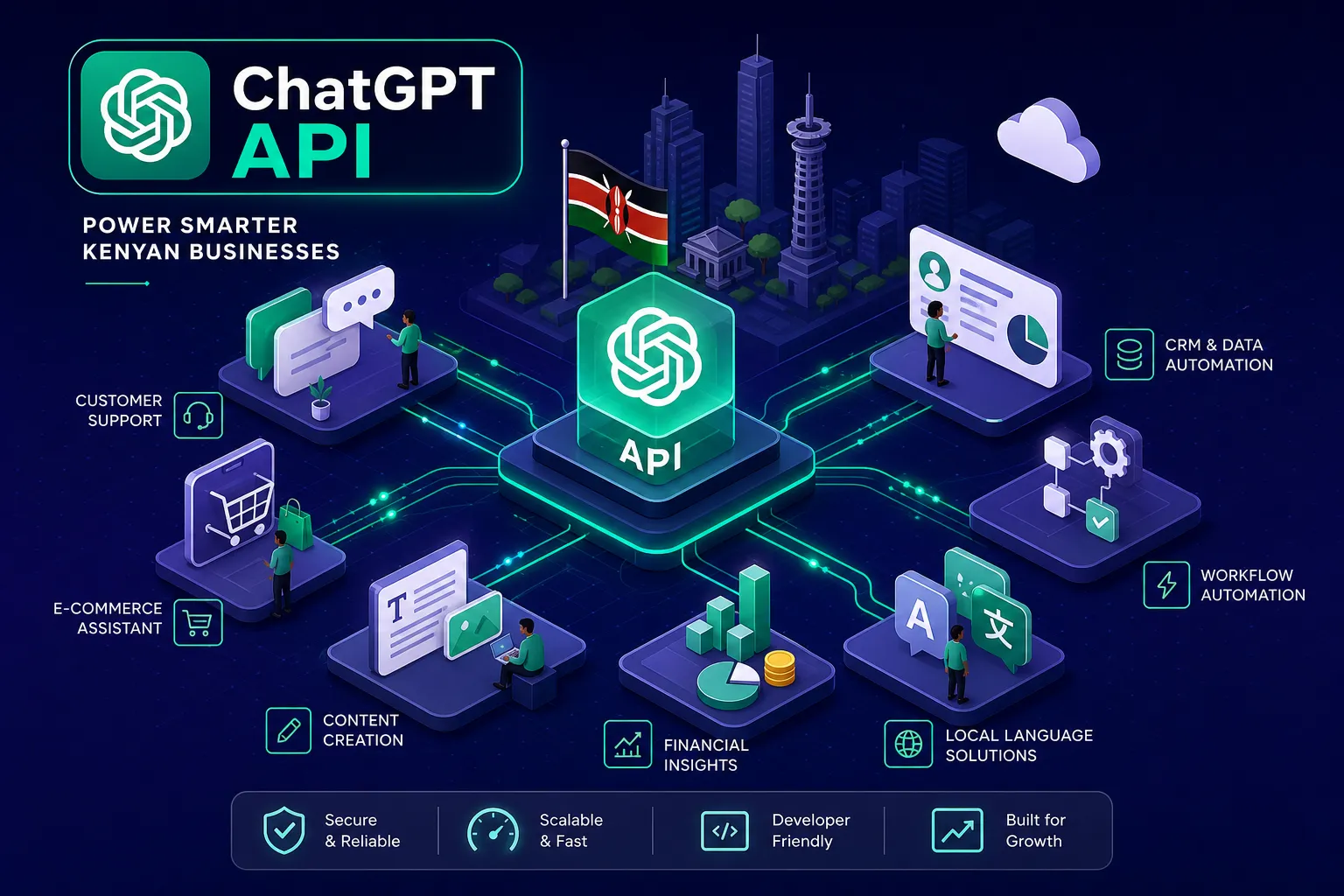
If you have been asking what are the best ways to use ChatGPT API for a Kenyan business, this article gives you 10 practical use cases, organised by business function, with real integration notes, KES-denominated cost estimates, and a compliance checklist specific to Kenyan law. Many Kenyan SMEs already have access to the OpenAI API but struggle to operationalise it, because the real question is never "should we use this?" It is always "where exactly do we start?" The gap between knowing the API exists and knowing which use case will actually move your business forward is where most SMEs in Nairobi, Mombasa, and Kisumu get stuck.
That gap is closable with the right starting point. At Alvine Otieno, a Kisumu-based freelance software developer and tech consultancy, we have deployed OpenAI-powered WhatsApp bots for businesses across Kenya, production systems handling real customers, real payments, and real queries every day. The proof that this works outside Silicon Valley already exists. By the end of this article, you will know which two or three use cases match your business, what the setup looks like, and what it will cost you per month.
What are the best ways to use ChatGPT API for a Kenyan business, an overview
The ten use cases below span customer-facing and internal workflows. They are drawn from production deployments and documented integration patterns used by Kenyan SMEs in 2026. Start with one use case close to where your team currently loses time or misses revenue, then build from there.
1. Automating customer support on WhatsApp in Swahili and English
WhatsApp is already where your customers are. For Kenyan SMEs, the ChatGPT API turns that channel into a 24/7 support agent that can often cost less per month than a single part-time hire, particularly once the initial build is complete and you are paying only for API usage, hosting, and BSP fees. The leverage is immediate.
Handling multilingual queries without a human agent
The API can be instructed to detect the language of an incoming message and respond in the same language. A customer sends "Bei ya delivery ni ngapi?" and the bot replies in Swahili with the correct fee, pulled from your product database in real time. No translation delay, no human hand-off required. In our deployments, the ability to alternate between English and Swahili has consistently been the primary reason Kenyan SMEs adopt the OpenAI API, it solves a real operational problem that no off-the-shelf chatbot handles well without customisation.
Building a WhatsApp AI bot with Meta WhatsApp Cloud API and n8n
The integration stack is straightforward: a WhatsApp Business API account through a Kenyan BSP such as Celcom Africa, the OpenAI API for language processing, and n8n as the middleware that connects them. In n8n, a webhook node catches incoming WhatsApp messages, a function node detects the language, an OpenAI Chat Model node generates the response, and a WhatsApp Cloud API node sends it back within seconds. Since OpenAI ended its direct WhatsApp integration in January 2026, this custom stack is the only supported path forward for any business wanting to run ChatGPT on WhatsApp.
2. Generating M-Pesa payment confirmations and transactional messages
Most Kenyan businesses still send payment confirmation messages manually, or not at all. The ChatGPT API connected to the M-Pesa Daraja API automates that process entirely, provided the integration is built with reliable webhook handling and idempotency checks, and it can trigger several downstream workflows at the same time.
How the M-Pesa and ChatGPT integration works
The flow works like this: a customer pays via STK Push, Daraja sends an asynchronous callback to your server with the transaction result, the ChatGPT API generates a personalised confirmation message, and that message goes to the customer via WhatsApp or SMS within seconds. Your server must return a 200 HTTP response immediately upon receiving the callback, or Safaricom treats the delivery as failed, building in an STK Push Query fallback and idempotency checks is recommended for production systems. Businesses that want to avoid building this payment infrastructure themselves can use Fikra API, an OpenAI-compatible inference service priced in KES with M-Pesa payments built in via Paystack.
Three transactional use cases beyond receipts
Payment confirmations are only the beginning. Automated order status updates trigger the moment a payment event is confirmed, keeping customers informed without any manual effort. Failed payment follow-ups work the same way: the bot sends a templated retry message in the customer's preferred language when an STK Push times out. Subscription renewal reminders tied to M-Pesa paybill transaction data round out this use case, turning your payment system into a proactive customer communication engine.
3. Lead qualification and conversational sales automation
A qualified lead that comes through WhatsApp at 11 PM is worthless if nobody follows up until morning. The ChatGPT API closes that gap by qualifying and responding to inbound leads the moment they arrive, regardless of the time or how many enquiries come in simultaneously.
Qualifying inbound leads automatically
A bot configured with the ChatGPT API can ask structured qualification questions covering budget, timeline, location, and product interest, then score or route the lead before any human responds. Real estate agencies using this architecture, for example, have reported pre-qualifying dozens of daily enquiries automatically, passing only the strongest prospects to agents. The quality of follow-up conversations improves because agents already know the prospect's position before the first call.
Automating follow-up sequences and bilingual content
Beyond qualification, the API generates personalised follow-up messages based on what a prospect said in their initial conversation, so every follow-up feels relevant rather than generic. Lead qualification also opens the door to a closely related use case: content creation. Generating bilingual ad copy in English and Swahili, writing product descriptions for e-commerce catalogues, and drafting email campaigns are all tasks the OpenAI API handles in seconds, freeing up time your team currently spends on manual writing work.
4. Internal operations: inventory alerts and admin automation
The ChatGPT API is just as useful behind the scenes as it is in the customer chat window. For small teams carrying significant operational overhead, the internal use cases often deliver faster returns than the customer-facing ones.
Automating inventory alerts and supplier reorder messages
A retailer can connect their stock management spreadsheet to the OpenAI API via n8n so that when an item drops below a set threshold, the bot drafts a supplier reorder message and sends it automatically via WhatsApp. This runs on the same infrastructure already used for customer support, meaning there is no separate system to build or maintain. The configuration is a workflow addition, not a new project.
Meeting summaries, legal translation, and admin tasks
The API summarises recorded meeting transcripts and extracts action items, saving small teams hours each week that currently go into manual note-taking and follow-up drafting. Legal document translation from English to Swahili reduces friction when onboarding local partners or customers who prefer transacting in Swahili. Grant research summaries, pricing model drafts, and bookkeeping checklists are further administrative use cases that require no technical customisation beyond a well-written prompt, making them accessible to any business owner immediately.
5. What integration actually costs for a Kenyan SME
Cost is the first question every Kenyan business owner asks. The answer in 2026 is more affordable than most expect, but understanding the full picture matters before you commit to building.
OpenAI API pricing for typical SME workloads
GPT-5 Mini is the most practical model for high-volume customer support, priced at $0.25 per million input tokens and $2.00 per million output tokens, verify the latest rates at platform.openai.com before you build. A WhatsApp chatbot handling 10,000 conversations per month at average token volumes costs roughly $7 to $10 per month in API fees alone. GPT-5.4-mini offers a performance step up at approximately $17 per month for the same volume, while the standard GPT-5.4 model runs around $57 per month, a tier that is rarely necessary for SME support workloads. The Batch API option cuts costs by 50% for asynchronous workloads such as overnight inventory reports or bulk document processing.
Total cost of ownership beyond the API bill
The full monthly cost includes three main components: your WhatsApp Business API BSP fees (Celcom Africa's SME plans start at KES 15,000 per month), n8n hosting on a VPS (self-hosted is significantly cheaper than managed cloud plans), and a one-off developer build fee paid at the start. Depending on which use cases you activate, the BSP fee will typically represent the largest ongoing line item. Businesses that qualify for a lower-tier BSP plan, or that use Fikra API's KES-denominated pricing as an alternative, can reduce that figure materially. The model is build-once-run-continuously, which is what makes the upfront investment worthwhile once you account for the manual work it replaces.
6. Data privacy and compliance checklist before you go live
Every guide on ChatGPT API integrations covers the technical setup. Few cover what your legal obligations are under Kenyan law. Before your first customer message passes through the OpenAI API, you need to understand your compliance position.
What the Data Protection Act 2019 requires
Kenyan businesses processing customer data through third-party AI services must register with the Office of the Data Protection Commissioner (ODPC) as a Data Controller or Data Processor. Registration is mandatory if your business has ten or more employees or an annual turnover of KES 5 million or more, and also if you operate in sectors such as financial services or direct marketing, or if you process sensitive personal data regardless of size.
Express consent is required before using customer data for commercial AI processing. Cross-border data transfer restrictions also apply: sensitive personal data cannot leave Kenya without specific legal safeguards. Since OpenAI's servers process data outside Kenya, this is a genuine compliance consideration, not a theoretical one.
Four steps before deploying any customer-facing AI tool
- Conduct a Data Protection Impact Assessment (DPIA) that documents the specific risks of the ChatGPT integration and how each risk is mitigated.
- Update your privacy policy to explicitly name OpenAI as a third-party data processor and describe how customer data is handled and retained.
- Apply data minimisation: never pass customer ID numbers, full financial records, or sensitive personal data into the API unless strictly necessary and fully consented to.
- Sign a Data Processing Agreement with OpenAI that covers purpose limitation, security safeguards, breach notification, and your right to audit.
The ODPC registration fee for micro and small enterprises is KES 4,000, paid once through the ODPC portal with a certificate typically issued within 14 days. The compliance overhead is manageable; the risk of skipping it is not.
Picking your starting point and building from there
When thinking about what are the best ways to use ChatGPT API for a Kenyan business, customer support automation and M-Pesa transactional messaging consistently deliver the fastest return on investment, they solve problems that cost money right now: missed queries, delayed confirmations, and manual messaging work. Lead qualification and operations automation compound value over time as the bot handles more volume without adding headcount.
The ChatGPT API is not a single product you deploy once and walk away from. It is a flexible engine that slots into the workflows already running in your business, whether that is your WhatsApp inbox, your payment flow, your stock management sheet, or your content pipeline. The right use case is the one closest to where your team currently loses time or misses revenue.
If you want to skip the technical setup and work directly with someone who has already deployed these systems in production across Kenya, Alvine Otieno builds and maintains OpenAI-powered WhatsApp bots, M-Pesa automation workflows, and operational AI integrations for businesses across Nairobi, Mombasa, Kisumu, and beyond. Reach out through alvineotieno.com to discuss which use cases fit your business. As new OpenAI models and local integrations continue maturing through 2026, the infrastructure is cheaper to build today than it will be once every BSP in Kenya is charging a premium for it.
Software engineer writing about the craft of building products on the web.