Customer support automation in Kenya: a practical guide
Explore practical customer support automation in Kenya, focusing on WhatsApp, M-Pesa integration, and essential features. Learn to evaluate providers and identify solutions tailored for the Kenyan market.
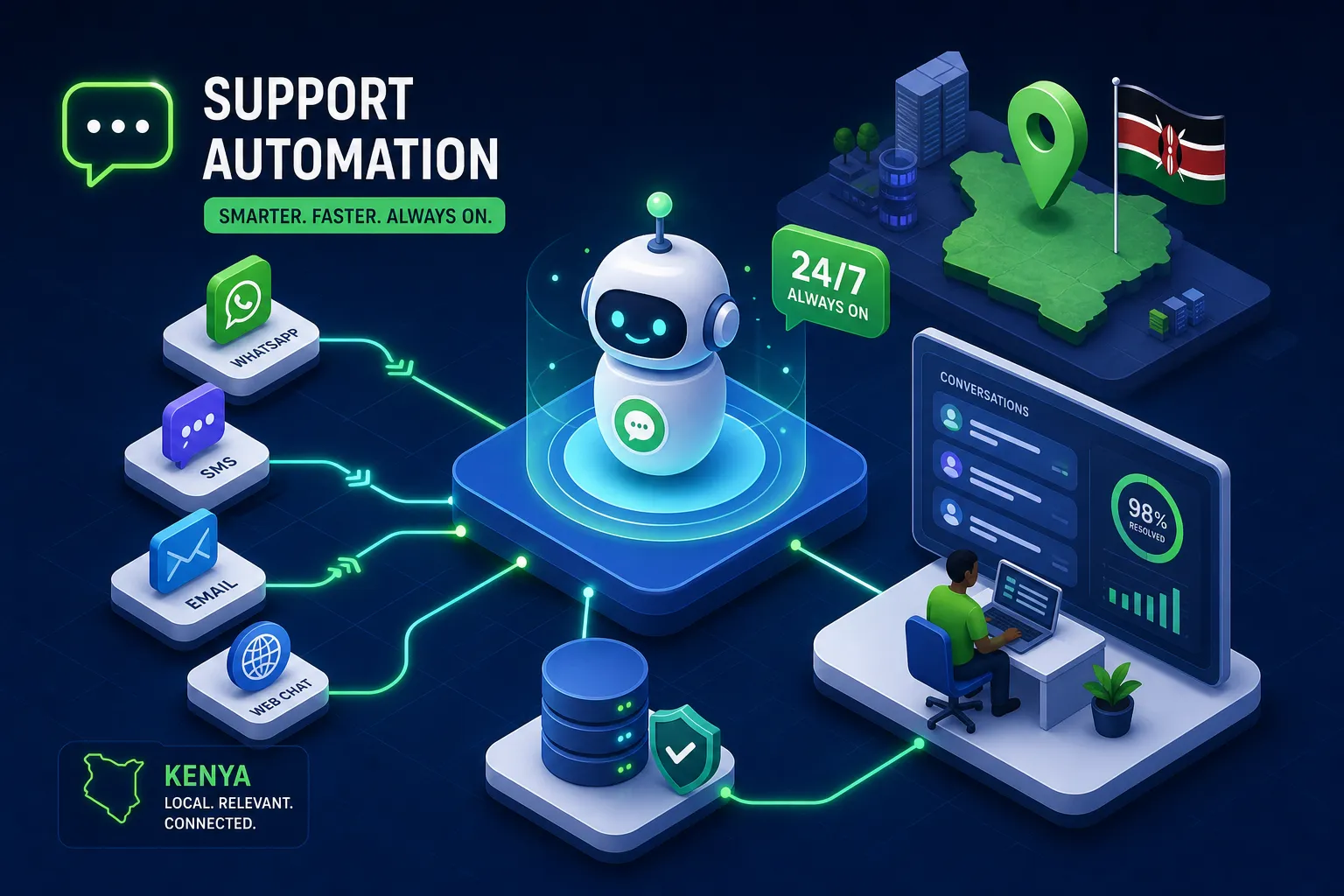
Customer support automation in Kenya is already solving a problem most business owners know personally. Picture a business owner in Nairobi sitting at her desk at 7 a.m., phone already buzzing with WhatsApp messages. Order status. Store hours. Payment confirmation. The same 200 questions, arriving daily, answered by two staff members who could be doing something far more valuable. Meanwhile, a WhatsApp bot deployed by Kisumu-based developer Alvine Otieno has processed over 50,000 customer interactions in production, handling queries around the clock without a single human picking up a phone. That is not a Silicon Valley story. That is a Kenyan one.
This guide walks you through what customer support automation in Kenya actually looks like in practice: the right channel to start with, the features worth paying for, realistic costs broken down by tier, the ROI you can reasonably expect, and the compliance questions every vendor must answer before you commit. By the end, you will have a shortlist framework and enough technical grounding to evaluate any provider without being misled by a polished sales deck.
Why WhatsApp is Kenya's default support channel
WhatsApp reaches approximately 95 to 97 percent of Kenyan internet users, giving it one of the highest adoption rates on the African continent, according to data from the Communications Authority of Kenya and regional digital adoption surveys. In population terms, around 53.9 percent of all Kenyans use the platform monthly, translating to somewhere between 22 and 26 million active users. Few other messaging platforms come close to those numbers in this market.
Kenyan customers access the internet almost entirely through mobile devices, and WhatsApp is where their communication habits already live. It is the app they use to speak with family, receive payment confirmations from M-Pesa, and coordinate group purchases. Expecting them to shift to a web chat widget or a support email creates friction that kills response rates before any automation even enters the picture.
Traditional helpdesk platforms like Zendesk and Freshdesk have their place in larger enterprise environments where ticket volume, multi-department routing, and SLA reporting are the primary needs. For the majority of Kenyan SMEs, though, WhatsApp is where the actual volume lives. Any automation strategy that does not start with WhatsApp is misaligned with how Kenyan customers actually communicate. Building there first is not a compromise; it is the correct architecture decision.
Features that actually matter in a Kenyan support setup
Global vendors love to present feature lists that look comprehensive until you notice what is missing. Automated FAQ handling, conversation routing, and escalation to human agents are table stakes. What separates a useful Kenyan deployment from a generic one is the local layer underneath those features.
Multilingual support covering both Swahili and English is non-negotiable for any business serving customers outside Nairobi's CBD. The WhatsApp Business API gives you a 24-hour service window during which replies to customer-initiated conversations are free and can be sent as free-form text. Outside that window, you must use pre-approved utility templates. Understanding this distinction matters for your response SLA design: a bot that goes silent after 24 hours because the team has not set up templates correctly is a compliance and customer experience problem simultaneously.
M-Pesa Daraja API integration is a critical local requirement for any business that collects payments. If a provider cannot demonstrate a working STK Push flow, where a customer receives a payment prompt directly within a WhatsApp conversation, that provider has not been built with the Kenyan market in mind. CRM sync with commonly used platforms such as Zoho, HubSpot, and, in larger deployments, Salesforce, transforms a simple FAQ bot into a tool that updates customer records, logs tickets, and triggers follow-up workflows without any manual input from your team.
Customer support automation in Kenya: tools and providers compared
The market splits into two categories: global platforms with WhatsApp support, and local or custom-built solutions designed around Kenyan business realities. Knowing which category fits your needs saves months of frustration.
Global platforms
On the global side, Tidio works well for small teams with limited budgets. Intercom Fin handles enterprise-grade multilingual support across multiple channels. Freshdesk with Freddy AI suits businesses that already run Freshdesk as their helpdesk. Each of these is useful in the right context, but they are built for global markets. Payment flows, M-Pesa integration, and local language NLP are afterthoughts rather than core features.
Local and custom providers
Among Kenyan providers, CCSA (Call Centre Solutions Africa) specialises in IVR and contact centre automation. HelloDuty offers cloud-based solutions with CRM integration and owns its own platform rather than reselling third-party tools. Ongair aggregates messaging across WhatsApp, Telegram, and Facebook Messenger and connects those channels to helpdesk systems.
For businesses that need a system designed specifically around their workflows, a custom-built WhatsApp chatbot in Kenya is the strongest option available. Alvine's custom bots are built using the Meta WhatsApp Cloud API, OpenAI for natural language processing, and n8n for workflow automation. The 50,000-plus event milestone referenced earlier reflects production usage across real customer interactions, payment flows, and edge cases, the kind of track record that separates a tested system from a polished prototype.
What customer support automation costs for a Kenyan SME
Pricing in this space follows a hybrid model: a one-time setup fee, a monthly subscription, and variable costs from Meta's conversation charges. Most businesses are quoted only the first two, then surprised by the third.
At the basic tier, setup runs between KES 5,000 and KES 10,000, with monthly costs of KES 500 to KES 2,500. This covers 10 to 30 response flows and basic FAQ automation. Annual cost at the low end is roughly KES 15,000. The standard tier, which includes M-Pesa STK Push integration, bilingual NLP, and appointment booking, costs KES 25,000 to KES 50,000 to set up and KES 6,000 to KES 12,000 monthly, putting year-one costs around KES 100,000. The AI and custom tier, with GPT-based intelligence, CRM sync, and advanced workflow automation, runs KES 150,000 to KES 300,000 for setup and KES 15,000 to KES 25,000 monthly, totalling KES 350,000-plus in the first year.
Meta's conversation charges add a layer on top. Service replies within the 24-hour window are free. Marketing messages cost approximately KES 3.53 per conversation. Utility messages run around KES 0.63 each. A business sending 1,000 marketing messages monthly pays roughly KES 3,530 in Meta fees alone, separate from any platform subscription. Build this into your budget before committing to a tier.
The most common mistake is over-engineering from day one. A basic FAQ bot running cleanly and handling your top 20 customer queries is more valuable than a sophisticated AI system that nobody on your team can maintain or troubleshoot. Start at the tier that matches your current volume, and scale up once the operational habits are in place.
ROI evidence from real Kenyan deployments
The business case for customer service automation tools in Kenya is supported by production data, not theory. NCBA Bank reduced customer response time from eight minutes to 30 seconds after deploying AI customer service, while cutting Year 1 operational costs by 35 percent, with 75 percent of enquiries now auto-resolved. A client deployment at a mid-sized logistics company in Nairobi reported KES 18 million in annual savings, with 70 percent of customer enquiries handled automatically and a 25 percent reduction in fuel costs linked to route optimisation connected to the same platform. A Kisumu agribusiness client using a WhatsApp chatbot in Kenya saw a 40 percent increase in sales conversions after shifting customer communication to an automated channel.
Across sectors, early automation adopters in Kenya are reporting positive ROI within 90 days of deployment. That timeline is achievable because labour cost reduction and increased resolution speed both show up on the income statement quickly. The businesses seeing the slowest returns are those that deployed automation without designing proper escalation pathways, creating customer frustration when the bot reaches its limits and has no clean handoff to a human agent.
When evaluating any provider's ROI claims, these three questions will separate genuine track records from sales promises: How many events or conversations has their system handled in production, not in controlled demos? What were the CSAT scores before and after deployment? What does the average time-to-resolution comparison show? A provider who cannot answer all three with real data is selling you a promise, not a track record.
Compliance requirements you cannot skip
Kenya's Data Protection Act 2019 applies directly to automated customer support systems, and non-compliance is not a minor administrative issue. Any organisation processing personal data through automated means must register with the Office of the Data Protection Commissioner (ODPC). Registration requires submitting an application through the ODPC's online portal, describing your processing activities, listing third parties with whom data is shared, and detailing your security safeguards. The ODPC typically issues a certificate within 14 days of a complete application, valid for 24 months.
You must appoint a Data Protection Officer, conduct a Data Protection Impact Assessment before deploying any high-risk automated processing, and build human intervention pathways into your system so customers can request a human review of any automated decision that affects them. Audit trails are mandatory. If your bot is handling financial queries, payment confirmations, or any health-related data, explicit opt-in consent is required. A passive checkbox does not meet the DPA standard.
On the WhatsApp API side, the governing rules are straightforward. Users must explicitly opt in before receiving any messages. Outbound messages outside the 24-hour window must use pre-approved utility templates, which Meta typically approves within one to five minutes for customer service use cases. Your business, your API provider, and Meta must also have a compliant data processing agreement in place covering how user data flows between those parties. Ask any prospective provider to show you their approved template library and walk you through how they handle the 24-hour conversation window. If they cannot do this clearly and immediately, treat that as a red flag.
Customer support automation in Kenya: your decision checklist
Start with WhatsApp. Demand M-Pesa integration and bilingual Swahili/English support as baseline requirements, not optional extras. Match the tool tier to your actual current volume rather than your aspirational future state.
Validate every ROI claim with production data, events handled, CSAT changes, and resolution time comparisons. Then run the compliance checklist before signing anything: ODPC registration, DPO appointment, consent mechanisms, and template approvals all need to be confirmed, not assumed.
Customer support automation in Kenya is no longer something only large banks and telecoms can afford. The cost tiers and the production evidence both confirm it is accessible to SMEs right now, with meaningful returns visible within a single quarter for businesses that deploy thoughtfully.
For businesses that want a custom-built WhatsApp bot tailored to their specific workflows, M-Pesa payment flows, and customer language, working with a specialist developer is worth evaluating before committing to an off-the-shelf platform that may not fit your operations. Alvine Otieno builds these systems for production use, integrated with local tools and tested against real volume. Get in touch to discuss your specific use case before making any platform decision.
Frequently asked questions
How much does customer support automation cost for a small Kenyan business?
Entry-level WhatsApp bot setups start from as little as KES 5,000 for initial configuration, with monthly costs ranging from KES 500 to KES 2,500. You should also budget for Meta's conversation charges, which vary based on message type and volume. A realistic first-year cost at the basic tier is around KES 15,000, excluding Meta fees.
Is M-Pesa integration available with WhatsApp automation tools?
Yes, but not with every provider. M-Pesa Daraja API integration, specifically STK Push, which sends a payment prompt within a WhatsApp conversation, is a feature to confirm explicitly before signing with any provider. Custom-built solutions are more likely to include this than global off-the-shelf platforms.
What is the WhatsApp 24-hour conversation window?
When a customer messages your business on WhatsApp, a 24-hour window opens during which you can reply freely with any content at no charge. Once that window closes, any outbound message must use a pre-approved utility or marketing template. Failure to manage this correctly leads to blocked messages and compliance issues.
Does my business need to register with the ODPC before deploying a chatbot?
Yes, if your automated system processes personal data, which virtually all customer-facing chatbots do. Registration with the Office of the Data Protection Commissioner (ODPC) is mandatory under Kenya's Data Protection Act 2019. You must also appoint a Data Protection Officer and conduct a Data Protection Impact Assessment for high-risk processing activities.
How quickly can a Kenyan SME expect to see ROI from automation?
Most businesses deploying well-designed automation report positive ROI within 90 days. The fastest returns come from reductions in agent handling time and improved first-contact resolution rates. Businesses that skip proper escalation design tend to see slower returns due to increased customer dissatisfaction when the bot cannot hand off cleanly to a human agent.
What is a WhatsApp chatbot in Kenya typically used for?
Common use cases include FAQ handling, order status updates, appointment booking, payment collection via M-Pesa STK Push, and lead qualification. More advanced deployments integrate with CRM systems to update customer records and trigger follow-up workflows automatically, turning a simple bot into a full customer service automation tool.
Software engineer writing about the craft of building products on the web.