Event automation in Kenya: WhatsApp bots, n8n, and M-Pesa
Discover how event organizers in Kenya can automate their operations using WhatsApp bots, n8n, and M-Pesa. Solve payment reconciliation issues, manage RSVPs, and reduce no-shows.
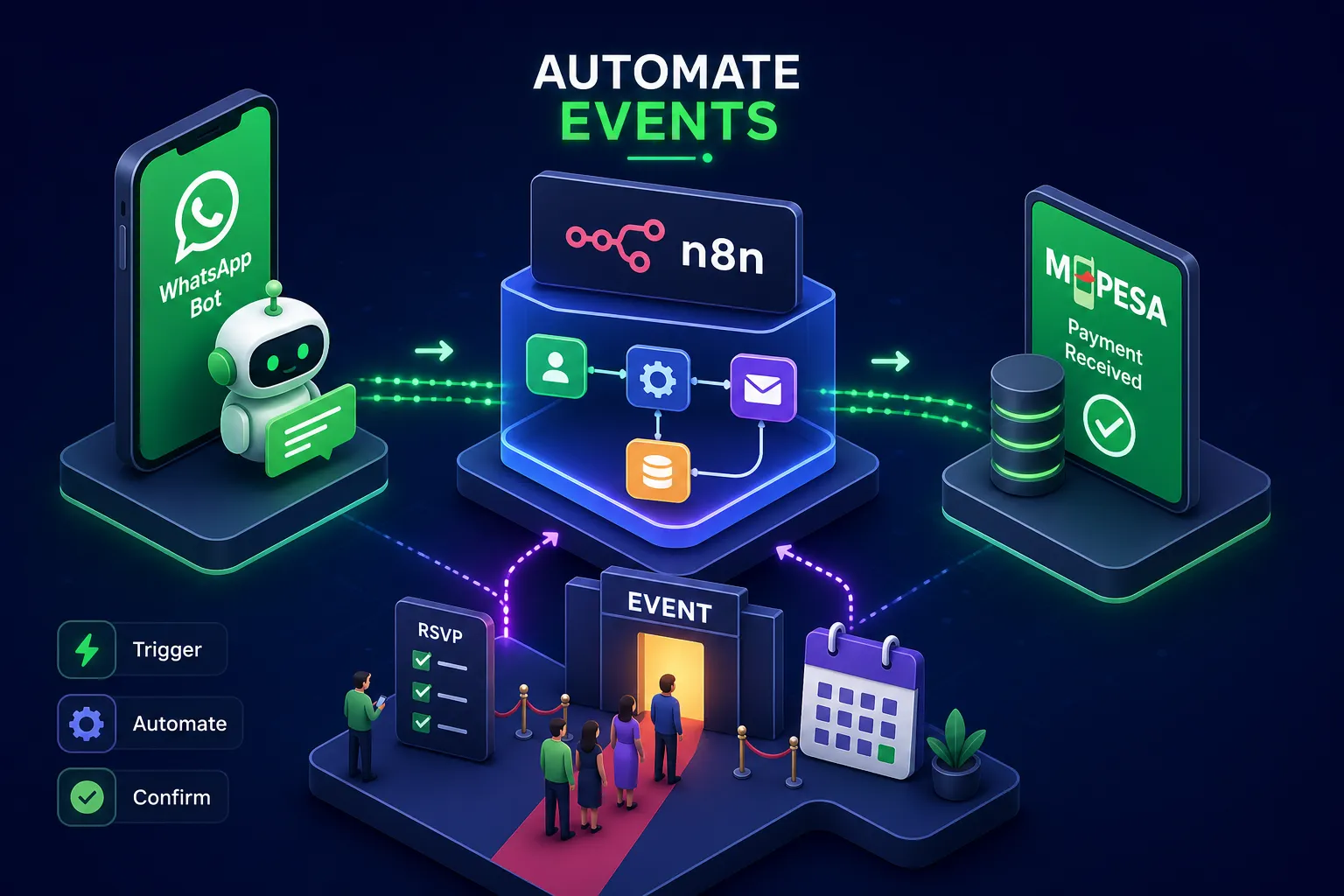
Picture this: an event organiser in Nairobi, sitting in bed at midnight, fielding WhatsApp messages from 300 attendees. She's cross-referencing M-Pesa paybill screenshots against a Google Sheet, squinting at transaction names that never quite match what people registered under. By 6 a.m. she gives up on sleep, drives to the venue, and watches 40 confirmed registrants simply not show up. The event runs. But it nearly broke her.
This is not an edge case. For many mid-size Kenyan events, it's the standard operating procedure, and it doesn't have to be. Event automation in Kenya is no longer a niche technical project. With WhatsApp widely used across the country and M-Pesa as the default payment method for the vast majority of Kenyan consumers, the infrastructure for automating the entire event lifecycle already exists. Many organisers have simply not yet connected the pieces.
A WhatsApp bot built for Kenyan clients by Kisumu-based developer Alvine Otieno has reportedly processed over 50,000 event interactions across multiple sectors. This article walks through what to automate, how to build the workflow, and which tools actually work in this market.
Why manual event management keeps failing Kenyan organisers
The M-Pesa matching problem nobody talks about
Attendees pay via till number or paybill, then send a screenshot to the organiser's WhatsApp. The organiser manually matches each payment to a name on a spreadsheet, often doing this in batches hours later. The compounding effect is brutal: duplicate registrations slip through, confirmations arrive late or not at all, and attendees show up at the gate with no record of their payment because the matching never happened.
The irony is that M-Pesa already generates a unique transaction ID the moment a payment completes. That ID can trigger an automated confirmation in real time. The infrastructure exists; the workflow connecting it doesn't.
Last-minute RSVPs and the WhatsApp flood
For many mid-size Kenyan events, the organiser's personal WhatsApp becomes the de facto registration system. The messages start manageable and then become unmanageable. By the time the organiser is trying to set up the venue two hours before doors open, "Can I still register?" messages are stacking up faster than they can be answered. Every response is a manual action. Every unanswered message is a lost attendee or an angry one.
The no-show rate that drains event revenue
Without automated reminders, a significant portion of registered attendees simply forget. Industry benchmarks for mid-size events typically put the no-show rate at around 23% with normal communication. Without reminders at all, that climbs to 35, 40% for free events. For a Kenyan event with 300 registrants, that's over 100 empty seats. The problem isn't commitment; it's proximity. People registered weeks ago and life moved on. A well-timed WhatsApp message the day before, and again two hours before, changes the outcome. These are solvable problems, not permanent conditions.
What event automation in Kenya actually covers
Registration and RSVP collection without a spreadsheet
Automated event registration in Kenya means a WhatsApp bot or web form captures attendee details, triggers a confirmation message, and logs the entry in a centralised database automatically. No manual data entry, no copy-pasting from screenshots. Where the Google Forms plus till number model still common at Kenyan events requires human intervention at every step, a properly automated workflow runs without it.
Automated M-Pesa payment confirmation via Daraja API
The M-Pesa Daraja API's STK Push sends the customer a PIN prompt directly on their phone. When they confirm, Safaricom fires a callback to your server within 10, 30 seconds. That callback updates the attendee's payment status, generates a QR code ticket, and sends a WhatsApp confirmation, all without a human touching it.
This eliminates the screenshot-to-spreadsheet workflow entirely. The total end-to-end time from payment initiation to confirmation landing in the attendee's WhatsApp is typically under 90 seconds.
Reminder sequences and attendee communication
The reminder stack is straightforward: 7-day, 1-day, and 2-hour messages sent automatically via WhatsApp, each personalised with the attendee's name, event details, and venue link. This single change produces the most measurable impact on attendance rates of anything in the automation stack. An attendee who registered three weeks ago and has forgotten about the event will show up if reminded. An attendee who was never reminded often won't.
A live case study: one WhatsApp bot, 50,000+ event interactions in Kenya
How the bot was built and what it handles
The production WhatsApp bot built by Alvine Otieno runs on the Meta WhatsApp Cloud API, powered by n8n workflows. It was built for real Kenyan clients across multiple sectors and handles the full event lifecycle: RSVP capture, M-Pesa payment confirmation via Daraja API integration, QR ticket generation, reminder sequences, and day-of check-in support. The architecture isn't stitched together from off-the-shelf tools; it's purpose-built for the payment and communication patterns that define the Kenyan market.
The 50,000+ interaction milestone and what it proves
Processing over 50,000 event interactions in the Kenyan market is not a prototype result. It's a production system running daily for real businesses. At that scale, the architecture has been stress-tested: M-Pesa reconciliation runs cleanly, attendee communication stays accurate under high volumes, and edge cases like failed callbacks are handled without manual recovery. The evidence isn't a demo; it's a track record.
Why n8n is the workflow engine behind it
n8n acts as the connective tissue in this stack. It listens for M-Pesa webhook events from Daraja, routes data between WhatsApp, the registration database, and the confirmation message queue, and manages the time-based triggers for reminder sequences. n8n can be self-hosted on a Kenyan server, keeping operational costs lower than subscription-heavy SaaS alternatives that charge monthly fees regardless of event volume. For events with custom payment logic or volumes above what off-the-shelf platforms handle cleanly, n8n is the right engine.
How to build your first event automation workflow in Kenya
1. Identify the highest-friction points first
Start with what costs the most time: registration capture, payment confirmation, and pre-event reminders. These account for most of the manual work in any mid-size Kenyan event. Resist the temptation to automate everything at once. One clean workflow that runs reliably beats several broken ones running in parallel.
2. Connect WhatsApp, M-Pesa, and your registration form using n8n
The core workflow runs like this: a registration form submission or WhatsApp message triggers an n8n flow, which fires an M-Pesa STK Push to the attendee's phone. n8n then listens for the Daraja callback, and when it arrives with a success code, it updates the attendee record and sends a WhatsApp confirmation with a unique QR code. This is a sequence of triggers and actions rather than custom code built from scratch. With an experienced developer and an existing production stack, some organisers have accelerated the build to a few weeks, though a more typical timeline for a well-tested implementation runs 4, 8 weeks depending on complexity.
3. Set up your reminder sequence
In n8n, time-based triggers work by calculating the event date and subtracting intervals: 7 days out, 1 day out, 2 hours out. At each interval, the workflow sends the appropriate WhatsApp message template to every confirmed attendee. One important constraint: WhatsApp message templates require Meta approval before they can be sent. For a new business account, first submissions typically take 24, 48 hours to clear review, with subsequent approvals often coming within minutes. Build this into your setup timeline from the start.
4. Test with a low-stakes internal event first
Before running the workflow on a 500-person conference, run it on an internal team meeting. Use it as a dry run to verify that payment confirmation fires correctly, that each attendee's QR code is unique, and that reminders arrive on schedule. Failures in a low-stakes environment cost nothing. Failures in front of paying attendees cost credibility.
Choosing the right event automation platform in Kenya
Local ticketing platforms that actually support M-Pesa
The shortlist for most Kenyan organisers covers a few key platforms. LipaTix offers STK Push integration with no monthly fees and strong fraud protection. eTickets Kenya is free for free events and charges 5% per paid ticket with solid QR validation. Evenda runs a 0% commission model for up to 200 tickets on its Basic plan, with API and webhook support for custom workflows. These platforms cover the majority of use cases for events between 50 and 1,000 attendees. Pricing and features change frequently, so verify current terms directly with each provider before committing.
Eventbrite is worth addressing directly: it has no M-Pesa support. For a market where most attendees pay via mobile money, that's a structural disqualifier. Most Kenyan attendees cannot complete checkout on a platform that only accepts cards or PayPal.
The automation layer: n8n versus off-the-shelf event management software
Off-the-shelf event management software in Kenya handles common workflows well enough for straightforward events. When the requirements include custom payment logic, high volumes, or a WhatsApp-native experience rather than a redirect to a ticketing website, a purpose-built workflow is the stronger choice. n8n, running either self-hosted or on a managed instance, gives a developer the flexibility to connect every component of the event stack, including local payment rails and messaging channels, into a single automated flow. This is where Alvine Otieno's approach differs from generic event tech solutions.
Evaluation criteria that matter in the Kenyan market
Any event automation platform you evaluate should clear these non-negotiables: native M-Pesa integration, WhatsApp notification support, and real-time QR check-in validation. A further consideration that many organisers overlook is compliance with Kenya's Data Protection Act 2019. When you're storing attendee phone numbers, payment records, and personal details, you need a platform with clear data handling practices and a privacy policy that satisfies the Office of the Data Protection Commissioner's requirements.
Where to start without overcomplicating it
Start with payment confirmation, not the whole stack
If you automate nothing else, automate M-Pesa reconciliation. It is the single biggest time drain in Kenyan event management and the quickest win available. A single n8n workflow connecting the Daraja API to WhatsApp can eliminate hours of manual matching per event. That alone justifies the setup effort for most mid-size organisers.
A realistic timeline for event automation in Kenya
For an event with 200, 1,000 attendees, a realistic implementation runs 4, 8 weeks when working with an experienced developer who already has the stack in production. Budget time to build and test the core registration and payment workflow, a further week to set up the reminder sequences and get WhatsApp templates approved, and at least one pilot run on a smaller internal event before the main event goes live. Rushing this timeline to meet an event date is a common source of failures, the reconciliation logic and callback handling need proper testing before they run against real attendee payments.
Getting help building the workflow
If the technical setup feels heavy, Alvine Otieno builds exactly this kind of WhatsApp bot and n8n workflow stack for Kenyan clients. The system is available as a starting point rather than a blueprint to construct from scratch, which significantly reduces build time and de-risks the first implementation. Reach out, describe the event, and get a workflow built specifically for how the Kenyan market actually pays and communicates.
The first automated event is the hardest
Event automation in Kenya isn't about replacing the human touch that makes events memorable. It's about removing the manual friction that exhausts organisers before the event even begins. The attendee experience improves when confirmations arrive instantly, reminders land on time, and check-in doesn't involve a printed list and a frantic organiser with a highlighter.
The core stack is straightforward: WhatsApp as the communication layer, M-Pesa Daraja as the payment engine, and n8n as the workflow backbone. Alvine Otieno has built and scaled this events automation solution in the Kenyan market for real clients, not as a theoretical exercise, and the approach is replicable for any organiser willing to invest the setup time.
The first automated event requires the most effort. After that, the workflow runs itself.
Software engineer writing about the craft of building products on the web.