How Kenyan businesses use WhatsApp to serve customers
Explore how Kenyan businesses leverage WhatsApp for customer communication, from basic chats to AI-powered bots. Discover real-world examples and workflows for sales, support, and payment confirmations.
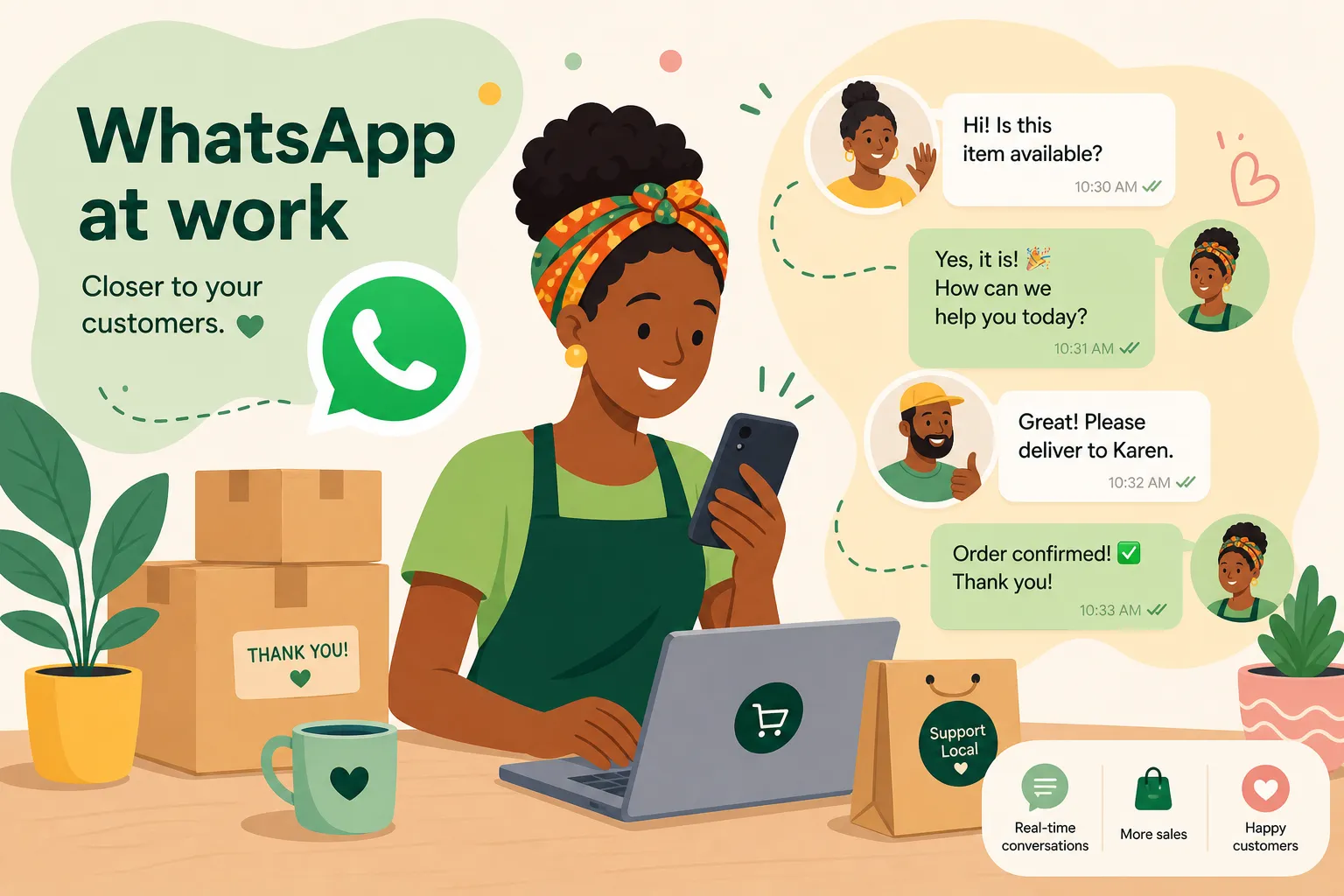
How do Kenyan businesses use WhatsApp to communicate with customers? The answer has changed dramatically. Ninety-seven per cent of Kenyan internet users are on WhatsApp every single day, and seventy per cent of Kenyan SMEs actively use WhatsApp Business for customer communication. Those two figures sitting next to each other tell a clear story: WhatsApp is not a channel businesses chose; it is the channel customers chose for them, driven by near-universal adoption among internet users and behaviour that made it the default for everything from price enquiries to payment confirmations. The real divide in 2026 is not between businesses that use WhatsApp and those that do not. It is between businesses that use it casually and those that have built a structured system around it.
Many businesses are still in the casual camp: a personal number, a few quick replies saved, and a broadcast list with a handful of contacts. A smaller group has moved to the WhatsApp Business App and set up a catalogue. And a growing number have gone further, working with developers like Alvine Otieno to build AI-powered bots that handle hundreds of customer conversations automatically, confirm M-Pesa payments in real time, and escalate complex issues to a human agent without dropping a single lead. By the end of this article, you will know exactly where your business sits on that spectrum and what to do about it.
Why WhatsApp became Kenya's default business channel
The numbers are hard to argue with. WhatsApp messages in Kenya carry a 98% open rate within five minutes of delivery, compared to 22% for email. SMS used to fill this role, but WhatsApp overtook it for one simple reason: it is where the customer already is, and it requires minimal data to receive a message. For a business, that means a promotional update or an order confirmation is almost guaranteed to be seen within moments of being sent.
The second reason WhatsApp dominates is structural, and it is uniquely Kenyan. The combination of WhatsApp and M-Pesa created a commerce loop that no other market has quite replicated. A customer browses a product photo sent on WhatsApp, places an order by replying to the same message, and pays via M-Pesa, all without switching apps or opening a browser. That three-step loop (browse, order, pay) is the reason WhatsApp overtook phone calls and SMS as the primary business communication channel in Kenya. It is not a messaging app anymore. For many businesses, it is the entire sales interface.
How do Kenyan businesses use WhatsApp to communicate with customers, real examples by industry
Matatu SACCOs and shuttle operators use WhatsApp broadcast lists to push route updates, peak-hour fare alerts, and departure confirmations to passengers. When a booking is made through a dedicated app or by phone, an instant WhatsApp message carrying the booking reference code and M-Pesa payment confirmation lands on the passenger's phone within seconds. The group handles internal fleet coordination between drivers, conductors, and SACCO admins; the broadcast list handles the customer-facing updates. WhatsApp does not replace the booking system, but it is the communication layer that makes the booking feel real and confirmed.
In retail, the pattern is equally practical. A Nairobi grocery shop sends a daily product list via WhatsApp catalogue or a simple broadcast, takes orders by reply, receives an M-Pesa screenshot as payment, and confirms dispatch. A Nairobi e-commerce store using the WhatsApp Business Platform integrated with its customer relationship management (CRM) system achieved a 30% abandoned-cart conversion rate and a 90% open rate on flash-sale broadcasts. These are not outliers. They are what happens when a business treats WhatsApp as a channel worth investing in properly rather than something managed between other tasks.
NGOs and financial institutions have pushed this further. Equity Bank's Eazzy ChatBanking handles balance checks, loan applications, and KYC across seven million customers on WhatsApp, saving KES 1.2 billion annually in call-centre costs. Co-op Bank reduced its support team workload by 35% through automated WhatsApp responses for FAQs and transaction alerts. Smaller SACCOs and NGOs are replicating this at a fraction of the cost, using broadcast lists to deliver payment alerts and programme updates to beneficiaries in low-bandwidth rural areas, in local languages, via voice notes that require minimal data.
The four core WhatsApp workflows Kenyan businesses run daily
Order intake and payment confirmation
The WhatsApp Business catalogue supports up to 500 products and functions as a lightweight storefront for small retailers. A customer taps a catalogue link shared in a broadcast, browses the available items, and sends an enquiry. A quick reply or automated greeting captures the order details, and the business sends an M-Pesa payment prompt. For a sole trader or micro-business handling fewer than 100 messages per day, this flow works cleanly on the free Business App without any additional investment.
Customer support and payment confirmations
Customer support is where WhatsApp replaces the phone call entirely. Return requests, delivery queries, and stock availability checks that used to require a call now arrive as WhatsApp messages, handled via a library of saved quick replies. The payment confirmation step ties off the M-Pesa transaction: after a payment comes through, a manual or automated WhatsApp message confirming receipt eliminates the "did you receive my payment?" follow-up calls that waste enormous amounts of team time. Kamari Events saw this effect directly. After setting up an automated welcome flow, their response rate jumped from 62% to 100%, with all replies delivered within 30 seconds.
Lead qualification and post-sale follow-up
The other two workflows are lead qualification and post-sale follow-up. Businesses that have moved to the WhatsApp Business Platform send pre-approved message templates for appointment reminders, shipping updates, and re-engagement sequences. These templates require Meta approval, but once live they run without any manual input. A customer who has not purchased in 30 days receives a personalised discount message. A lead who enquired but did not buy gets a follow-up with a catalogue link. These are the workflows that turn WhatsApp from a support channel into a revenue engine.
WhatsApp Business App vs the WhatsApp Business Platform: which one fits your business
The free WhatsApp Business App handles a surprising amount: a catalogue of up to 500 products, quick replies, greeting and away messages, and up to five linked devices. For a sole trader or small team managing under 100 customer conversations per day, it is a legitimate and cost-free solution. The mistake businesses make is staying on it for too long, because the limitations are not obvious until they become genuinely damaging.
The broadcast limit is the first problem. The App caps broadcast lists at 256 contacts, and reports indicate that in many regions this has been reduced to 50 unless the business subscribes to Meta Verified. The second problem is the five-device cap, which breaks down the moment a business needs more than one support agent on the same number. The third is the absence of pre-approved message templates. Without templates, a business cannot run compliant outbound marketing campaigns at scale, and any message sent outside the 24-hour customer service window risks being blocked entirely.
The WhatsApp Business Platform removes all of these constraints. Broadcast limits scale by tier, starting at 1,000 messages per day and increasing to unlimited as your account builds a track record. Unlimited agents can handle conversations on the same number simultaneously. Pre-approved templates cover marketing, utility, authentication, and service categories.
In Kenya, the active Business Solution Providers (BSPs) that provide access to the Platform include Celcom Africa, HelloDuty, Ominiflow, and TECHenya Solutions. Platform fees range from approximately KES 4,000 to KES 50,000 per month depending on the BSP, with Meta conversation charges applied per 24-hour window: KES 3.525 for marketing conversations, KES 1.12 for utility and authentication, and service conversations free within the window. BSPs may add their own markup on top of these base rates.
Staying compliant: opt-in rules and Kenya's data protection requirements
Kenya's Consumer Protection Regulations 2025, issued by the Communications Authority, are direct on this point: all direct marketing via WhatsApp, SMS, or email must be based on an opt-in principle. A customer who visited your shop, liked your Instagram post, or bought from you once has not given you permission to send them promotional messages. You need explicit, documented consent before the first message goes out.
Practical opt-in mechanisms include a sign-up form at checkout with a checkbox for WhatsApp marketing, a click-to-chat link with a pre-filled consent message, or a verbal opt-in recorded against the customer's number in your customer relationship management (CRM) system. That consent must be time-stamped and stored, because the Office of the Data Protection Commissioner (ODPC) requires businesses engaged in direct marketing to register and to demonstrate a clear audit trail for every contact in their list.
Every outbound marketing message must include an opt-out mechanism, typically "Reply STOP to unsubscribe", and opt-out requests must be honoured within seven days. Buying contact lists, scraping numbers from directories, and assuming consent from a prior business relationship are all prohibited under the Data Protection Act 2019.
Compliance here is not a bureaucratic burden. It is what separates a business that builds trust on WhatsApp from one that eventually gets blocked by its own customers.
When manual replies can't keep up: scaling WhatsApp beyond the Business App
The pattern is predictable. A business runs a successful WhatsApp broadcast, the responses come in overnight, and by morning the team is three days behind. This is the moment most businesses realise that WhatsApp is not just a messaging tool; it is a customer-facing product that needs to work without a human on the other end at all times. A Kisumu agribusiness that hit this wall deployed a WhatsApp chatbot to handle farmer queries on seed prices and delivery schedules. Response time dropped from hours to seconds. Sales conversions increased by 40%.
At this stage, a business needs an AI bot built on the WhatsApp Business Platform, one that handles order intake, sends M-Pesa payment confirmations automatically after the Daraja API callback fires, answers FAQs, qualifies leads, and escalates complex issues to a human agent without losing context. Building this requires the Meta WhatsApp Cloud API, an integration layer like n8n, and an AI model like OpenAI's GPT to handle unstructured customer questions in natural language.
This is precisely the kind of system Alvine Otieno builds. He creates production-ready WhatsApp bots that have handled over 50,000 events for live businesses, engineered to manage the volume that the Business App and a manual team simply cannot sustain. If your business is at the point where WhatsApp is generating more conversations than your team can handle, the system is working. The question is whether your infrastructure is keeping up with it.
The businesses winning on WhatsApp in Kenya in 2026
Understanding how Kenyan businesses use WhatsApp to communicate with customers reveals how far the channel has moved beyond sending a text. The businesses leading in 2026 have built structured, compliant, and scalable conversation systems. They have a clear opt-in process, a catalogue that functions as a storefront, pre-approved templates that run marketing campaigns without manual input, and automated payment confirmations that complete the M-Pesa transaction cycle instantly.
The WhatsApp Business App is a legitimate starting point for micro-businesses. Growing businesses need the Platform, verified templates, and eventually automation to serve customers at the speed customers now expect. The businesses winning are not the ones with the most followers. They are the ones that respond in seconds, confirm payments the moment they land, and never leave a customer waiting overnight for an answer that a well-built bot could have sent at 2 AM.
Knowing how Kenyan businesses use WhatsApp to communicate with customers helps you prioritise what to fix first: team capacity, broadcast scale, or payment confirmation delays. If you are ready to move to the Platform or need an AI bot that handles volume reliably, Alvine Otieno builds exactly that. Reach out to discuss what your WhatsApp stack should look like at your current stage of growth.
Software engineer writing about the craft of building products on the web.