How to automate business processes on a Kenyan budget
Discover how Kenyan SMEs can leverage affordable automation tools like n8n and WhatsApp Cloud API to streamline operations, save time, and increase revenue. Learn to automate finance, sales, and customer service without a huge budget.
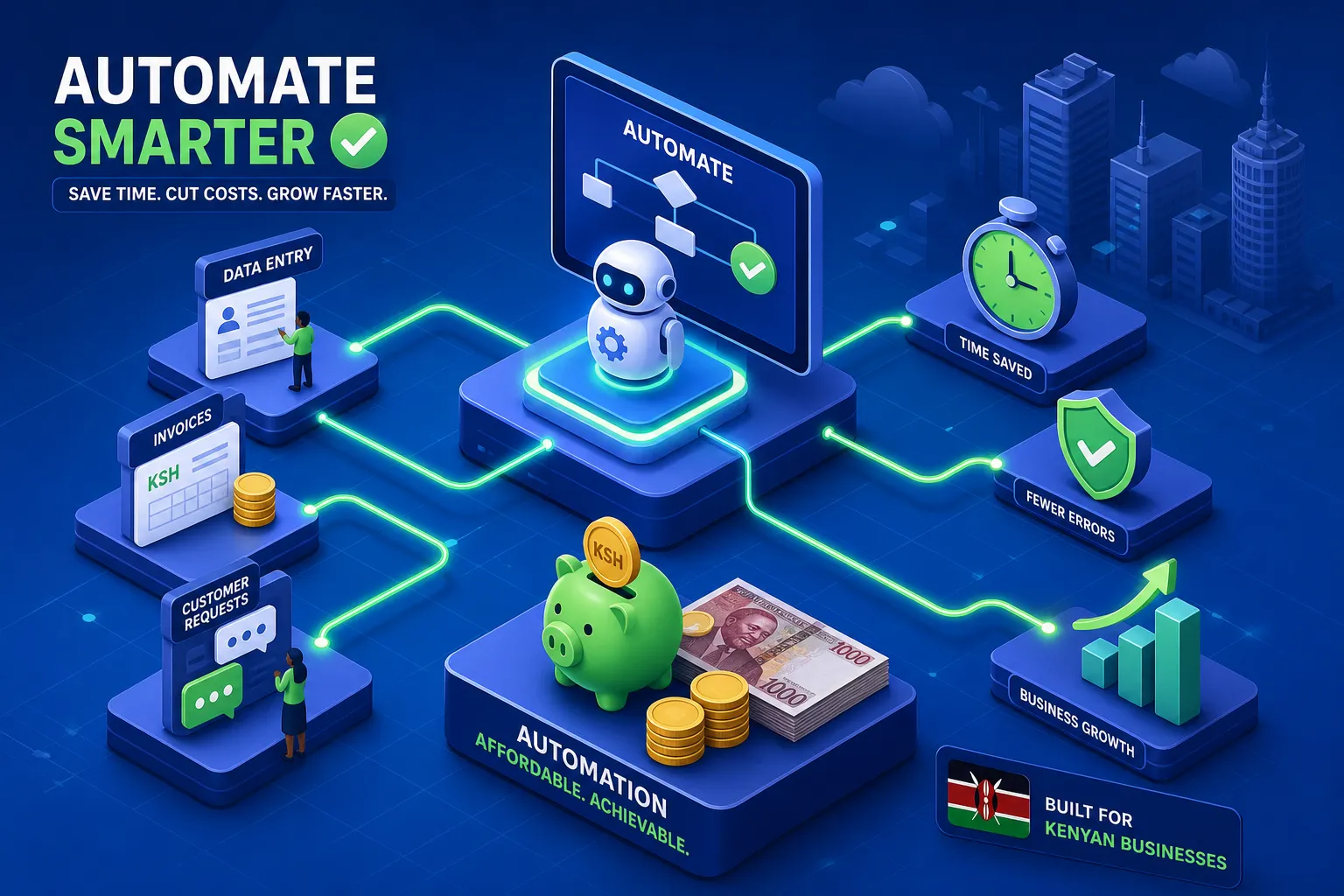
The sales lead that arrived on Friday and got followed up on Tuesday, if at all. The invoice that sat unpaid for 45 days because someone was waiting to make a phone call that never happened. The customer who messaged on WhatsApp at 8 p.m. and got a reply the next afternoon, if they were lucky.
These aren't problems caused by bad teams or lack of effort. They're systems problems, and they're costing Kenyan businesses real money every week. Kenyan SMEs that automate business processes recover hours each week and reduce the kind of revenue leakage that accumulates quietly until it becomes a cash flow crisis. Clients who have worked with Alvine Otieno have addressed each of these problems using affordable automation tools, including a WhatsApp bot that has processed over 50,000 events without a dedicated customer service team sitting behind it.
By the end of this article, you'll know which processes to automate first, which tools suit a Kenyan budget, how to calculate whether the investment makes financial sense, and how to run a controlled pilot without disrupting what's already working.
The four processes draining the most time in Kenyan businesses
Finance, sales, customer service, and HR onboarding together account for the bulk of manual hours that Kenyan SMEs waste every week. These four areas are where repetitive, rule-based tasks pile up, eating into productive time that could be spent on growth. You don't need to automate all four at once, picking one process and doing it well delivers meaningful results fast.
Invoice reminders and payment follow-ups
Automating payment reminders delivers the highest ROI of any starting point because it directly addresses cash flow. The pattern is familiar: you send an invoice, wait, send a reminder, wait again, then finally make an awkward phone call two months later. Sending automated reminders at 7, 14, and 30 days overdue can recover 1 to 3 hours per week in manual chasing and significantly shorten payment cycles. For Kenyan SMEs reconciling M-Pesa payments manually, this problem is especially pronounced: a business processing 200 invoices a month can spend 15 to 25 hours on a task that automation handles in 30 minutes.
Lead management and customer follow-ups
Most Kenyan businesses lose leads not because the product is wrong, but because the follow-up is inconsistent. A potential customer fills a form, sends a WhatsApp message, or enquires at an event. Nobody responds within the window when they are still interested. Automating lead qualification and routing, so a hot lead receives a calendar booking link or product message within minutes, can save 3 to 5 hours weekly and meaningfully improve conversion rates.
Order tracking and customer service queries
"Where is my order?" is one of the most common messages a Kenyan business with physical products receives. It's also one of the easiest to automate, because the answer follows a predictable pattern almost every time. Automating standard customer queries frees your staff for complex cases while improving response times for routine ones. Based on typical SME deployments handling moderate volumes, this kind of automation saves 2 to 3 hours weekly, and the improvement in customer experience is immediate.
How to automate business processes affordably in Kenya
You don't need enterprise software or a large IT budget to automate business workflows. The platforms available today are low-code or no-code, work well in Kenya's WhatsApp-first environment, and cost a fraction of what a part-time employee would. Understanding business process automation (BPA), that is, using technology to execute recurring tasks with minimal human intervention, is the starting point for applying these tools effectively.
n8n and Make for backend workflow automation
n8n and Make (formerly Integromat) connect your apps and trigger actions automatically based on rules you define. n8n can be self-hosted on a basic Kenyan VPS for roughly KSh 2,000 per month, giving you unlimited workflows and executions with no per-task fees. Make has a more beginner-friendly interface with a free tier and is easier to configure if you want to test automation before committing any budget. Both platforms serve as practical workflow management software for SMEs, handling invoice reminders, lead routing, and follow-up sequences without requiring you to write a single line of code. For businesses with moderate to high workflow volumes, self-hosted n8n is 3 to 4 times more cost-effective annually than scaling a Make paid plan.
WhatsApp Cloud API for customer-facing automation
WhatsApp is the right channel for customer-facing automation in Kenya. According to Datareportal, Kenya consistently ranks among the world's highest WhatsApp adoption markets, making it the platform where your customers already communicate. The Meta WhatsApp Cloud API allows businesses to automate replies, send order updates, collect payment confirmations, and route enquiries, all within WhatsApp. When you connect it to n8n for workflow logic and OpenAI for intelligent natural language responses, it becomes a fully capable AI-powered assistant that handles conversations around the clock. This combination is precisely what powers the 50,000-event bot built through Alvine Otieno's practice.
Keeping costs realistic
A practical automation stack for a Kenyan SME, covering a self-hosted n8n instance (approximately KSh 2,000/month), WhatsApp Cloud API template message fees, and a WhatsApp Business Solution Provider (BSP), typically runs between $30 and $50 USD per month at moderate message volumes. That assumes roughly 1,000 to 3,000 template messages monthly; costs scale with volume but remain predictable. Compare that to the cost of a part-time employee performing the same repetitive tasks manually, and the economics become clear. The tools are accessible; in practice, the primary barrier is knowing where to start rather than the cost of starting.
What this looks like when it's live and handling real volume
A WhatsApp bot handling 50,000+ events
The WhatsApp bot deployed through Alvine Otieno has processed over 50,000 customer interactions without a human fielding each one. The architecture is straightforward: WhatsApp Cloud API manages the messaging layer, n8n handles workflow logic and routing, and OpenAI generates intelligent responses where natural language understanding is needed. As a single production case example, the system demonstrates what automating business processes looks like at real volume in Kenya, operating at a monthly cost well below what even a part-time customer service role would require.
From manual responses to an automated customer journey
Before automation, a staff member replied to each WhatsApp message manually, often hours after it arrived. After automation, a customer sends a message and receives an instant intelligent reply, gets routed to the right product information or payment link, and the business owner only steps in for genuinely complex cases. This maps directly to the three processes covered above: lead follow-ups run automatically, order tracking queries get resolved without human input, and invoice reminders go out on schedule without anyone having to remember.
How to calculate your ROI before spending anything
Before committing to automation, you need to know whether the investment makes financial sense. Use this formula and worked example as a decision-making tool you can replicate for your own business.
The core ROI formula
ROI % = ((Annual Benefits − Annual Costs) ÷ Total Investment) × 100. Annual Benefits cover three areas: time saved (hours recovered multiplied by staff hourly cost), error reduction (fewer billing mistakes and missed leads), and cost avoidance (growth handled without new hires). Total Investment includes platform subscriptions, setup or developer costs, and ongoing maintenance. Every one of these inputs must sit in the calculation, or the number you get will be misleading.
A worked example for invoice automation in Kenya
Take a business processing 50 invoices per month, each requiring 20 minutes of manual follow-up. That's roughly 200 hours of staff time per year. At a conservative KSh 300 per hour for an admin role, the annual time cost is KSh 60,000. Setting up the automation costs KSh 25,000 in developer time, with ongoing tool costs of KSh 2,000 per month (KSh 24,000 annually). Total first-year investment: KSh 49,000. First-year benefit: KSh 60,000 in recovered time, plus shorter payment cycles that improve cash flow. First-year ROI: 22%.
By year two, the one-off setup cost drops out of the calculation, leaving only the KSh 24,000 in ongoing tool costs as Total Investment. On the same KSh 60,000 annual benefit, ROI climbs to 150%. The system pays for itself before the end of the first year, and that calculation doesn't account for the revenue impact of faster payments.
Running your first pilot without disrupting your business
Knowing what to automate and having the tools is not enough. The implementation approach determines whether the project succeeds or fails. Most automation projects that fail do so in execution, not in concept.
Choosing the right process to start with
The process you choose for your first pilot should meet four criteria: repetitive, rule-based, high-volume, and currently handled entirely by hand. Invoice reminders and lead follow-up sequences meet all four. Avoid starting with a process that has many exceptions or requires complex judgement calls. It will break the pilot and create scepticism about automation across your entire team, which is far harder to recover from than a delayed launch.
The 6-week pilot checklist
Follow this sequence for a controlled, low-risk first implementation:
- Map the real process on one page, counting every touch, handoff, and decision point
- Define your auto-processing rules and the thresholds that trigger a human review
- Build the automation on a narrow scope: one workflow, two connected systems
- Run with real volume for 2 to 4 weeks alongside the existing manual process
- Log every exception and resolve root causes within 48 to 72 hours
- Measure cycle time and error rate at week 6 before expanding to the next workflow
Mistakes that kill automation projects before they deliver
Automating the wrong process first
The most common mistake is choosing a process that feels impressive rather than one with clear ROI. A complex, exception-heavy workflow will generate more problems than it solves in the first 90 days. Stick with invoice reminders or a single lead follow-up sequence for your first build. It may feel unglamorous, but reliable results in a simple process build the organisational confidence needed to expand into more complex workflows.
Treating automation as a technology project instead of a change project
More automation projects fail because of poor communication than because of bad tools. When staff don't understand what's changing, or fear that automation threatens their roles, they work around the system rather than with it. Brief your team before launch. Explain clearly what the automation handles, what they still own, and how success will be measured. Track the metrics that reflect real business impact, cycle time, error rate, and customer response speed, rather than the raw number of tasks automated.
Where to go from here
You now have a clear path from manual operations to automated business processes, without a large IT budget or a full development team. Start with invoicing or lead follow-ups, choose n8n or WhatsApp Cloud API depending on your use case, run a tight 6-week pilot, and measure before expanding scope. This is not a one-time project. It's an ongoing system that improves as you add workflows and refine the ones already running.
If you want to automate business processes but aren't sure where to begin, Alvine Otieno offers hands-on implementation support: from WhatsApp bot deployment to complete workflow automation builds. The 50,000-event bot is proof that this works at real volume in Kenya, on a budget that makes sense. Get in touch to discuss what your first pilot could look like and how quickly it can be live.
Software engineer writing about the craft of building products on the web.