Is Replit Worth It for Building Web Apps in Kenya?
Is Replit a good platform for building and deploying web apps in Kenya? This article provides an honest verdict, examining Replit as a development environment, its deployment options, and the impact of connectivity and server locations
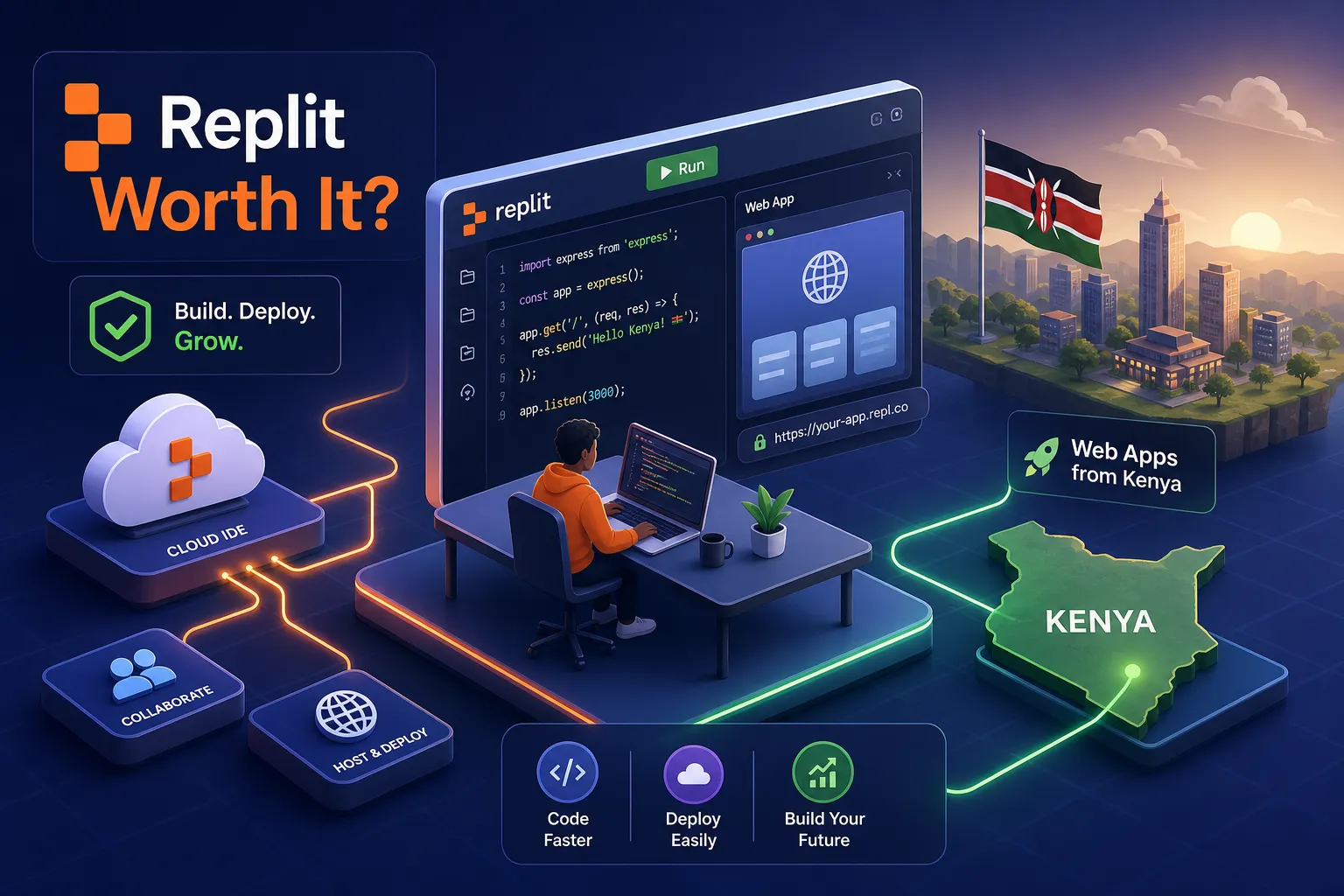
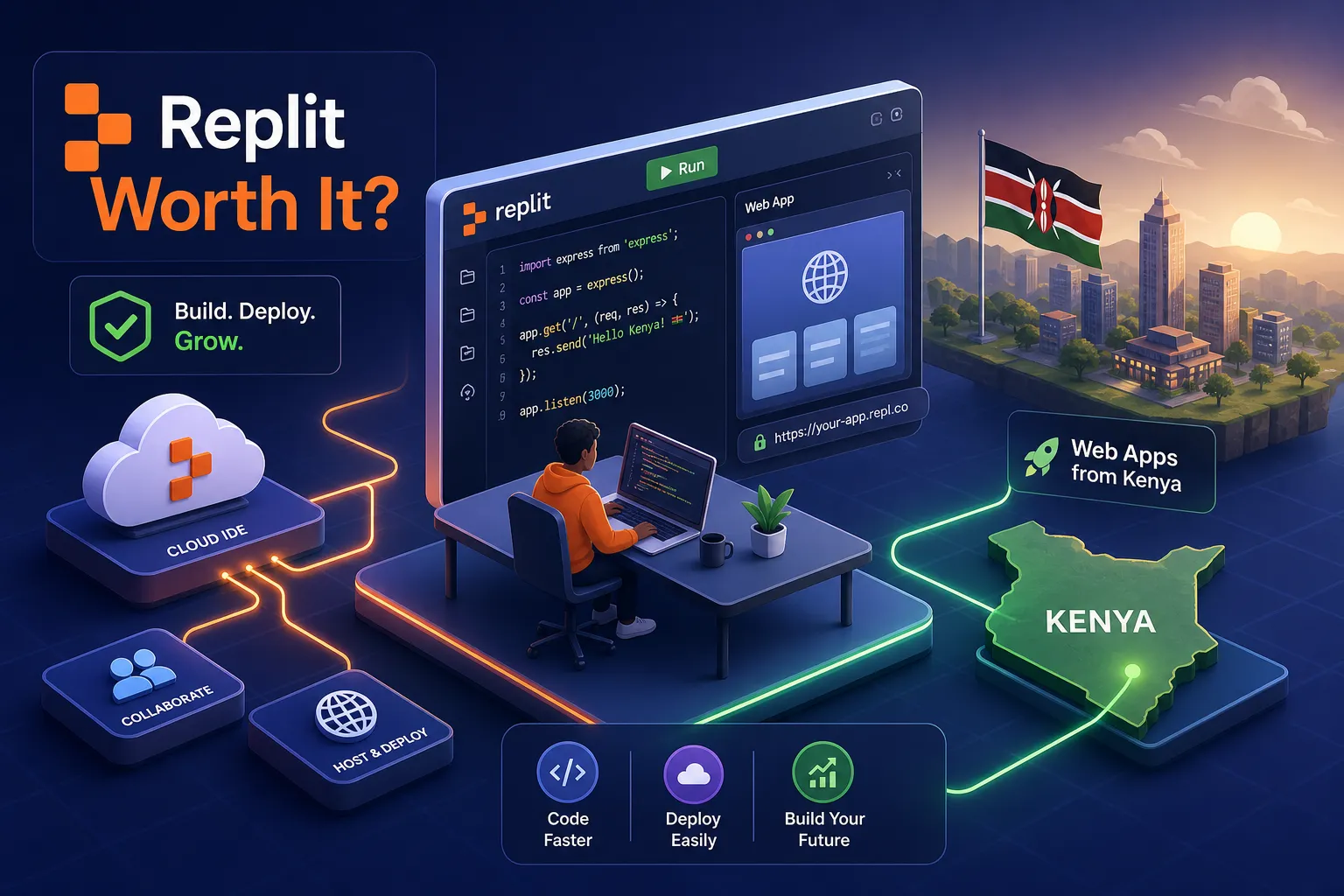
Is Replit a good platform for building and deploying web apps in Kenya? I have shipped WhatsApp bots on Replit. I have also migrated off it when a client needed something that stayed awake past midnight without cold starts. My relationship with the platform is not one of blind loyalty or reflexive dismissal: it is the relationship of a builder who has used Replit at the right stage of a project and learned, sometimes the hard way, when that stage ends. Replit divides developer opinion sharply, and in Kenya specifically, the debate carries extra weight because infrastructure access, hardware constraints, and connectivity realities all intersect with a platform designed primarily with US and European developers in mind. This article is the honest verdict.
The core tension is straightforward. Replit is genuinely powerful as a development and prototyping environment. Whether it works for your specific Kenyan project depends almost entirely on which plan you are on, what you are building, and whether your users can afford to wait an extra 300 milliseconds for every page load.
What Replit actually is (and what it is not)
In my experience, most developers arrive at Replit expecting a simple hosting platform. What they find is something quite different: a browser-based cloud IDE that bundles deployment, AI-assisted code generation, a built-in database, and real-time multiplayer collaboration into a single browser tab. That distinction matters enormously before you evaluate whether it fits a Kenyan project. Replit does not compete with Netlify or Heroku as a standalone deployment platform. It competes with the entire stack of VS Code plus Railway plus GitHub plus an AI coding assistant, all combined into one subscription.
The browser-based IDE and Replit Agent 3
Replit Agent 3 is the headline feature of the 2026 platform. According to Replit's official documentation, it is an AI that can autonomously build, test, and deploy a full-stack application for up to 200 minutes per session, a significant jump from the 20-minute limit of its predecessor. It runs in three effort modes: Economy for cost-efficient everyday builds, Power for complex work on larger codebases, and Turbo for 2.5 times faster execution, though Turbo is locked to Pro and Enterprise plans. For a Kenyan side-hustle builder who wants to describe a product idea and watch it scaffold into something runnable, this is one of the most accessible entry points into serious software development currently available.
Four deployment types and what each one does
Replit offers four deployment types, and knowing which tier unlocks which type is essential before you commit to any plan:
-
Static deployments are free and suited for client-side sites with no backend logic.
-
Autoscale handles dynamic apps and is available on Core and above, though plan limits and potential add-on costs are worth confirming on Replit's current pricing page.
-
Reserved VMs provide always-on, stateful processes, the only viable option for something like a WhatsApp bot that needs to respond at any hour.
-
Scheduled deployments handle timed jobs, subject to an 11-hour maximum per job.
Free users get Static only, with no custom domains and North American servers by default. Everything else requires a paid plan.
Is Replit a good platform for Kenyan web apps? The connectivity problem
Replit has no infrastructure in Africa. This is not speculation. There is no Kenyan node, no East African presence, and no announced timeline for one. The closest regions available to paying users are EU (roughly 150 ms from Nairobi under real-world ISP conditions) and Mumbai (120 to 180 ms, varying by provider and network route). Free plan users are served from North America by default, which pushes round-trip latency to 200 to 300 ms for Kenyan visitors before a single line of your application code has run. That is a meaningful UX penalty for any customer-facing product.
No African servers and what this means in practice
To translate those numbers into user experience: a 300 ms baseline delay means your Kenyan customer is waiting on the network before the browser has done anything at all. Compound that with app logic, database queries, and rendering time, and you are looking at load times that will register as sluggish on mobile connections. In my own sessions building from Nairobi, I have seen AI agent responses spike above 1.5 seconds during active builds, because the control plane has historically been US-centric regardless of where your compute is deployed. There have also been reports from developers elsewhere on the continent of access restriction errors on the platform, though I have not personally encountered this in Kenya and no formal incident report has named Kenyan users specifically.
How the free tier makes connectivity worse, not better
Based on what I see with developers approaching me for advice, the free tier is where many Kenyan beginners and side-hustle builders start, and it stacks every constraint at once. North American servers by default. No custom domain, so your app sits on a replit.app subdomain that no client will take seriously. According to Replit's documentation, apps sleep after five minutes of inactivity, triggering a cold start of up to 30 seconds for the next visitor. That is not a slow app: that is an app that appears broken. None of this is a reason to walk away from Replit entirely, but beginners need to know exactly what they are walking into before they show a client anything hosted on the free tier.
Replit's 2026 pricing, tier by tier
Replit overhauled its pricing in February 2026, retiring the Teams tier and restructuring into Free, Core, and Pro. Most reviews you will find online still reference outdated numbers, so here is the current picture based on Replit's official pricing page. Free is genuinely useful only for static sites and experimentation. Core at $25 per month includes $20 in monthly usage credits, two parallel Agent sessions, Autoscale deployment, and the ability to select the EU region. Pro at $100 per month unlocks Reserved VMs, ten parallel Agent sessions, Turbo Mode, and 28-day database rollback.
When the cost makes sense for a Kenyan project
The $25 Core fee looks reasonable when you consider what it replaces: a cloud IDE subscription, a hosting platform, an AI coding assistant, and a database, all bundled together. A solo Kenyan developer building an MVP with no local development setup needs at minimum Core to deploy a dynamic app with any real responsiveness, and at that level the bundle pricing is defensible. It starts to look expensive the moment you already have a local development environment and only need hosting for an existing project. In that scenario, you are paying for a cloud IDE you are not using, and Railway or Vercel will serve you better at lower cost. Pro at $100 per month is relevant only when you need always-on stateful processes or heavy parallel Agent usage, which describes production-grade WhatsApp bots and larger automation systems, not early-stage projects.
Production limits that will catch you off guard
Replit markets itself as production-ready, and in narrow, well-understood use cases it is. There are hard limits, however, that are easy to miss during prototyping and genuinely disruptive to discover after you have launched.
Cold starts, background workers, and the always-on problem
Always-on deployments are only available on Core and above, using Reserved VMs. On Autoscale, apps can still experience cold starts during low-traffic periods, and background workers compete for the same container RAM as your main application. Scheduled deployments have a hard 11-hour job timeout; anything longer requires a Reserved VM. For a WhatsApp bot or a payment processing API that needs to respond in seconds at any hour, these constraints are not theoretical. A WhatsApp bot that cold-starts when a customer sends a message at 2am is a broken product from the customer's perspective, even if your logs show a successful response 30 seconds later.
Custom domains, storage caps, and the concurrency ceiling
Free plans restrict you to a replit.app subdomain. No client-facing business product should go live on a subdomain you do not control, and custom domain support requires Core or above. Storage is capped by plan, with the free tier sitting at approximately 1 GB. Replit enforces a hard limit of 20 concurrent apps per account, not a concern for individual developers, but relevant for agencies managing multiple client projects. There is no native CI/CD pipeline, no built-in staging environment, and observability tooling is limited compared to AWS or GCP. These constraints define clearly where the platform's ceiling sits.
Where Replit genuinely earns its place in a Kenyan workflow
For specific use cases, Replit is the best tool on the table, and several of those use cases map directly onto how developers in Kenya actually work.
Prototyping without a local setup: the low-hardware advantage
A browser-based IDE that runs everything in the cloud is a genuine advantage when team members are on older laptops, shared devices, or mobile hotspots. The ability to spin up a working Node.js environment, connect a PostgreSQL database, and have Replit Agent 3 scaffold a full API within a single session, without installing anything locally, removes a real barrier for early-stage Kenyan projects. For a solo developer validating an idea before investing in production infrastructure, this is not a minor convenience: it is the difference between shipping in a week and spending three days configuring a local environment.
How Replit fits an AI-assisted rapid-prototyping workflow
In my own work building WhatsApp bots and workflow automations for Kenyan clients, Replit serves a specific and deliberate role: the fastest path from a described requirement to something running and testable. The workflow is to prototype on Replit, validate the logic and user experience with the client quickly, then move the production build to a more cost-effective always-on environment once the concept is confirmed. This keeps iteration cycles tight and client feedback loops short, which matters when you are working across time zones or on a lean project budget. Replit is a prototyping layer in a larger process, not the final destination for a production deployment.
Stronger platforms to consider when Replit is not enough
Once your prototype is validated and you need a production deployment, the decision comes down to what your app actually does and how much you want to spend.
Railway for full-stack apps that need to stay awake
Railway is a practical alternative for full-stack Kenyan projects that need a persistent backend, a database, and background processes without cold starts. At a $5 per month entry cost with usage-based pricing and no per-seat fees, it is considerably cheaper than Replit Core for production workloads. A typical Node.js app with PostgreSQL on Railway comes to roughly $15 to $35 per month depending on traffic and database size, competitive with Replit Core, especially since Railway does not charge for a cloud IDE you may not need. It assumes you have a local development setup or a separate AI coding tool, so it suits developers who are comfortable with Git and local environments.
Vercel and Netlify for frontend-first projects
Vercel performs well for Next.js and React projects, with a global edge network that brings content closer to Kenyan users than Replit's default North American region. Its free tier covers static and serverless frontend projects, though team plan costs scale quickly. Netlify is a solid choice for static and JAMstack sites where the generous free tier matters most. Neither platform replaces Replit's browser-based IDE, but both are more suitable for deploying frontend projects once your code is ready. If you are building a business website or a landing page for a Kenyan client, Netlify is worth evaluating before reaching for Replit or Railway.
Is Replit a good platform for building and deploying web apps in Kenya? The verdict
Using Replit to build and deploy web apps in Kenya works well at the prototyping and early validation stage, particularly in a low-hardware environment with AI-assisted development. It has a legitimate and specific place in a Kenyan developer's toolkit for those jobs. It is not a reliable production platform on the free tier, and the Core plan needs to be weighed honestly against what you actually need rather than what it bundles. If you are on a free account and wondering why your app feels slow or keeps going offline, the latency figures and cold-start behaviour above explain exactly why.
For business owners in Kenya who need a WhatsApp bot, a workflow automation, or a full-stack web app built and deployed correctly from the start, the platform choices matter less than having a developer who already knows which tool to use at each stage. In my practice at Alvine Otieno, I handle that decision, prototyping happens fast, the production deployment runs on infrastructure that stays awake, and you spend your time reviewing a working product rather than fielding complaints about a bot that went silent at 2am. If you are ready to build something that actually runs, get in touch.
Software engineer writing about the craft of building products on the web.