Next.js vs WordPress: The Kenyan Business Guide for 2026
Deciding between Next.js and WordPress for your Kenyan business involves more than just the initial cost. This guide breaks down the real expenses of building, launching, and maintaining each platform over time, considering factors like loc
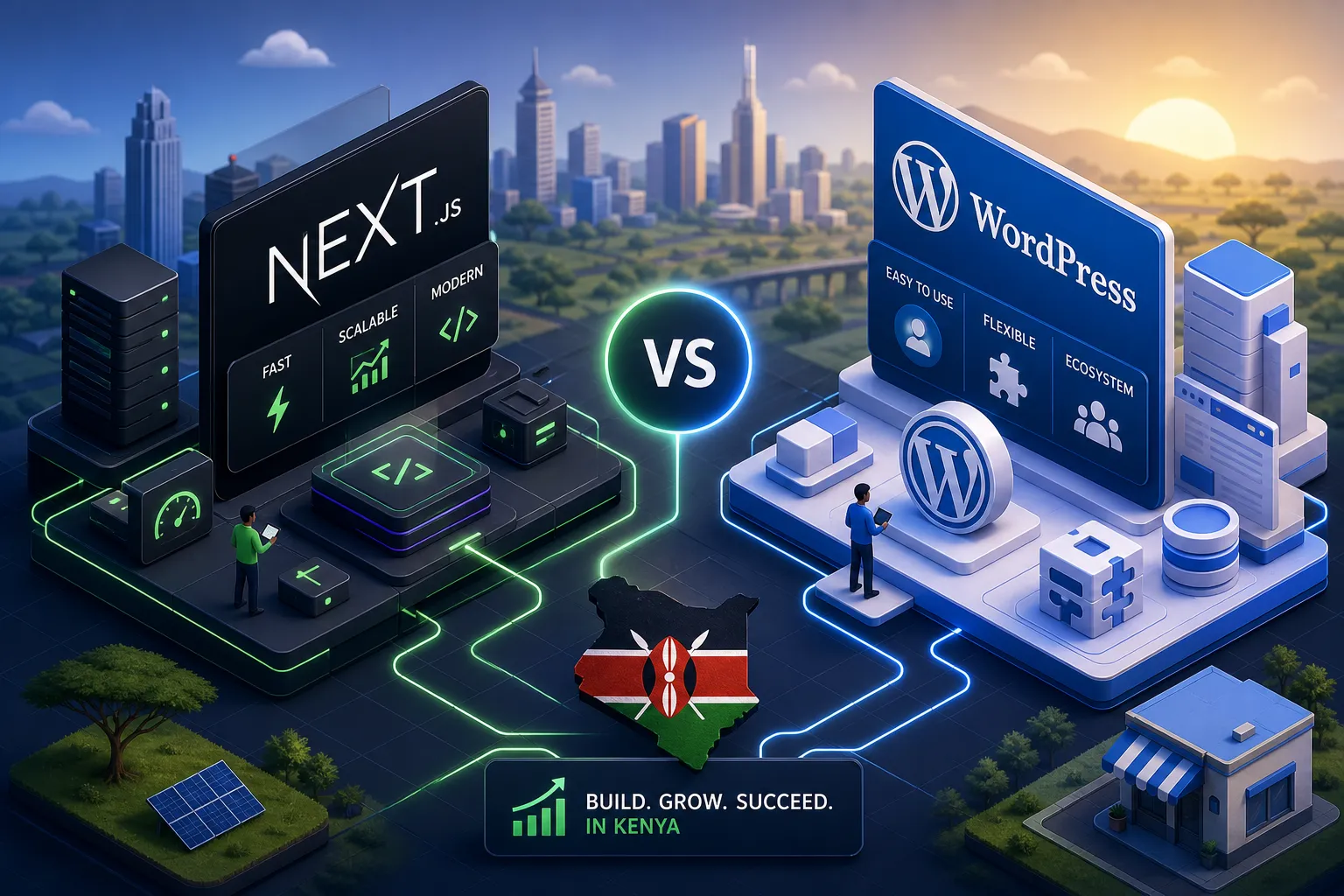
When comparing Next.js vs WordPress for your Kenyan business, the gap between a KES 400,000 React build and a KES 30,000 WordPress site is not just about price, it is about what each platform actually costs to build, launch, and maintain over time. A developer quotes you KES 400,000 for a "React site." Your friend got a working business website for KES 30,000 on WordPress last month and swears by it. Both pitches sound reasonable. Both developers seem competent. So what is actually going on, and which option is right for your business?
This is not a debate between developers arguing over code quality. It is a practical breakdown for Kenyan business owners who need to make a real decision with real money. Alvine Otieno, a Kisumu-based developer who has built and shipped production sites on both platforms for clients across Kenya and the US, contributes the field perspective here. By the end of this guide, you will know which platform fits your budget, your team, and your growth plan.
The real cost of building with Next.js vs WordPress in Kenya
A common mistake among Kenyan business owners is choosing a platform without understanding what it actually costs to build, launch, and maintain over time. The sticker price rarely reflects the full picture, ongoing expenses such as hosting, maintenance, payments integration, and security can significantly change the total cost of ownership.
What WordPress costs in KES from day one
A basic WordPress brochure site built on a template typically costs between KES 15,000 and KES 50,000 with a local developer. Add annual hosting at KES 5,000 to KES 20,000, and your first-year total sits between KES 20,000 and KES 70,000. The timeline is one to two weeks. For a business that needs to get online quickly with a tight budget, these numbers are genuinely hard to argue with.
What Next.js costs in KES from day one
A custom Next.js brochure site is an entirely different conversation. Expect KES 250,000 to KES 500,000 for the build alone, with developer rates running KES 4,000 to KES 12,000 per hour. The timeline stretches to three to six weeks. Hosting on Vercel or Accentrix Cloud adds KES 2,000 to KES 30,000 per year on top of that, based on Vercel's Pro plan at approximately $20 per month and Accentrix Cloud's local plans starting at KES 2,400 per month. This is not a budget option by any measure.
When the higher cost of Next.js is justified
The cost gap is real, but it is not the whole story. One Nairobi electronics retailer that Alvine worked with migrated from WordPress to Next.js and saw significant conversion and revenue gains in the following six months, largely because load times dropped from around 8 seconds to under 1.5 seconds. For businesses where site speed directly drives revenue, the premium can pay for itself. For a local physiotherapy clinic that needs a contact page and a service list, it does not.
Speed on Kenyan connections: what the numbers actually show
Performance is where Next.js builds its strongest case, and the Kenyan context makes this argument particularly compelling. Based on field testing by Alvine Otieno across Kenyan business sites, average load times on Safaricom 4G can stretch well beyond 4 seconds on unoptimised WordPress setups, a significant problem for any site trying to convert visitors.
Real-world performance benchmarks on 4G and 3G
On simulated 4G Nairobi connections, Next.js sites consistently achieve Largest Contentful Paint (LCP) of 0.8 to 2.0 seconds. A typical WordPress setup on shared hosting delivers LCP of 2.5 to 5.8 seconds. On 3G connections, which remain common outside Nairobi, WordPress can take 4 to 8 seconds to load due to database queries, while a well-built Next.js site using static generation holds under 2 seconds.
Why TTFB matters more than most Kenyan businesses realise
Time To First Byte (TTFB) measures how long before the browser receives its first data packet. On Vercel or Cloudflare Pages, Next.js sites achieve TTFB of 20 to 200 milliseconds. WordPress on shared hosting, even with caching plugins installed, typically returns 400 to 1,400 milliseconds. For users on slower connections, this difference is the gap between staying on your site and bouncing before it loads.
Can a well-optimised WordPress site close the gap?
Yes, partially. A WordPress site with a solid caching plugin, a CDN, and compressed images can reach LCP of 2.0 to 2.5 seconds, which sits within Google's "Good" Core Web Vitals threshold. Results above 2.5 seconds fall into the "Needs Improvement" band, and anything above 4.0 seconds is classified as "Poor." It will still trail a properly built Next.js site, but the honest answer is that optimised WordPress is fast enough for most small Kenyan businesses. Next.js wins specifically for high-traffic, conversion-sensitive sites where every second costs you a sale.
Next.js vs WordPress hosting and M-Pesa billing in Kenya
Choosing the right platform also means choosing where it lives and how you pay for it. This is one area where the two platforms diverge significantly for Kenyan operators, particularly around local billing options.
WordPress hosting with M-Pesa billing
Local providers like Kenya Web Experts and HostPinnacle offer WordPress shared hosting from KES 500 to KES 2,000 per month, payable via M-Pesa. Plans typically include one-click WordPress installation, free SSL, and local support teams. For the majority of Kenyan SMEs, this is the most practical starting point. Global providers like SiteGround offer better performance but require international payment cards and carry significantly higher renewal costs.
Next.js hosting: local and global options
For Next.js, Vercel is the native platform. Its free tier covers small projects, and the Pro plan costs roughly $20 per month, payable by international card only. Cloudflare Pages offers full features from $5 per month and is the most cost-effective global option. Accentrix Cloud is one of the primary Kenyan providers with dedicated Next.js support, priced at roughly KES 2,400 per month, with local billing options. For teams comfortable with server management, self-hosting on Hetzner or DigitalOcean at $4 to $6 per month is the cheapest production route.
The M-Pesa billing gap for Next.js
This is a practical pain point that often goes unmentioned: most Next.js hosting options, including Vercel and Cloudflare Pages, require a USD-denominated card. For many Kenyan business owners who prefer or only have M-Pesa, this creates a real barrier. If local billing is non-negotiable for your business, WordPress on Kenya Web Experts or HostPinnacle remains the easier path. If you already run a Safaricom Global Pay card or hold a USD account, the barrier largely disappears, and Accentrix Cloud's local billing makes it a practical alternative for Next.js projects that need to stay within the Kenyan payments ecosystem.
Security, maintenance and M-Pesa integration compatibility
Long-term ownership cost is about more than the build. It is about what you spend every year to keep the site running safely, and whether the platform plays nicely with Kenyan payment infrastructure.
WordPress plugin risks and what they cost to manage
WordPress vulnerabilities come overwhelmingly from plugins. According to Patchstack's 2024 WordPress vulnerability report, 93% of known WordPress security issues trace back to third-party plugins rather than core WordPress itself. In Alvine's experience auditing Kenyan business sites, it is common to find active installations running 30 or more plugins, with at least one carrying an unpatched vulnerability. Routine maintenance covering plugin updates, security scans, and off-site backups typically runs KES 3,000 to KES 13,000 per month through a local developer, based on standard local developer service rates and the scope of a typical monthly maintenance retainer. This is manageable, but it requires consistent attention, not a "set it and forget it" approach.
Next.js security model and dependency management
Unlike WordPress, Next.js does not rely on a plugin architecture. Security risks shift instead to npm package vulnerabilities, server-side rendering misconfigurations, and environment variable exposure. This is a narrower attack surface, but fixing issues requires a React or Node.js developer. Those specialists charge KES 4,000 to KES 12,000 per hour in Kenya, and there are fewer of them locally than WordPress developers. Annual maintenance costs for a Next.js site run roughly KES 60,000 to KES 250,000, primarily in developer labour.
M-Pesa integration: how each platform handles it
Both platforms can integrate M-Pesa via Safaricom's Daraja API. On WordPress, WooCommerce plugins handle the connection with minimal custom code, making it accessible even for developers who are not deeply specialised. On Next.js, M-Pesa integration is built directly into the API routes, which is more flexible and better suited to non-standard payment flows such as instalment billing, subscription models, or multi-party disbursements. For straightforward e-commerce checkouts, WordPress wins on simplicity. For complex payment logic, Next.js wins on control.
SEO: which platform actually helps you rank
Both platforms can rank on Google. The difference is in how much technical work each one demands to get there, and how much that work depends on having a developer on call.
Core Web Vitals and Kenyan search rankings
Next.js sites built on edge infrastructure routinely score Lighthouse 92 to 99 on mobile, compared to WordPress averages of 32 to 70 on unoptimised setups. Since Core Web Vitals are a confirmed ranking factor, a faster Next.js site carries a built-in SEO advantage on competitive Kenyan keywords where page experience is a tiebreaker. That said, WordPress wins on content workflow. Plugins like Yoast SEO give non-technical editors full control over meta titles, descriptions, schema markup, and XML sitemaps without touching any code. For Kenyan businesses running blogs, news sites, or content-led marketing, this flexibility matters more than raw speed scores.
What happens when SEO is handled carelessly
WordPress can be SEO-perfect or SEO-broken depending on plugins and theme code. Next.js requires developers to manually implement structured data, canonical tags, Open Graph, and sitemap generation. Done right, it is exceptional. Done carelessly, it ships a site with zero meta structure and no sitemap. For teams without a dedicated developer, WordPress is simply easier to keep SEO-healthy over time.
Next.js vs WordPress comparison for Kenyan SMEs: making the right call
The Next.js vs WordPress question in Kenya comes down to four factors: budget, team capability, content update frequency, and how directly site speed affects your revenue.
Choose WordPress if your situation looks like this
WordPress is the right call for most Kenyan small and medium businesses. You need a site within two weeks, your budget is under KES 100,000, your team will manage content themselves, and your business model does not depend on site speed as a direct revenue driver. That covers most service businesses, NGOs, schools, clinics, hospitality operators, and content-driven brands. The combination of local hosting, M-Pesa billing, and an abundant pool of local developers makes WordPress the practical default for this segment. For many of these operators, a headless CMS for Kenyan businesses, where WordPress manages content via its REST API while a faster front end handles display, is worth exploring as they grow, but it is rarely the starting point.
Choose Next.js if your situation looks like this
Next.js makes sense when performance is a competitive advantage: high-traffic e-commerce stores, fintech platforms, SaaS products, or corporate sites where bounce rates directly affect revenue. If your target user is loading your site on a patchy 3G connection in Kisumu or Mombasa and a five-second delay costs you a sale, Next.js is the better investment. It also suits teams that have access to React developers and the budget for ongoing technical maintenance, not just the initial build. A JAMstack vs CMS comparison is useful here: JAMstack architecture, which Next.js supports natively, pre-renders pages at build time and serves them from a CDN, while a traditional CMS like WordPress generates pages dynamically on each request.
When to get a professional opinion before committing
Some businesses are genuinely in the middle: a growing e-commerce store that started on WordPress and is hitting performance limits, or a startup that wants a custom platform but has limited runway. This is where a headless WordPress Kenya setup, using WordPress as a content backend with the WordPress REST API powering a Next.js front end, becomes a viable middle ground worth evaluating.
This is exactly the kind of decision Alvine Otieno works through with clients directly. Having shipped production systems on both platforms for Kenyan and US-based clients, including a WhatsApp bot that has handled over 50,000 events, the approach is always grounded in what actually works for your users and your budget, not what sounds impressive in a pitch. If you are unsure which path fits your business, a direct consultation is the fastest way to get clarity before committing tens of thousands of shillings in the wrong direction.
Making the call
The Next.js vs WordPress decision in Kenya is ultimately a business question, not a technical one. WordPress is the stronger choice on cost, speed-to-launch, local hosting, M-Pesa billing, and ease of content management. Next.js holds the advantage on raw performance, security architecture, and custom integration flexibility, including complex M-Pesa workflows that go well beyond a standard checkout.
For most Kenyan businesses starting out or operating on typical SME budgets, WordPress is the practical choice. For performance-critical platforms where every second of load time affects conversions, Next.js earns its premium. The biggest mistake is choosing a platform based on what sounds more sophisticated rather than what fits your actual use case. Understand your budget, your team's capability, and your growth trajectory, then build accordingly.
If you want a straight answer on which platform suits your specific situation, reach out to Alvine Otieno for a direct assessment. He will tell you which platform actually fits your situation, based on what your business needs, not what looks good in a proposal.
Software engineer writing about the craft of building products on the web.