Next.js vs WordPress: What Kenyan Businesses Need to Know
Choosing between Next.js and WordPress for your Kenyan business website? This guide breaks down five practical factors, including cost, speed, and ease of use, to help you decide which platform best fits your specific needs and customer bro
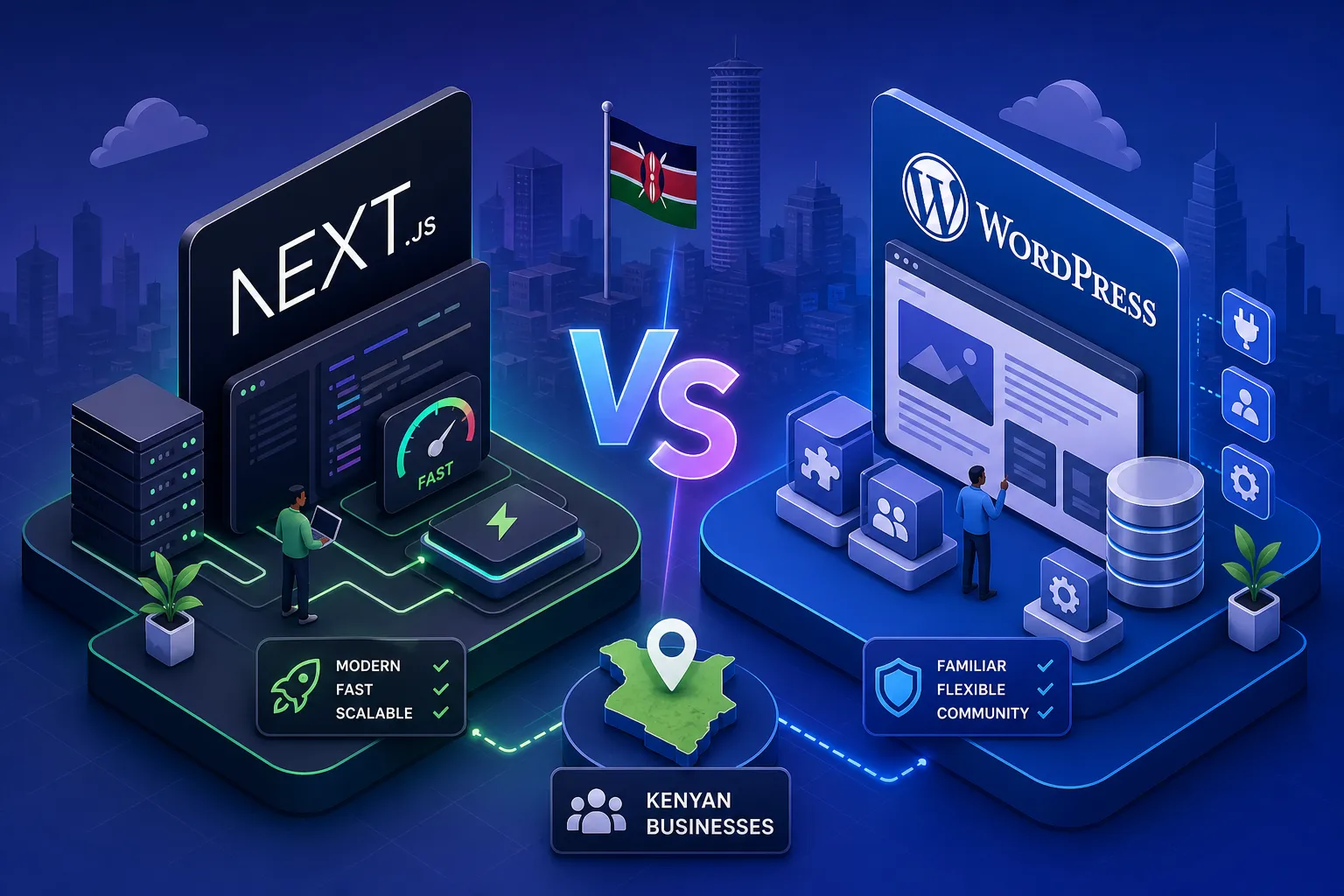
A business owner in Mombasa paid a developer KES 80,000 for a new website. Three months later, the site was taking seven seconds to load on a 4G connection, customers were dropping off before seeing the homepage, and the developer had gone quiet. The culprit was not the developer's laziness. It was the wrong platform choice for that specific business, locked in before anyone asked the right questions.
So, is Next.js or WordPress better for a Kenyan business website? The honest answer is: it depends on five practical factors that most developers never walk you through before taking your deposit. This is not an abstract debate about which platform is technically superior. It is about which one fits your business model, your team's ability to manage it, and the reality of how your Kenyan customers actually browse. With 98.2% of Kenyan internet users accessing websites primarily on smartphones, and most of them on 4G or 3G connections, platform decisions have a direct line to revenue. Having built and shipped production-ready sites on both stacks for Kenyan clients, including booking platforms, e-commerce stores, and content portals, the patterns of which platform fits which business are consistent. Here are the five practical factors every business owner should weigh before committing.
What WordPress and Next.js are actually built for
The core difference between these two platforms is not technical. It is organisational. WordPress is a content management system designed so that non-technical people can publish, update, and manage content without writing a single line of code. Next.js is a React framework: a development tool that gives engineers precise control over how a site is built, rendered, and delivered to browsers.
That distinction shapes everything downstream, from who can maintain the site to how fast it loads on a 3G connection in Kisumu. You may have heard of "headless WordPress," which pairs WordPress's content management with a Next.js front end. It is an option some teams explore, but it removes WordPress's primary advantage, ease of use for non-technical staff, while adding Next.js's complexity. For most Kenyan SMEs, headless is a solution looking for a problem.
WordPress as a CMS for Kenyan SMEs: strengths and trade-offs
According to W3Techs market-share data, WordPress powers roughly 43% of websites globally, and that reach is earned, because it genuinely works for teams that need content flexibility without developer dependency. A marketing manager in Nairobi can log in, update a product page, and publish a blog post without calling anyone. That accessibility is the platform's real selling point, not its themes or plugins.
The cost of that accessibility is real, though. WordPress runs on PHP and a MySQL database, and every additional plugin introduces page weight, potential security vulnerabilities, and maintenance overhead. Research into typical WordPress deployments shows that sites commonly run 10 to 15 plugins within a couple of years of launch, each one slowing the site a little further and widening the attack surface.
Next.js as a React framework for custom web applications
Next.js gives developers the tools to build exactly what a business needs, with no extra weight. There is no admin dashboard out of the box, and content updates require either a developer or a connected headless CMS. The output is lean, fast, and built precisely around the business logic rather than around a generic template's assumptions.
For a straightforward performance comparison: Next.js wins on speed; WordPress wins on accessibility for non-technical teams. The question is which of those two factors matters more to your specific business right now.
Is Next.js or WordPress better for Kenyan businesses on cost?
Most Kenyan business owners underestimate the total cost of ownership, particularly on the maintenance side. The quoted build price is rarely the whole number.
WordPress development, hosting, and maintenance costs in KES
A professionally built WordPress site for a Kenyan SME typically costs between KES 40,000 and KES 100,000 for 10 to 20 pages with a custom theme setup and basic SEO. E-commerce builds with WooCommerce and M-Pesa integration push that range to KES 50,000 to KES 150,000.
Annual hosting runs KES 3,000 to KES 30,000 depending on whether you are on shared hosting or a VPS with LiteSpeed caching. Monthly maintenance retainers for updates, security, and backups sit between KES 5,000 and KES 25,000. When you add those numbers together for the first year, including three to six months of maintenance, the realistic total sits between KES 100,000 and KES 350,000. Most clients do not see that figure at kickoff, and it catches them off guard when the renewal invoices arrive.
Next.js development and hosting costs for Kenyan businesses
Next.js development costs more upfront because skilled engineers charge more. Production-grade Next.js developers in Kenya charge $35 to $45 per hour, compared to $20 to $30 per hour for experienced WordPress developers. That gap reflects the deeper technical skill set involved, not inflated rates.
On hosting, the options are genuinely flexible. Vercel's free tier works for low-traffic sites, and their $20/month plan covers most growing businesses. Kenyan Node.js-capable hosts like Accentrix Cloud and CloudSpinx start at around KES 150 to KES 300 per month and offer a meaningful local latency advantage. Based on typical routing behaviour, a Nairobi-hosted server is likely to deliver response times well under 20 milliseconds to Kenyan users, whereas Vercel routes most Kenyan traffic through European edge nodes, typically adding tens of milliseconds to round-trip times. For self-hosters, a Hetzner or DigitalOcean VPS costs $4 to $6 per month and gives full control, but requires more hands-on server management.
Page speed on Kenyan mobile networks
Kenya's average 4G download speed sits between 13.7 and 24 Mbps depending on the operator and measurement method. That is fast enough to load an optimised site quickly. The problem is that most Kenyan WordPress deployments are not optimised. A site that takes six seconds to load loses more than half its visitors before they see a product, and Google's own CrUX data consistently shows the majority of small-business WordPress sites failing Core Web Vitals benchmarks.
How typical WordPress sites perform on Kenyan networks
Kenyan WordPress sites running 10 to 15 plugins, which is standard, typically show Largest Contentful Paint times of 5 to 8 seconds on 4G, pushing abandonment rates above 50%. The combined Core Web Vitals pass rate among small business WordPress sites in Kenya sits between 10% and 16%, meaning the vast majority of local WordPress sites are actively failing Google's performance benchmarks.
A leaner WordPress setup with fewer than five plugins, a lightweight theme, and WP Rocket caching can bring LCP down to 2.5 to 4 seconds. That is significantly better, and acceptable for content-focused sites with low conversion dependency. But WordPress's PHP-to-database round trip adds a layer of latency that caching cannot fully eliminate on slower 3G connections in areas outside Nairobi.
Next.js performance advantages for low-bandwidth environments
Static generation and server-side rendering in Next.js eliminate database query delays at load time. A well-built Next.js site achieves LCP under 1.5 seconds on 4G Nairobi connections, with page sizes one-tenth to one-twentieth the size of a typical WordPress template. The broader JAMstack architecture makes this possible by pre-building pages rather than assembling them on each request.
The important caveat: a poorly implemented Next.js site that relies entirely on client-side rendering can underperform a tuned WordPress setup. The performance gains are real, but they depend entirely on how the site is built. Next.js is not a shortcut; it is a precision tool.
M-Pesa integration and local payment tools
Both platforms can integrate M-Pesa, but the path is different, and the difference matters when your business is processing real transactions daily. The plugin approach and the direct API approach each carry distinct trade-offs for security, transaction fees, and long-term reliability.
Next.js vs WordPress for M-Pesa integration: the plugin route
WordPress M-Pesa integration runs through WooCommerce combined with a gateway plugin such as Paynecta, IntaSend, or the M-Pesa Kenya Checkout plugin. Most free plugin versions do not handle STK Push callbacks automatically, which means orders must be confirmed manually. For a business processing more than ten transactions a day, that manual step creates real operational risk: missed confirmations, disputed orders, and reconciliation headaches.
Paid versions and gateway-as-a-service options like IntaSend resolve the callback problem but add transaction fees of roughly 1.5% to 3% per transaction on top of Safaricom's own charges. The security consideration also matters: Daraja API credentials must be stored securely in WordPress configuration files. The Consumer Key and Consumer Secret are sensitive values, and a poorly maintained site with an outdated plugin stack is a genuine exposure risk. For businesses that need STK Push automation without technical headaches, IntaSend or Paynecta are the more reliable choices within the WordPress ecosystem.
Direct Daraja API integration in a Next.js application
Next.js applications connect to the Safaricom Daraja API directly, without a plugin layer. A developer builds the STK Push flow, callback handling, and payment confirmation logic directly into the application. This means full control over how transaction data is handled, no dependency on a third-party plugin's update cycle, and lower per-transaction overhead since there is no gateway middleware taking a cut. For direct C2B STK Push via Daraja, Safaricom charges the customer a tiered fee and the merchant receives the full payment amount.
The trade-off is straightforward: this requires a developer with actual Daraja API experience, not just general Next.js knowledge. For businesses processing significant transaction volumes, that direct integration is more robust and more secure than any plugin solution currently available for WordPress.
Developer availability and long-term support in Kenya
A platform choice is only as good as the people who can build and maintain it locally. The developer market in Kenya is real and active, but it is not uniform across both platforms, and the quality gap within each category is wide.
Finding WordPress developers and agencies in Kenya
WordPress developers are widely available across Kenya on platforms like Upwork, local Facebook groups, and through agencies in Nairobi. Experienced WordPress freelancers typically charge $20 to $30 per hour, and agencies offering full builds with ongoing support are relatively easy to source. The risk is not availability; it is quality. The low barrier to entry in WordPress means the market ranges from competent professionals to people who installed a theme and called it development. A business inheriting a poorly configured site with 20 plugins and no documentation faces significant migration costs later.
Next.js developer availability and what production experience costs
Production-grade Next.js talent in Kenya is concentrated at the mid-to-senior level, with hourly rates ranging from $35 to $45. Developers with genuine shipping experience, not just tutorial projects, are less common than WordPress generalists, and they tend to avoid low-bid platforms where price drives every conversation. Finding the right Next.js developer requires more vetting time and a willingness to pay for demonstrated competence.
For businesses willing to invest, the difference in output is significant. A properly built Next.js codebase is maintainable, documented, and performant in ways that a typical agency WordPress theme rarely is. The higher cost at the start tends to translate to lower maintenance overhead and fewer emergency calls over time, a pattern that holds consistently across client engagements on both stacks.
Choosing the right platform for your Kenyan business
The five factors above point to clear patterns. Here is how to read them for your specific situation.
When WordPress is the smarter choice
WordPress makes sense for content-heavy businesses, blogs, news sites, and online directories, where non-technical staff need to manage content regularly without developer involvement. It also works well for businesses with a limited initial budget of KES 40,000 to KES 80,000, and for SMEs that primarily need a brochure site with basic WooCommerce M-Pesa functionality and can manage the plugin maintenance overhead. The key condition is keeping the plugin count low and the theme lightweight from day one. A WordPress site built with discipline performs well; one built with shortcuts deteriorates fast.
When Next.js is worth the investment for your business
Next.js is the right call when the website is a core product: booking platforms, customer portals, SaaS dashboards, or any system where the site does work rather than just displays information. It is also the better choice for any e-commerce store where page speed directly affects mobile conversion rates, for projects requiring custom Daraja API integration with full control over payment flows, and for businesses planning to scale traffic significantly within 12 to 24 months. The higher upfront cost delivers lower long-term maintenance overhead and a fundamentally faster product for Kenyan users on mobile data.
I have built production-ready sites on both platforms for Kenyan clients, including direct Daraja API integrations and full Next.js web applications. If you are not certain which stack fits your business model, team capacity, and growth plans, the free consultation at alvineotieno.com is the right starting point before you commit to a build. The wrong platform choice at the start costs significantly more to fix later.
Is Next.js or WordPress better for a Kenyan business website? Three questions to settle it
Neither Next.js nor WordPress is universally better for a Kenyan business website, but for a given business at a given stage, one is almost always the clearer choice. These three questions will get you there quickly.
Question 1: Who will maintain the site after launch?
If the answer is a non-technical team member, WordPress with a lean setup is almost always the right call. The CMS is built for exactly that person, and the ecosystem supports them. If the answer is a developer or a technical founder, Next.js unlocks significantly better performance and control, with no unnecessary overhead from features you will never use.
Question 2: What does the site actually do?
A brochure site with a contact form and a blog has different requirements from a platform processing daily M-Pesa transactions or managing customer accounts. The more your site does, payments, bookings, user data, real-time updates, the more Next.js's architecture pays for itself. The simpler the content function, the more WordPress's ease of use justifies the trade-offs.
Question 3: How much does page speed affect your revenue?
For an e-commerce store serving mobile users in Nairobi, the difference between a 1.5-second LCP and a 6-second LCP is the difference between a conversion and an abandoned session. If speed is directly tied to transactions, Next.js is the stronger platform. If your site is primarily informational and your audience is willing to wait a moment, a well-optimised WordPress setup can serve you well.
Use the five factors covered here, cost, hosting, page speed, M-Pesa integration, and developer availability, as your practical lens, and the answer tends to become clear. If it does not, reach out for a free consultation. Getting the platform decision right at the start is far cheaper than rebuilding from the wrong foundation six months later.
Frequently asked questions: Next.js vs WordPress for Kenyan businesses
Is Next.js or WordPress better for a Kenyan business website in 2026?
It depends on your business type and team. WordPress suits content-driven SMEs with non-technical staff and budgets starting from KES 40,000. Next.js suits product-focused businesses, e-commerce, bookings, SaaS, where mobile page speed and custom M-Pesa integration are revenue-critical. Neither is universally better; the five factors in this article determine the right fit for your specific situation.
Can WordPress handle M-Pesa integration for a Kenyan e-commerce store?
Yes, via WooCommerce plugins such as IntaSend or Paynecta. Free plugin versions often require manual order confirmation for STK Push callbacks. Paid versions automate this but add transaction fees of 1.5% to 3% per transaction. Next.js with a direct Daraja API integration avoids those fees and gives full control over payment flows, at the cost of requiring a developer with specific Daraja experience.
How much does a Next.js website cost compared to WordPress in Kenya?
WordPress builds start from KES 40,000 for a basic site. Next.js builds typically cost more upfront due to higher developer rates ($35 to $45 per hour versus $20 to $30 for WordPress). However, Next.js sites generally carry lower long-term maintenance overhead, which affects the true cost of ownership over 12 to 24 months.
Software engineer writing about the craft of building products on the web.