OpenAI API in Kenya: setup, costs, and real use cases
A comprehensive guide for Kenyan developers and business owners on using the OpenAI API, covering availability, account setup, cost breakdown in KES, and practical local applications. Learn how to overcome payment hurdles and integrate AI i
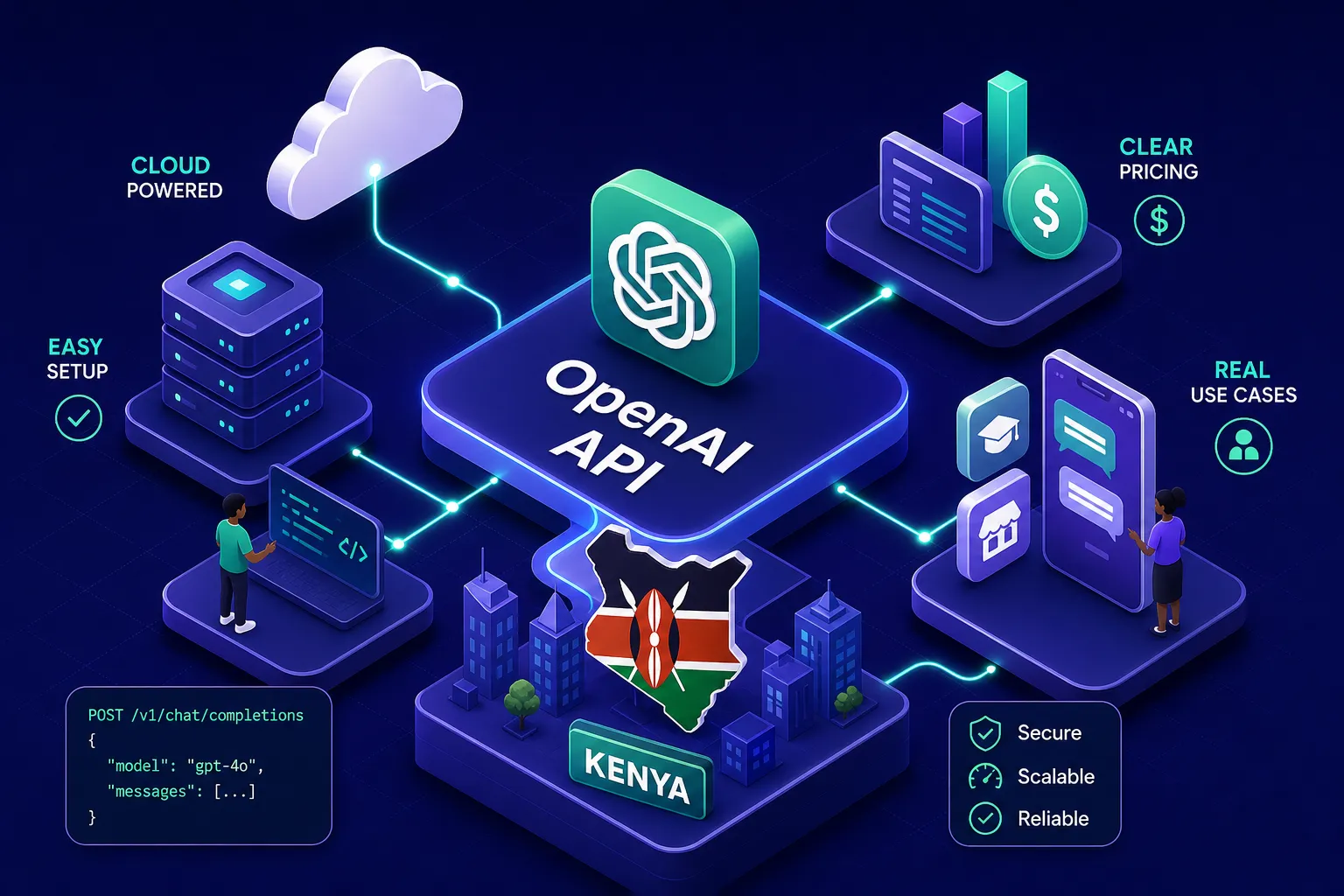
Picture this: a business owner in Nairobi opens WhatsApp at 8 a.m. to find 200 unread customer messages. Pricing questions, delivery status requests, booking confirmations, the same ten queries repeated in slightly different ways. She spends three hours answering them before she can do any actual work. Now remove that bottleneck entirely: one connection to the OpenAI API in Kenya, and the majority of those replies handle themselves in a matter of seconds.
This guide covers everything a Kenyan developer or business owner needs to know about using the OpenAI API in Kenya: confirming availability, creating your account, understanding what it actually costs in KES, running a working code sample, and seeing what local businesses are already doing with it. Developers here are already running OpenAI-powered systems that have processed tens of thousands of real events. This is not experimental territory.
OpenAI API Kenya: is it actually available here?
Kenya appears on OpenAI's official list of supported countries and territories. The API is accessible from over 160 countries globally, with restrictions applying only to regions under U.S. export controls and OFAC compliance, such as Russia, Iran, and North Korea. Kenya carries none of those restrictions, which means a developer or business owner here can sign up, fund an account, and start building.
Two practical limits are worth knowing. First, your payment method must come from a supported country, but as many Kenyan developers have discovered, this is where things get complicated (more on that shortly). Second, you cannot resell or redistribute API access to users in unsupported regions. Neither restriction creates any real obstacle for typical Kenyan use cases such as customer support bots, internal automation, or data processing tools. The API endpoints and capabilities are the same whether you are connecting from Nairobi or London; expect possible differences in payment acceptance and network latency, but not in what the API can do.
How to sign up and get your OpenAI API key in Kenya
The OpenAI developer platform is separate from the ChatGPT consumer product. Go to platform.openai.com, not chatgpt.com. Sign up with an email address or via Google or Microsoft SSO, confirm your email, and complete the mandatory phone verification using your Kenyan mobile number (+254). Safaricom, Airtel, and Telkom numbers are accepted for the SMS verification step in practice, though some virtual numbers are rejected, try a different carrier or contact OpenAI support if verification fails.
Here is something the official documentation glosses over: most Kenyan-issued bank cards are rejected at the billing stage. OpenAI uses Stripe as its payment processor, and Stripe has historically declined many Kenyan BINs, regardless of whether your card has international transactions enabled. A commonly reported workaround is an AstroPay Virtual Visa funded via M-Pesa. When creating the AstroPay account, set your billing address to a US address within the app; this bypasses the BIN rejection while still meeting OpenAI's requirement for a verifiable debit or credit card. The minimum top-up is $5 USD, roughly Ksh 645 to 700 at current exchange rates.
Disclaimer: the AstroPay workaround is widely used but is not officially endorsed by OpenAI or AstroPay. Confirm the current terms with your card issuer, AstroPay, and OpenAI's billing policies before proceeding, as terms may change.
Once your account has a positive credit balance, navigate to API Keys in the left sidebar, click "Create new secret key," give it a descriptive name such as "kenya-whatsapp-bot," and copy it immediately. OpenAI displays the key only once. Store it as an environment variable (OPENAI_API_KEY) and never paste it directly into source code or push it to a public GitHub repository. Setting a monthly spending limit in the billing dashboard is a sensible safeguard while you are getting started.
OpenAI API Kenya costs: a KES breakdown
There is no monthly subscription. You pay only for what you use, measured in tokens, where roughly 750 words equals 1,000 tokens. OpenAI prices input and output tokens separately, and the rate varies by model. For most Kenyan small business use cases, GPT-4.1 Nano at $0.10 per million input tokens and $0.40 per million output tokens handles tasks like FAQ responses, message categorisation, and summarisation well. Do note that for tasks requiring deeper reasoning or nuanced language, a higher-tier model such as GPT-4o-mini may produce more reliable results at a higher cost.
To put that in practical local terms: a WhatsApp bot handling 1,000 customer conversations daily, with each conversation consuming roughly 750 input tokens and 250 output tokens (a realistic estimate for a typical support exchange), uses approximately 750,000 input tokens and 250,000 output tokens per day. At GPT-4.1 Nano rates, that is around $0.175 daily, roughly Ksh 1,100 to 1,200 per month. For heavier reasoning tasks using GPT-4o-mini, multiply that estimate by five to ten. The Batch processing tier offers a 50% discount on all models for non-time-sensitive workloads such as nightly report summarisation, which is worth considering for data-heavy pipelines. For accurate billing estimates on your specific use case, run sample prompts through OpenAI's tokeniser tool before scaling.
New accounts reach Tier 1 after their first $5 top-up, unlocking up to $100 in monthly usage. Tier 2 requires $50 in cumulative spend and seven days of account history, raising the limit to $500 per month. For most Kenyan startups and SMEs, Tier 1 or Tier 2 covers everything needed to get started and grow through initial product-market fit.
Running your first OpenAI API call from Kenya
The API endpoint at api.openai.com is reachable directly from any standard Kenyan internet connection, no proxy or VPN required. Here is a minimal Node.js example framed around a real business task:
import OpenAI from "openai"; const client = new OpenAI();
const response = await client.chat.completions.create({ model: "gpt-4o-mini", messages: [ { role: "system", content: "Summarise customer complaints in one sentence." }, { role: "user", content: "My order arrived three days late and the packaging was damaged." } ] });
console.log(response.choices[0].message.content);
Install the SDK with npm install openai, set your environment variable, and run the file. The Python equivalent follows the same structure: pip install openai, then call client.chat.completions.create with a system prompt and a user message. A practical Python example might look like this:
from openai import OpenAI client = OpenAI()
response = client.chat.completions.create( model="gpt-4.1-nano", messages=[ { "role": "system", "content": "Categorise the following customer message as 'billing', 'technical', or 'general'." }, { "role": "user", "content": "I was charged twice for my subscription this month." } ] )
print(response.choices[0].message.content)
Both examples connect directly from any Kenyan internet connection, because there are no geographic restrictions on the API endpoint itself. For the full API reference and additional quickstart samples, see OpenAI's official quickstart documentation.
What Kenyan businesses are already doing with the OpenAI API
Beyond the quickstart syntax, the more interesting question is what this looks like in production. The most common local use case is automating customer responses on WhatsApp. When a customer sends a message, it triggers a workflow, typically built in n8n or via a custom webhook, that passes the message text to the OpenAI API, receives a response, and sends it back through the Meta WhatsApp Cloud API. In well-optimised setups on a stable connection, response times can be comfortably within Meta's five-second webhook window, though actual latency varies by model choice and network conditions.
Less visible but equally valuable is internal data summarisation. A logistics company can feed a week's worth of delivery notes into a prompt and receive a structured exception report without any manual analysis. A school administrator can paste a term's feedback forms into a single request and get a prioritised action list in seconds. These are the tasks where GPT-4.1 Nano earns its cost efficiency, doing real analytical work at a fraction of a cent per query.
This is not theoretical. Alvine Otieno, a Kisumu-based developer, has built and deployed OpenAI-powered WhatsApp bots for live business clients, with systems that have processed over 50,000 real events. The infrastructure works reliably, the latency is acceptable on Kenyan connections, and the costs scale sensibly at SME volumes. If the technology handles that load from a secondary city in Kenya, it handles your use case.
Where to learn more or get hands-on help in Kenya
Several local providers offer structured training. It is worth distinguishing between self-paced and instructor-led options before committing. For instructor-led learning, Nobleprog Kenya runs OpenAI API courses at 14 hours, available online or on-site. KenZobe Technologies offers tiered business AI programmes ranging from Ksh 30,000 for a basic three-module package to Ksh 200,000 for an enterprise on-site programme. For a more comprehensive qualification, DataMites Kenya has a full AI Engineer course discounted to approximately Ksh 95,000, which includes certifications. Self-paced learners on a tighter budget may prefer Talki Academy's annual plan at around Ksh 8,500 per year, which covers prompt engineering and LLM development fundamentals.
If your goal is a production-ready WhatsApp bot or an automated workflow connected to your existing systems, training yourself is the slower path. Working with a developer who already has live OpenAI integrations running in Kenya cuts the timeline from months to weeks. Alvine Otieno builds exactly this type of system, combining the OpenAI API with the Meta WhatsApp Cloud API, n8n automations, and M-Pesa payment integrations, for businesses that want a finished product rather than a learning project. A developer with existing live integrations will have already solved the M-Pesa webhook edge cases and WhatsApp message-type handling that would otherwise take weeks to debug from scratch.
Start with one API key and one clear task
The path from zero to a working integration is shorter than most people expect. Confirm Kenya's availability (done), create your account at platform.openai.com, fund it with a minimum of $5 using an AstroPay Virtual Visa loaded via M-Pesa, generate your API key, and run the Node.js or Python quickstart with a real task rather than a placeholder prompt. The first call to the API is always the one that makes the technology feel real.
The OpenAI API in Kenya is accessible, priced at a scale that works for local businesses, and already proving itself in real deployments at meaningful volume. Whether you build it yourself or work with a local expert who has the track record to back it up, the starting point is the same: one account, one API key, and a specific problem worth solving.
Software engineer writing about the craft of building products on the web.