OpenAI Integration: A Practical Guide for Kenyan SMEs
A practical guide for Kenyan small and medium-sized enterprises (SMEs) on integrating OpenAI, covering product choices, high-ROI use cases, compliance, and real-world examples for quick implementation.
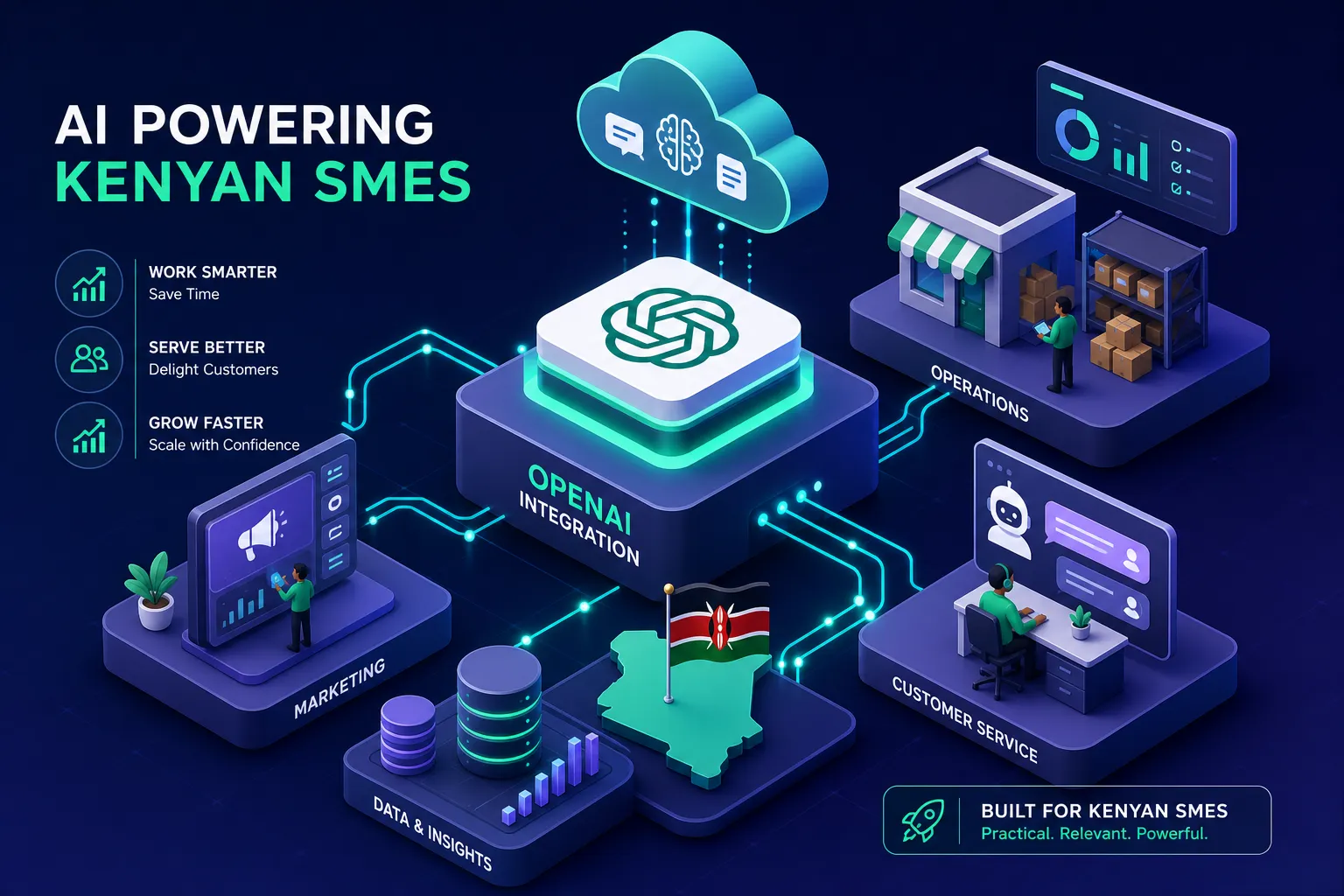
Many Kenyan small business owners are not short on curiosity about AI. They've heard the pitch, watched the demos, and probably dabbled with ChatGPT's free tier at some point. What they're short on is a clear, practical answer to one question: where do I actually start, and will it pay off? This guide covers exactly that, specifically, the OpenAI integration small business owners in Kenya can realistically implement this month. It covers the available OpenAI products, which ones suit a Kenyan SME's budget, the two use cases with the fastest return on investment, how a real integration works without jargon, and what compliance looks like under Kenya's Data Protection Act 2019.
Throughout this guide, you'll see references to integration patterns drawn from work that Alvine Otieno, a Kisumu-based developer, has built for Kenyan businesses in sectors including retail, hospitality, and professional services. These are anonymised, illustrative examples drawn from real deployments. The goal is to give you something grounded in what actually works locally, not what looks good in a Silicon Valley slide deck.
Why Kenyan SMEs are moving on OpenAI right now
There's a gap between knowing and doing, and right now that gap is costing businesses real money. Many SME owners have used ChatGPT personally to draft an email or summarise a document, but they haven't connected any AI capability into their actual business systems. That's the gap this guide is designed to help you close, because early adopters are already seeing measurable efficiency gains that are creating genuine competitive pressure.
The numbers are worth understanding in Kenyan business terms. A 2025 Salesforce SMB Trends report found that productivity gains for AI adopters in small businesses averaged 15 hours per month, roughly two full working days returned to your team every month. A separate Freshworks SMB survey found that 74% of small business AI adopters reported measurable efficiency boosts. These are not projections from a tech company's marketing team; they're aggregate outcomes from businesses that have actually deployed integrations. The results depend on how well the integration is designed, which is why setup matters as much as the tool itself.
OpenAI integration for small business: choosing the right product
The first decision point is straightforward: do you need a ready-to-use subscription, or do you need to embed AI into your own systems? Getting this wrong is the most common and most expensive mistake Kenyan SMEs make at the start.
ChatGPT Business and the Work tier explained
ChatGPT Business is the subscription route. No coding required, team accounts, enhanced privacy, and access to the latest models including GPT-5.6. Pricing is transparent: $20 per user per month on an annual plan, or $25 per user per month on a monthly basis, with a minimum of two users (see OpenAI's pricing page for current rates, as regional availability may vary). The ChatGPT Work tier, which launched in July 2026, adds higher effort-level settings and an ultra mode for complex or multi-step tasks. It's designed for teams who need the AI to handle genuinely demanding work rather than quick lookups. Both tiers are solid if what you need is to give your staff a capable AI assistant without building anything custom.
When the API route makes more sense for Kenyan SMEs
The API is a completely different product. You pay per token processed, not per seat, which makes it significantly more cost-effective for businesses with variable or low-volume needs. For a small business running 1,000 to 5,000 customer conversations per month, OpenAI API integration costs typically land between $40 and $100 using a cost-efficient model, based on average conversation lengths of roughly 500 tokens at Luna-tier pricing. The GPT-5.6 model family offers three tiers: Sol (the flagship), Terra (mid-range with competitive pricing), and Luna (the fastest and most affordable). Luna is the right starting point for most Kenyan SME pilots. The API is the correct choice when you want AI embedded inside a custom workflow, such as a WhatsApp bot, an automated invoice processor, or a report generator, rather than simply giving staff a chat interface to use manually.
The two use cases with the fastest ROI for Kenyan businesses
You don't need to automate everything at once. In fact, trying to do so is what causes most pilots to stall. The two OpenAI small business use cases below consistently deliver the fastest return on investment for Kenyan SMEs, and they apply across a range of sectors.
Customer service automation via WhatsApp, an OpenAI integration small business owners can deploy fast
Kenya has over 30 million WhatsApp users (Datareportal, 2025 Digital Kenya Report). For retail and hospitality SMEs, the highest-ROI use case is automating customer follow-ups, order confirmations, and inquiry responses directly on WhatsApp. Regional case studies from East African SME pilots show that automated WhatsApp follow-up sequences drive 20 to 40% more conversions from existing leads within 60 days, with a payback period under two months. Part of the reason these numbers hold up is that WhatsApp delivers 90 to 98% message open rates compared to roughly 20% for email (Statista, Global Messaging Benchmarks 2025). When a customer sends a query and gets an accurate, helpful reply in under a minute at 11pm on a Saturday, conversion rates move.
In practice, integrating OpenAI into small business workflows on WhatsApp works like this: a customer sends a message, the OpenAI API generates a contextually relevant reply, and that reply is delivered through the Meta WhatsApp Cloud API. Where a purchase is involved, M-Pesa payment confirmation can be woven in automatically via the Daraja API. This is the pattern used in production deployments by Alvine Otieno for Kenyan clients, combining the OpenAI API with n8n and the WhatsApp Cloud API into a single workflow that handles large volumes of events without manual intervention.
Invoice processing and document summarisation
For consultancies, law firms, and accounting practices, the fastest ROI comes from automating document-heavy work. A Nairobi consultancy processing over 200 invoices monthly documented savings of KES 140,000 per month after automating document processing, with net savings exceeding KES 100,000 after accounting for costs. Payback period was under three months. The integration pattern is straightforward: documents are fed into the OpenAI API, which extracts key fields, flags anomalies, and generates a structured summary, reducing reconciliation time from several hours to under 30 minutes.
One important threshold to note: this use case makes the most sense for businesses processing 100 or more invoices per month. Below that volume, the time savings are real but the financial ROI is slower. If you're at that volume and still reconciling invoices manually, this is the most direct path to cutting administrative cost without adding headcount.
What a real OpenAI integration looks like in practice
Many SME owners assume they need a large technical team to run an API integration. The architecture is simpler than it sounds, and understanding it in plain terms will help you make better decisions about build versus buy.
The three-layer architecture in plain language
Every OpenAI integration follows the same basic flow. A trigger, a customer message, a new invoice uploaded, a form submission, hits a middleware server. That server sends the relevant data to the OpenAI API, receives a processed response, and pushes it back into the business system, whether that's a CRM, a WhatsApp thread, or a Google Sheet. The middleware layer is where most of the business logic lives. It controls which data gets sent to OpenAI, how the prompt is structured, and what happens with the output. Two non-negotiable security basics apply here: API keys must be stored as environment variables, never hardcoded into the application, and the endpoint must run over HTTPS.
Where n8n fits for SMEs who want to avoid custom code
n8n is a visual workflow automation tool that can handle the middleware layer for most standard use cases without requiring custom code (see n8n's documentation for details on self-hosted versus managed deployment options). For a Kenyan SME that wants to connect an intake form to OpenAI and push the output to a WhatsApp thread or a spreadsheet, n8n can manage all three steps through a visual interface. The trade-off is real: n8n is faster to set up but has limits on complex logic. For high-volume or highly specific integrations, custom Node.js or Python webhooks offer more flexibility and reliability. Alvine Otieno uses n8n extensively in automation builds for Kenyan clients, which means the operational knowledge and ongoing support infrastructure are already in place for businesses that go that route.
Staying compliant with Kenya's Data Protection Act
Compliance tends to be the last thing SMEs think about when integrating AI, and the first thing that creates problems if it's ignored. Kenya's Data Protection Act 2019 has direct implications for any business sending customer data to OpenAI, and the requirements are specific enough to warrant their own checklist.
What the DPA 2019 requires before you send data to OpenAI
OpenAI is a US-based entity. Sending customer data to OpenAI constitutes an international data transfer under the DPA 2019, and Kenya has not issued an adequacy decision for the United States. This means your business must demonstrate to the Office of the Data Protection Commissioner (ODPC) that the receiving party provides appropriate safeguards, typically through contractual protections or technical security measures equivalent to Kenya's standards. SMEs must also obtain explicit, documented consent from customers specifically for AI processing and international transfer, not just a blanket mention buried in a privacy policy. Businesses handling personal data are required to register with the ODPC as data controllers or processors. For most digital SMEs, this is mandatory, not optional.
Five steps to take before going live
- Conduct a Data Protection Impact Assessment (DPIA) to identify what data flows through your OpenAI integration and what risks it creates for your customers.
- Enable OpenAI's zero data retention policy via your API account settings. This means OpenAI does not store your customer data after processing, which significantly reduces your exposure (see OpenAI's API data privacy documentation for eligibility conditions).
- Update your privacy policy to explicitly state that customer data may be processed by an AI system hosted outside Kenya, and that you have contractual safeguards in place.
- Create a one-page internal AI usage policy defining which data fields staff are permitted to include in AI prompts and which are off-limits, such as national ID numbers or detailed financial records.
- Appoint a data protection point of contact to handle breach notifications. The DPA 2019 requires reporting to the ODPC within 72 hours of any breach that poses risk to data subjects.
Your 30-day plan to pilot your first OpenAI integration
The businesses in Kenya seeing results from AI are not the ones that waited for the perfect moment or tried to automate everything simultaneously. They picked one use case, ran a focused pilot, measured carefully, and scaled what worked. Here's the week-by-week framework to do the same.
Week 1: Choose your product tier (ChatGPT Business or API) and define the single use case you will pilot, either WhatsApp customer service replies or invoice summarisation. Resist the urge to expand scope before the pilot is live.
Week 2: Run your DPIA, update your privacy policy, and register with the ODPC if you haven't already. Configure OpenAI's zero retention policy on your API account.
Week 3: Build or commission the integration. If you're using n8n, the core workflow can be live within days. If the use case requires a custom webhook or involves the WhatsApp Cloud API or M-Pesa, this is where a developer becomes essential rather than optional.
Week 4: Test with real data (anonymised where possible), measure against your baseline, and decide whether to scale or adjust. Track one specific metric: response time, conversion rate, or hours saved per week.
If your use case involves the WhatsApp Cloud API, M-Pesa, or any custom webhook logic, attempting to build without development experience will cost significantly more time than hiring someone who has already delivered it in production. Alvine Otieno has built OpenAI integrations for Kenyan SMEs across these exact scenarios, with live deployments serving clients in retail, hospitality, and professional services. His services cover the full stack: API integration, n8n automation, WhatsApp bot development, and ongoing system maintenance. For business owners who want to move from pilot to production without the trial-and-error, his services page is the practical next step.
The decision is simpler than it looks
OpenAI integration for small business owners in Kenya is no longer a future-state aspiration. The products are available, the ROI data is documented, and the compliance framework is manageable with the right preparation. The practical path forward is to pick one use case, size your budget against the right product tier, and run a focused 30-day pilot rather than attempting a wholesale digital transformation.
Kenyan businesses seeing results from OpenAI deployment right now started small, measured carefully, and scaled what worked. Whether you build it yourself or work with someone who has already mapped the terrain, the starting point is a single use case and a 30-day commitment, visit Alvine Otieno's services page to scope yours.
Software engineer writing about the craft of building products on the web.