SMS vs WhatsApp Marketing: What Actually Works in Kenya
Discover whether SMS or WhatsApp marketing is more effective for your business in Kenya. This in-depth comparison uses local data to analyze reach, engagement, and cost, helping you choose the best channel for your campaigns.
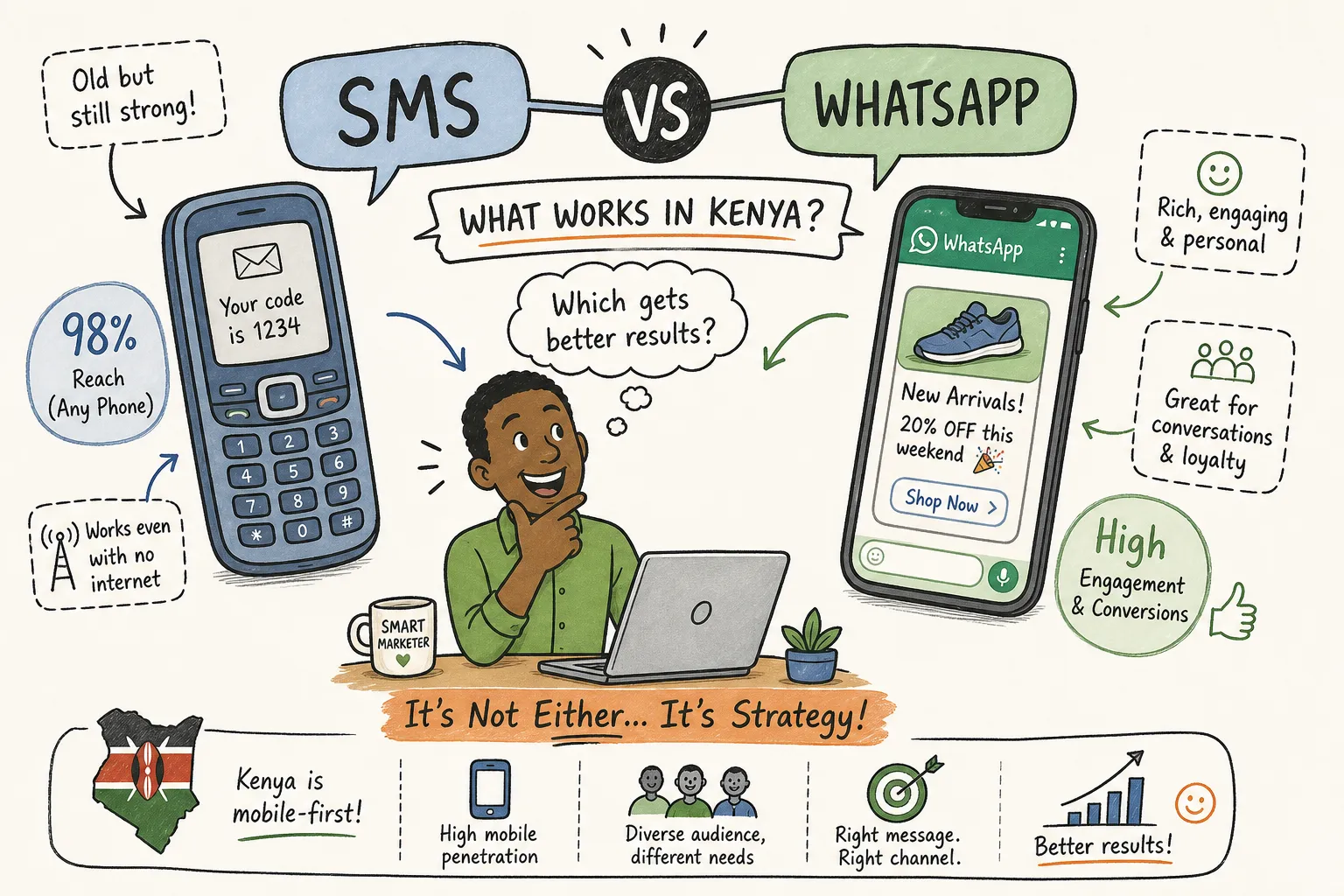
Most Kenyan businesses are running WhatsApp broadcasts from the standard app and blasting bulk SMS without a clear strategy for either. The result is two powerful channels producing mediocre results, not because the channels are weak, but because the wrong one keeps getting used for the wrong job. When weighing up SMS vs WhatsApp marketing for the Kenyan market specifically, the answer is rarely obvious: SMS reaches virtually every phone in the country, while WhatsApp is where actual conversations happen. Choosing between them without understanding the local context leads to wasted spend and missed conversions.
This comparison is built on real market data from Kenya, not global averages that rarely reflect local conditions. It also draws on the practitioner's perspective that comes from building WhatsApp systems that have processed over 50,000 events for businesses across multiple industries, the kind of hands-on experience that reveals how these channels behave differently under real campaign conditions, beyond what benchmarks alone can show.
Kenya's messaging landscape: why this comparison is different here
The Kenyan context changes this debate significantly. WhatsApp penetration among internet users sits at approximately 95 to 97%, placing Kenya among the highest adoption markets globally. At the same time, there are over 78 million active mobile subscriptions in the country, representing a penetration rate above 149%. Neither channel dominates cleanly. The decision comes down to who you are trying to reach and what you need them to do next.
WhatsApp's grip on connected Kenyans
As of early 2026, approximately 22 to 26 million Kenyans use WhatsApp actively, representing roughly 53.9% of the total population. Among internet users specifically, adoption is near-universal. For any business whose customers are online, WhatsApp is already running in the background of their day, every day. That makes it an unusually powerful engagement surface for businesses that know how to use it properly.
SMS and the reach no other channel can match
SMS works on every handset, in every county, with or without mobile data. An estimated 15% of mobile users in Kenya are still on feature phones that cannot access WhatsApp at all, and SMS quarterly traffic still runs at approximately 14 billion messages. Rural customers, older demographics, and low-income segments remain reliably reachable only through SMS. No other channel matches that.
SMS vs WhatsApp marketing: open rates and engagement in Kenya
Industry benchmarks widely cited by messaging platforms and aggregators put SMS open rates at 95 to 98%, with 90% of messages read within three to five minutes. WhatsApp open rates sit lower, at 75 to 85%. Taken at face value, SMS wins on that single metric. But the figure that actually determines campaign success is not the open rate, it is what happens after the message is opened.
Why SMS open rates don't tell the whole story
A 98% open rate sounds compelling until you look at what follows. The average SMS click-through rate in Kenya ranges from 18 to 35%, and once the recipient has read the message, the interaction is essentially over. There is no reply, no follow-up question, no product catalogue to browse. SMS is a one-way broadcast with a read receipt attached. For campaigns where the entire goal is delivery and awareness, that is sufficient. For campaigns that require any form of response, it is a fundamental limitation.
Where WhatsApp outperforms on actual engagement
WhatsApp's response rate runs five to ten times higher than SMS because the interface is inherently conversational. Customers can reply instantly, tap a button, ask for more information, or share a photo, all within the same thread. This interactivity places WhatsApp in a different category of communication entirely, rather than simply being a better version of SMS. For businesses running loyalty programmes, product enquiries, or post-purchase support, the reply rate is the metric that drives revenue, and WhatsApp owns that metric decisively.
Cost per message and what a real campaign costs in Kenya
Pricing on both channels is frequently misquoted because it depends heavily on volume and channel structure. Bulk SMS uses straightforward per-message pricing, while the WhatsApp Business API charges per conversation window, not per individual message. Understanding both models clearly changes how you evaluate campaign budgets and which channel delivers better value for a specific objective.
Bulk SMS pricing tiers from Kenyan aggregators
Major SMS aggregators operating in Kenya, including Africa's Talking, Celcom Africa, Mobitech, and Taifa Mobile, charge between KES 0.25 and KES 0.60 per message at typical SME volumes. At 10,000 messages, expect to pay KES 3,000 to 5,000. At 100,000 messages, costs drop to KES 25,000 to 40,000, with per-message rates falling to KES 0.25 to 0.40. Volume is where bulk SMS becomes exceptionally competitive for broad-reach campaigns with no interactivity requirement.
WhatsApp Business API pricing explained
Meta moved from conversation-based pricing to per-message pricing for marketing and utility templates in mid-2025. As of 2026, marketing messages cost approximately KES 5.20 per message delivered, utility messages such as order confirmations and appointment reminders cost around KES 0.80, and authentication messages sit at roughly KES 0.50. Service messages, replies within a 24-hour customer-initiated window, remain free. For a 10,000-recipient marketing campaign on WhatsApp, the per-contact cost is significantly higher than text message marketing via SMS, but weigh that against the higher conversion rates that often reduce the actual cost per sale for higher-value products.
What each channel does best: matching campaign type to channel
The most important insight in this SMS and WhatsApp marketing comparison is that the two channels are not competing for the same role. Treating them as interchangeable is what produces poor results. Each channel has a clear lane, and the businesses extracting the most value from messaging are the ones running both with distinct, deliberate purposes rather than defaulting to whichever is more familiar.
SMS use cases where it consistently wins
Broadcast alerts, payment reminders, appointment confirmations, two-factor authentication, and mass promotional sends to large, mixed audiences are SMS territory. No internet connection is required, no template approval is needed, and delivery is near-instant. For a flash sale sent to 50,000 contacts that includes a significant share of rural or feature-phone users, SMS is the only channel that guarantees universal reach. The message lands, gets read within minutes, and drives immediate action.
WhatsApp use cases where interactivity changes the outcome
Customer onboarding, order status updates with rich formatting, lead qualification, product catalogue sharing, and post-purchase follow-up all perform better on WhatsApp. The two-way capability transforms a broadcast into a conversation, and conversations convert better than one-way blasts for almost every high-consideration purchase. A property firm following up on enquiries, a health clinic handling patient questions, or an e-commerce business managing returns all belong on WhatsApp rather than SMS, because the customer journey requires dialogue, not just delivery.
The next level: automating WhatsApp at scale
For businesses that commit to WhatsApp as their primary engagement channel, the natural progression is automation. An AI-powered WhatsApp bot handles hundreds of simultaneous conversations, answering FAQs, qualifying leads, confirming orders, and routing complex queries, without adding headcount. Alvine Otieno builds exactly this kind of infrastructure: production-ready WhatsApp AI bots using the Meta WhatsApp Cloud API and OpenAI, deployed for businesses that need to handle thousands of interactions reliably. The difference between sending broadcasts and running a bot-powered WhatsApp system is the difference between a megaphone and a sales team.
Compliance you cannot skip: Kenya's legal requirements for both channels
A significant number of Kenyan businesses run bulk SMS and WhatsApp broadcast messages without realising both fall under the Data Protection Act 2019 and Communications Authority regulations. Ignorance is not a defence the ODPC accepts. The requirements are specific, and the penalties for non-compliance are serious.
What explicit consent actually looks like in practice
Consent cannot be assumed or inferred from a prior transaction. A customer who gave you their phone number to receive a delivery update has not consented to receive promotional messages. Consent must be specific, documented, and tied to a clearly stated purpose, whether collected through a web form checkbox, a USSD prompt, or a WhatsApp opt-in flow. Every promotional message on both channels must also include a functional opt-out mechanism, such as a "Reply STOP" instruction. The Communications Authority restricts promotional SMS to between 7:00 AM and 7:00 PM, and sender IDs must be pre-registered. WhatsApp adds its own layer: only Meta-approved templates may be used for outbound marketing, and purchased contact lists will result in a permanent ban on the business number.
The penalties for getting this wrong
The ODPC can fine businesses up to KES 5 million for sending unsolicited marketing messages, and that figure applies equally to SMS and WhatsApp campaigns. WhatsApp adds a compounding penalty: a permanent ban on the number used for sending. For any business that has invested in building a WhatsApp customer channel, losing that number destroys the asset entirely. Consent-first practices are not optional compliance overhead; they are business continuity requirements.
SMS vs WhatsApp marketing: how to choose for your next campaign
The decision framework becomes straightforward once you match campaign goal to channel capability. Consider the core trade-offs: SMS delivers maximum reach with no internet dependency, while WhatsApp drives engagement, conversation, and conversion from an online audience. Time-sensitive broadcast campaigns favour SMS; anything that requires a response or follow-up belongs on WhatsApp. That said, framing this purely as either/or misses the point, most Kenyan businesses benefit most from running both channels with clearly separated roles.
A quick decision framework for Kenyan marketers
Four common scenarios illustrate how the choice plays out in practice. A flash sale to 50,000 contacts across diverse demographics belongs on SMS: the priority is universal delivery, not dialogue. Customer support for an e-commerce business belongs on WhatsApp: buyers need to ask questions and resolve issues in real time. Appointment reminders for a clinic work well on SMS for initial delivery and WhatsApp for two-way confirmation and rescheduling. Lead qualification for a property firm belongs on WhatsApp: the conversion journey requires multiple exchanges, rich content, and a human-feeling interaction that SMS structurally cannot provide.
Implementation checklist before you send your first campaign
Both channels share five non-negotiable steps before any campaign goes live:
- Build a consent-verified contact list. Document when, how, and for what purpose each contact opted in.
- Register your sender ID or business number. Set up your sender ID with the Communications Authority, or configure your WhatsApp Business number with a verified BSP.
- Draft and approve your message templates. Include the mandatory opt-out instruction in every outbound message.
- Configure your suppression list. Ensure opted-out contacts are automatically excluded from all future sends.
- Test before the full send. Confirm delivery across Safaricom and Airtel on a sample group, checking formatting, delivery speed, and opt-out functionality.
Conclusion
SMS and WhatsApp are not competing for the same job. SMS is infrastructure: broad, reliable, and universal, reaching every mobile subscriber in Kenya regardless of handset or data access. WhatsApp is engagement: conversational, rich, and increasingly automated, built for the interactions that move customers through a decision journey. The SMS vs WhatsApp marketing debate, then, is not really a debate at all, for most Kenyan businesses, the answer is to deploy both deliberately, with each channel assigned to the role it is structurally built for.
As WhatsApp automation matures and more businesses deploy AI bots to handle conversations at scale, the performance gap between broadcast SMS and automated WhatsApp engagement will widen further. The businesses that build that infrastructure now will be significantly ahead. If you are ready to move beyond manual broadcasts and build a WhatsApp system that handles thousands of interactions reliably, Alvine Otieno is the right place to start.
Software engineer writing about the craft of building products on the web.