The self-hosted software benefits Kenyan businesses overlook
Discover how self-hosting software can save Kenyan businesses money, enhance data privacy, and provide greater control compared to SaaS, with a focus on local hosting options and cost breakdowns.
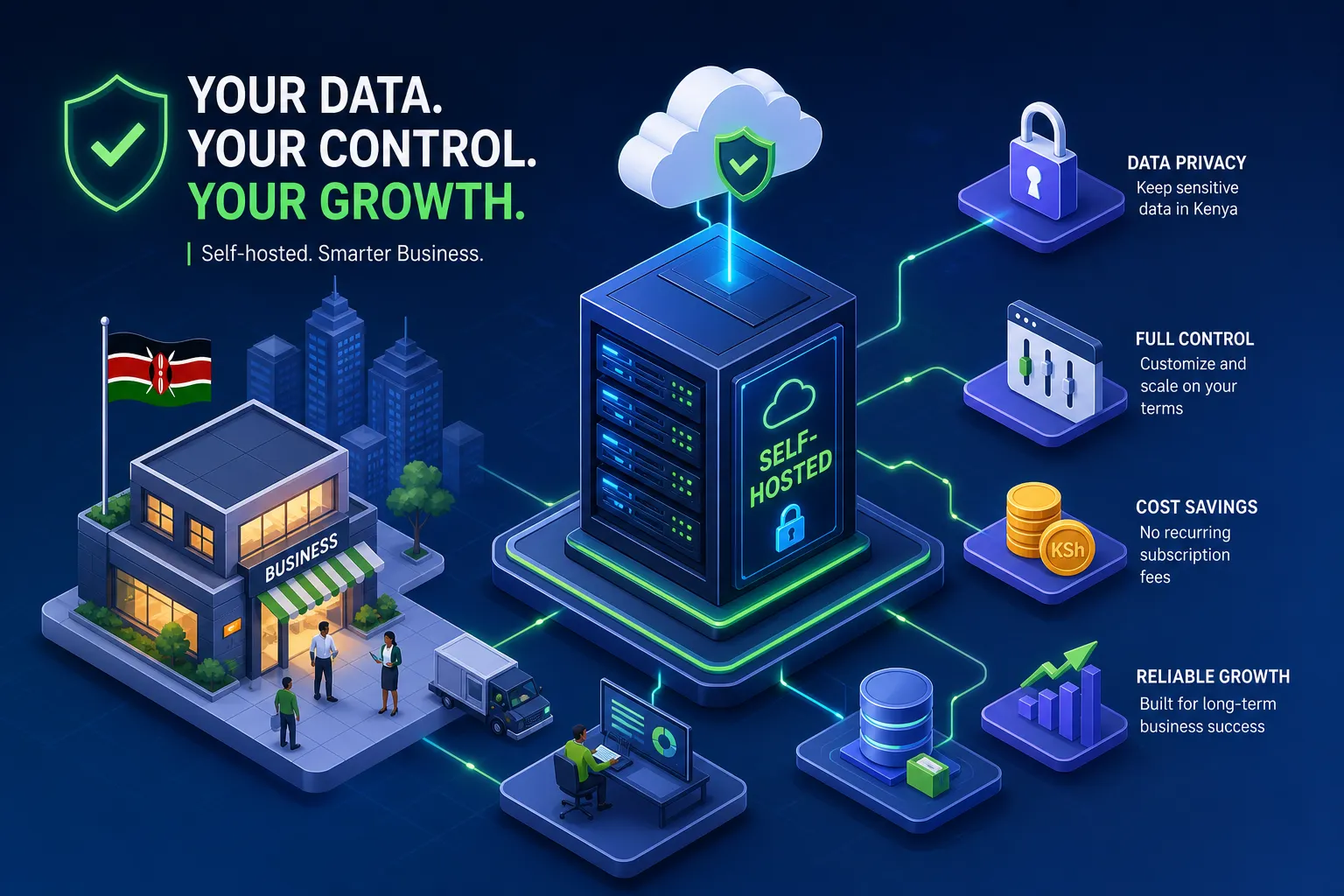
Picture this: you signed up for a SaaS automation tool eighteen months ago at $29 a month. It worked well enough. Then an email arrived last quarter announcing a "plan restructure," and your cost jumped to $49. You are now paying for three tiers of features your team will never use, and the vendor owns your data, your workflows, and your ability to stay operational. Many Kenyan small businesses report being caught off-guard by exactly this kind of plan restructure, and it is one of the clearest reasons the self hosted software benefits conversation is worth having.
Self-hosting means running software on your own server (a VPS or an on-premises machine) rather than renting access from a vendor. It is not about building software from scratch. It is about taking open-source tools that already exist, installing them on infrastructure you control, and running your business on a stack no vendor can arbitrarily reprice. More Kenyan businesses are making this move in 2026, especially with automation tools like n8n, and the financial and compliance case for doing so has never been stronger.
This article covers four of the most consequential self hosted software benefits: cost savings, data privacy, full control, and freedom from vendor dependency. It also covers the honest trade-offs, a shortlist of tools worth deploying, and what getting started in Kenya actually costs.
What self hosted software benefits actually mean for your business
The difference between SaaS and running your own stack
With SaaS, you pay a vendor monthly for access to software that runs on their servers. Your data sits in their database, and your configurations depend on their decisions. Self-hosting flips this arrangement entirely. You install the software on a server you control, and everything on it belongs to you.
The n8n workflow automation tool illustrates the self hosted software benefits clearly. The n8n Cloud Starter plan costs $24 per month and caps you at 2,500 workflow executions. The self-hosted Community Edition is free to run on a VPS that costs as little as KSh 800 per month from Truehost's Nairobi data centre, with no execution limits whatsoever. The core automation functionality is largely identical; the main differences are that managed cloud tiers add team-management features, hosted scaling, and vendor support, none of which most small businesses need in the early stages. The real difference is simply who owns the infrastructure it runs on.
Who self hosted software benefits most
This is not a developer-only conversation. Business owners who want predictable infrastructure costs and companies handling sensitive customer data are the clearest candidates. Developers building automations for clients also benefit significantly, since per-seat SaaS pricing eats directly into margins. The assumption that self-hosting requires deep technical expertise has stopped many Kenyan businesses from even exploring it. The reality is more nuanced: some tools take an experienced developer 15 minutes to deploy; others take longer. The question is whether the long-term advantages justify the upfront effort.
Self hosted software benefits: the cost case
Subscription fees compound; server costs do not
A mid-tier SaaS automation tool costs between $49 and $99 per month. SaaS pricing scales with your usage, more seats, more executions, more API calls, and you move to a higher tier. A VPS running the same tool self-hosted starts at KSh 800 per month on Truehost Kenya or KSh 1,100 per month on HostPinnacle, and that cost stays flat regardless of how many workflows you run or how many team members access it.
At an approximate exchange rate of KSh 130 per USD (verified against mid-2026 interbank rates), a $49/month SaaS subscription costs roughly KSh 76,400 over 12 months. A KSh 1,100/month VPS costs KSh 13,200 over the same period. The remaining KSh 63,000 either stays in the business or funds the one-time setup cost with significant change to spare.
Real Kenya hosting costs you should know before you start
Entry-level self-managed VPS hosting in Kenya runs from KSh 800 per month (Truehost: 1 vCPU, 1GB RAM, 25GB SSD) to KSh 1,100 per month (HostPinnacle: 4 cores, 6GB RAM, 100GB SSD). Mid-range plans with better performance or managed support land between KSh 3,000 and KSh 6,000 per month. Many providers include generous bandwidth allowances, so data transfer is rarely a separate line item, though it is worth confirming this against the specific plan you choose.
The honest caveat: upfront setup costs exist, particularly if you bring in a developer to configure the initial deployment. For most tools, the break-even point against SaaS subscription costs is often under six months depending on usage and the tool in question, though running your own numbers for your specific situation is always the right starting point.
Data privacy, self hosted software benefits for Kenyan firms
Where your data goes when you use foreign SaaS platforms
Most popular SaaS tools run on US or EU cloud infrastructure. When a Kenyan business stores customer data on these platforms, that data sits in a foreign legal jurisdiction. Foreign courts can compel disclosure without your knowledge, and your visibility into exactly where your data resides is limited to whatever the vendor's terms of service states. Under Kenya's Data Protection Act 2019, transferring personal data outside Kenya requires proof of appropriate safeguards to the Office of the Data Protection Commissioner (ODPC). The burden of proof rests with you as the data controller, not the vendor.
How self-hosting keeps you on the right side of DPA 2019
Self-hosting on a Kenya-based VPS means your data physically stays in Kenya. There are no cross-border transfers to document, no Standard Contractual Clauses to negotiate, and no adequacy determinations to verify. Regulators can audit your own servers directly. This is not a theoretical compliance benefit. In 2024, Absa Bank Kenya was fined KES 1.5 billion for data protection violations, the largest such penalty in East Africa at the time. For businesses in finance, healthcare, education, or any sector handling sensitive personal data, local data residency is a compliance requirement, not a preference. Banking, telecommunications, and public sector organisations face the strictest localisation rules under DPA 2019 and CBK regulations, but the obligations apply to all data controllers regardless of size or sector.
Full control, deep customisation, and no vendor lock-in
Owning your stack means the rules do not change on you
When a SaaS vendor changes pricing, deprecates a feature, or shuts down entirely, your workflows break and your team scrambles. Self-hosting significantly reduces that risk, though it is worth noting it introduces a different set of operational responsibilities, covered in the trade-offs section below. You run the software version you choose, upgrade on your own schedule, and configure the system to match your exact operational requirements. For automation infrastructure in particular, this matters: a self-hosted n8n instance supports custom nodes, local volume mounts, and direct database connections. Some of these capabilities are unavailable or restricted on the cloud version, refer to n8n's features comparison documentation for the current breakdown, as the distinction evolves with each release.
What "no vendor lock-in" actually looks like in practice
Your data lives in a format you control, on a server you own. If you decide to change tools, move to a different provider, or restructure your automation stack entirely, you take everything with you, no export request, no waiting on vendor support, no risk of data being held hostage during a contract dispute. Many business owners only fully appreciate this self hosted software benefit after going through a forced SaaS migration. Build your operational stack on tools you own, not tools you rent month to month.
Self-hosted tools worth knowing about in 2026
n8n: the most practical starting point for automation
n8n is an open-source workflow automation tool comparable to Zapier or Make, but fully self-hostable on any standard VPS. It connects apps, automates repetitive tasks, and integrates with WhatsApp Business APIs, databases, and payment systems including M-Pesa (via HTTP Request nodes or community-built connectors, check n8n's integrations directory for current M-Pesa support options). The self-hosted Community Edition is free and handles far higher execution volumes than most small businesses will ever generate. Deployment is Docker-based, well-documented, and takes an experienced Linux developer roughly 15 to 30 minutes for a basic working instance. For Kenyan businesses evaluating automation infrastructure, self-hosted n8n is the most cost-effective entry point available.
Other tools that are worth self-hosting
- Nextcloud: file sync and team collaboration as a Google Drive alternative; medium deployment complexity with Docker support
- Vaultwarden: password management fully compatible with the Bitwarden client; single Docker container, straightforward setup
- Plausible Analytics: privacy-first website analytics replacing Google Analytics; single-container Docker deployment, lightweight
- Matomo: more feature-rich analytics with deeper configuration options; medium complexity, PHP and MySQL required
Each of these tools has a free, self-hosted version that directly replaces a recurring SaaS subscription. As a worked example: a mid-range VPS at KSh 2,500 per month (such as a 2 vCPU, 4GB RAM plan from Truehost or HostPinnacle) can comfortably run n8n, Nextcloud, Vaultwarden, and Plausible Analytics simultaneously, replacing four separate monthly subscriptions for less than KSh 3,000 per month in total infrastructure costs. The exact figure will vary with your chosen provider and plan, but the order of magnitude holds for most lightweight deployments.
The honest trade-offs and when to bring in a specialist
Self-hosting has real operational overhead
The self hosted software benefits are genuine, but so are the demands. You are responsible for server security, software updates, uptime monitoring, and backup management. For someone managing everything independently, this typically runs 2 to 5 hours per week once the initial setup is stable, this is not a one-time cost, and ongoing security patching in particular should be treated as non-negotiable. If your server goes down and you have no one to call, your automation workflows go with it. Businesses in regulated sectors need to treat server security with particular seriousness: misconfigured firewall rules and missed patches create real attack surfaces.
When working with a specialist makes more sense
For businesses that want the cost and control benefits of self-hosting without carrying the operational burden internally, the practical move is to work with a developer who has configured this infrastructure before. A correctly set-up self-hosted instance typically requires minimal ongoing intervention once the foundation is solid, though routine maintenance and monitoring remain necessary throughout its life. I work with Kenyan businesses to deploy and maintain self-hosted automation infrastructure, including n8n, as part of my workflow automation services. The technical configuration is handled so the business captures the cost savings, data privacy, and control advantages without the headaches that come from a misconfigured first deployment.
Is self-hosting right for your organisation?
The self hosted software benefits are most significant for businesses that care about predictable costs, data privacy, and long-term control over their tools. For Kenyan businesses specifically, the DPA 2019 compliance angle and the CBK enforcement track record add urgency to a conversation that is often framed purely as a cost comparison. The trade-offs are real but manageable, especially when the initial setup is handled by someone who has deployed this infrastructure before.
Start with the numbers. If you are evaluating n8n for workflow automation, compare the SaaS subscription cost against a KSh 1,100 per month VPS from HostPinnacle. Run the 12-month calculation. Include the one-time setup cost. The break-even point is often well under six months, and after that the savings compound quietly in the background while your competitors keep paying monthly for capabilities you now own outright.
The self hosted software benefits outlined here are operational and financial wins that accumulate over time: lower costs, cleaner compliance, and a stack no vendor can reprice out from under you. If you are ready to explore what this looks like for your specific tools and workflows, get in touch. The setup is simpler than most people expect, and the returns start immediately.
FAQ: Are self hosted software benefits worth the effort?
Is self-hosting secure?
Yes, when configured correctly. The responsibility for security shifts from the vendor to you, which means keeping software updated, hardening firewall rules, and monitoring for unusual activity. Many businesses find that working with a specialist for the initial deployment significantly reduces ongoing security risk.
Do I need a dedicated server, or will a VPS work?
A VPS is sufficient for the vast majority of small and medium-sized business workloads. The KSh 800 to KSh 1,100 per month entry-level options from Truehost and HostPinnacle are adequate starting points for tools like n8n, Vaultwarden, and Plausible Analytics.
What happens if my self-hosted server goes down?
Your hosted services go offline until the issue is resolved. This is the core operational trade-off compared to managed SaaS. Mitigation options include automated monitoring alerts, regular off-site backups, and working with a managed hosting provider or consultant who can respond to incidents on your behalf.
Is self-hosting legal under Kenya's Data Protection Act 2019?
Not only is it legal, for businesses processing sensitive personal data, hosting on Kenyan infrastructure is often the most straightforward path to DPA 2019 compliance. Local data residency removes the complexity of cross-border transfer documentation entirely.
Software engineer writing about the craft of building products on the web.