Top WhatsApp Support Automation Tools for Kenyan Businesses
Discover the best WhatsApp support automation tools for Kenyan businesses in 2026. This guide compares Respond.io, Tidio, n8n, and WATI, focusing on M-Pesa compatibility, Meta API access, and cost for the Kenyan market.
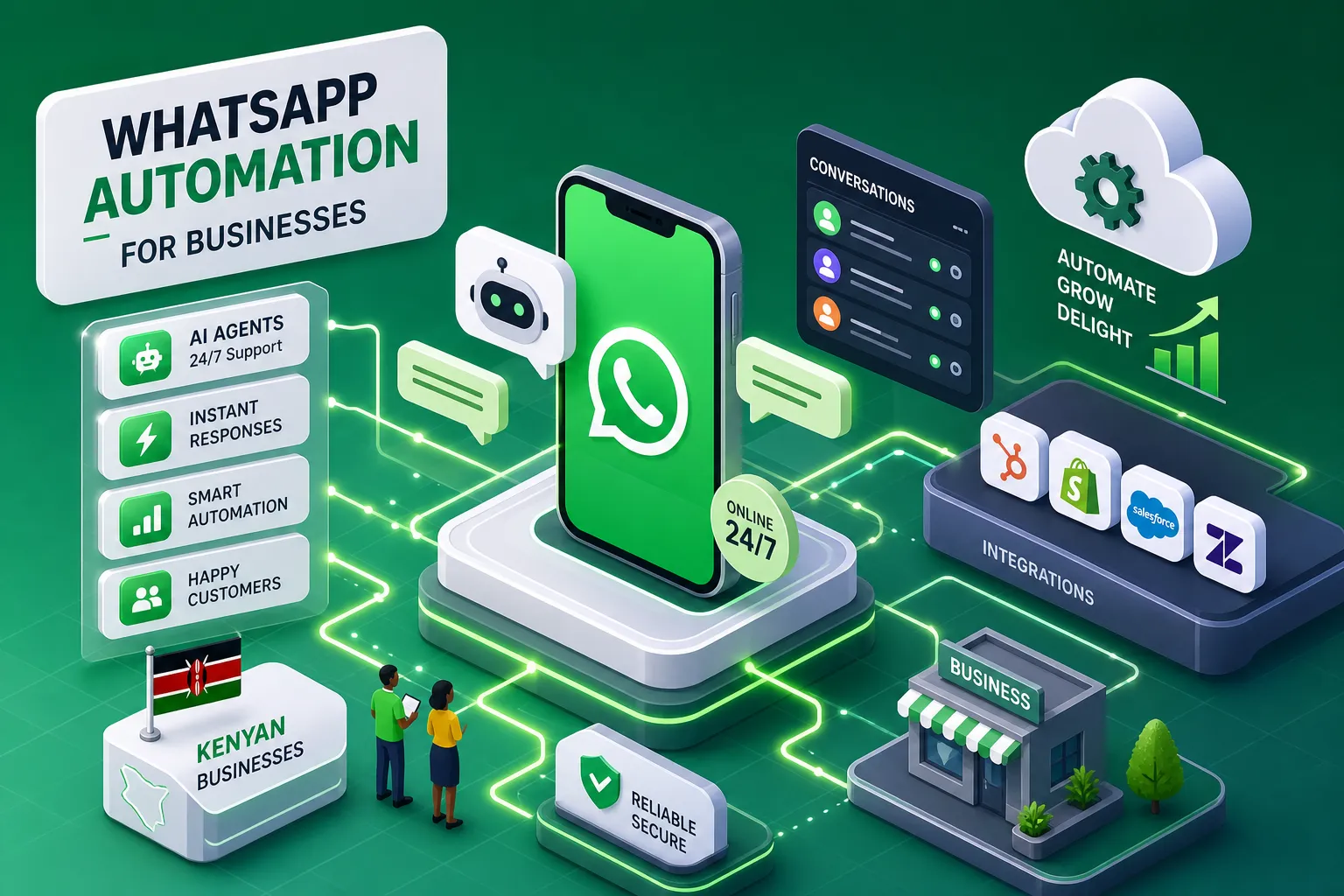
If you are asking what is the best tool to automate customer support on WhatsApp in Kenya, you are asking the right question, but most comparison articles will give you the wrong answer. They rank tools on features, interface, and integrations without accounting for M-Pesa, Safaricom's Daraja API, or the real cost of USD billing on a Kenyan SME budget. This guide compares the top WhatsApp support automation tools available in 2026 from a builder's perspective, not a reviewer's.
Most Kenyan businesses are still running WhatsApp customer support manually. Someone checks the phone, reads the message, types a reply, and moves on to the next one. Multiply that by 80 messages a day and you have a full-time job that produces no revenue. Meanwhile, businesses elsewhere have bots handling thousands of conversations, confirming payments, routing queries, and updating records without a human touching a single message.
The real question is not whether to automate WhatsApp support. It is which tool actually works in Kenya, where M-Pesa is the dominant payment method, Meta Business API access requires jumping through specific hoops, and monthly fees billed in USD quietly eat into margins. Having built WhatsApp bots that have processed over 50,000 events for live businesses, the evaluation below comes from direct build experience.
This article covers Respond.io, Tidio, n8n, and WATI, assessed on M-Pesa compatibility, Meta API access, cost structure, and how well each fits Kenyan business realities. By the end, you will have a clear shortlist and know exactly what your next step looks like.
What actually matters when picking a WhatsApp automation tool in Kenya
Global software review sites rank WhatsApp automation tools on features, UI, and integrations. Those criteria matter, but they miss three things that will make or break your decision as a Kenyan business owner. Understanding these filters before the comparison saves you from signing up for a platform that looks impressive and then discovering its limitations after the first payment cycle.
M-Pesa compatibility is non-negotiable
Most global WhatsApp automation platforms have zero native connection to Safaricom's Daraja API. For a business where customers pay via M-Pesa, this creates a critical gap in the support flow: the bot can answer FAQs and collect order details, but the moment a payment is involved, a human must manually check the M-Pesa statement, confirm the transaction, and then resume the conversation. That is not automation, that is just a fancier version of the same manual process.
Genuine M-Pesa integration means the system sends an STK Push to the customer's phone, receives a callback from Safaricom confirming the payment result, and automatically triggers the next step in the conversation. No human required. Very few WhatsApp support platforms offer this natively, and those that do not will require custom development to close the gap.
Meta Business API access and what it requires
Any serious WhatsApp customer support automation at volume requires the WhatsApp Cloud API, which means going through a Meta Business Solution Provider (BSP). Kenyan businesses cannot apply directly to Meta. You need to work through an approved BSP, and the registration process requires your Certificate of Incorporation or BRS certificate, and in some cases your KRA PIN. This is not a quick afternoon task, especially if your Facebook Business Manager account is not yet verified.
BSP selection also affects your long-term cost and control. Some BSPs bundle their subscription with Meta's API fees; others pass them through transparently. As of 2026, Meta bills per delivered template message: marketing messages cost around $0.0225, utility messages $0.0040, and authentication messages $0.0080. Service messages (customer-initiated replies) remain free. Choose a BSP that makes this billing visible, not one that obscures it inside a bundled monthly fee.
Cost structure: subscriptions, per-message fees, and USD billing
Paying in USD with a credit card is a genuine barrier for many Kenyan SMEs. A platform priced at $79 per month is not KES 10,000 one month and KES 10,000 the next. Exchange rate movement adds unpredictability to an already tight budget. Factor in the Meta per-message fees on top of your platform subscription and the total monthly cost is rarely what the pricing page suggests. Build a realistic estimate before committing to any platform.
What is the best tool to automate customer support on WhatsApp in Kenya? Platform-by-platform comparison
Each of these WhatsApp Business API providers occupies a different position in the market. None of them is the right answer for every Kenyan business, and each has at least one significant limitation in the local context. Here is an honest assessment of each.
Respond.io: powerful inbox, global pricing
Respond.io starts at $79 per month on annual billing and gives teams a solid omnichannel inbox combining WhatsApp, Messenger, and email in one place. Conversation routing, CRM connectors for Zoho and HubSpot, and a clean team interface make it genuinely useful for mid-size businesses managing high message volumes. The platform is a certified Meta BSP, so API access is straightforward once your business documentation is in order.
The gaps for Kenyan businesses are predictable: no native M-Pesa integration, USD billing, and no local support structure. If your business already handles payments through a separate system and just needs a well-built support inbox, Respond.io is a capable contender. If M-Pesa is central to your transaction flow, you will need a developer to build the bridge between Respond.io's webhooks and Safaricom's Daraja API.
Tidio: easy to start, shallow on WhatsApp
Tidio is marketed as a no-code chatbot builder with an approachable interface, and it delivers on that promise for website live chat. The problem is that its WhatsApp capabilities are considerably thinner than its website widget offering. For a business whose primary communication channel is WhatsApp, Tidio is an awkward fit. It is better described as a website chat tool that also supports WhatsApp, not the other way around. If your support strategy is WhatsApp-first, Tidio should not be at the top of your shortlist.
n8n: the automation backbone that needs a builder
n8n is not a WhatsApp platform. It is a workflow automation engine that connects to the WhatsApp Cloud API via webhooks and HTTP nodes, and it is exceptionally capable when configured correctly. The WhatsApp Business Cloud Trigger node handles Meta's verification handshake automatically, and from there you can build workflows that receive messages, process them with OpenAI, query a database, trigger an M-Pesa STK Push via Daraja API, and send a reply, all in one automated sequence.
For Kenyan businesses, n8n's core advantage is cost. It is self-hostable on a cloud VM, which eliminates the platform subscription entirely. You pay for your server and Meta's API fees, nothing more. The trade-off is that someone needs to build and maintain the workflows. For businesses with a developer on the team, or working with a consultant to set it up, n8n is one of the most cost-effective and capable backends available for WhatsApp customer support automation in this market.
WATI: the quickest WhatsApp-specific setup
WATI starts at $39 per month on annual billing (Growth plan) and is purpose-built for WhatsApp. The interface is clean, the chatbot builder requires no coding, broadcast messaging works well, and setup time is meaningfully shorter than most alternatives. It is a certified Meta BSP, making it one of the more accessible WhatsApp chatbot providers for Kenyan businesses that need to move quickly without deep technical resources.
M-Pesa integration is not native. You can configure M-Pesa callbacks via webhooks with development support, but it requires someone who knows the Daraja API. WATI also charges separately for extra users beyond the plan allowance, and the per-user cost adds up quickly once your team grows beyond five people. Start with WATI if you need to move fast; plan for a more capable system as your volumes increase.
The M-Pesa gap most global platforms quietly ignore
This is the most Kenya-specific issue in the entire comparison, and it is consistently underplayed in global software reviews that have no reason to care about it. For many Kenyan businesses, M-Pesa is not a payment option. It is the payment option. Any WhatsApp support platform that cannot handle it completely is an incomplete solution.
What "no native M-Pesa support" means in practice
When your WhatsApp bot has no M-Pesa integration, the automated flow works until the moment money needs to change hands. The bot collects the order, quotes the price, and then stalls. A human must check the M-Pesa transaction record, confirm the payment arrived, and manually resume the conversation. For a business processing thirty or forty payments per day, this is precisely the kind of manual bottleneck that automation was supposed to eliminate. You have spent money on a platform and still have the same problem.
How real M-Pesa plus WhatsApp automation works
The Safaricom Daraja API enables STK Push, which sends a payment prompt directly to the customer's phone. The customer enters their M-Pesa PIN, and Safaricom sends a callback to your server confirming whether the payment succeeded. When this callback is connected to your WhatsApp bot, the conversation progresses automatically: an order confirmation goes out, a fulfilment action triggers, a CRM record updates. The customer experiences a seamless transaction without switching apps or waiting for a human to verify anything.
This WhatsApp M-Pesa integration is not something any major global platform offers natively. It requires custom integration with the Daraja API. Most global platforms have not built it, because their primary markets do not use M-Pesa. For Kenyan businesses, this gap is the single most important factor in choosing between an off-the-shelf tool and a custom-built solution.
When a custom WhatsApp AI bot is the smarter investment
Off-the-shelf platforms are not wrong choices. They are right for certain businesses at certain stages. But for businesses with specific local requirements, M-Pesa payment flows, AI-powered replies, CRM logging, and workflow triggers all working together, no single global platform currently delivers all of this in one production-ready system configured for Kenya.
Businesses using Respond.io still need a separate payment integration. Businesses using WATI still need a developer if they want M-Pesa webhooks or OpenAI-generated replies. The result is multiple vendors, multiple subscriptions, multiple points of failure, and a fragile stack that no single provider takes full responsibility for. The total cost of these combined subscriptions frequently exceeds the one-time cost of a custom build.
A custom-built WhatsApp AI bot using Meta's Cloud API, OpenAI, n8n, and Safaricom's Daraja API can handle the entire flow in one system: AI-generated replies to customer queries, automatic M-Pesa payment confirmation via STK Push, conversation logging to a CRM, and backend workflow triggers. This is not theoretical. At Alvine Otieno, bots built on exactly this architecture have handled over 50,000 events for live businesses. There are no recurring platform fees, no USD billing surprises, and no feature ceilings imposed by a vendor whose roadmap has nothing to do with your business needs.
How to match the right tool to your business size and workflow
The worst outcome after reading a comparison like this is decision paralysis. Here is a direct framework for matching the right tool to where your business actually is.
Solo operators and small teams with simple needs
If you are running a micro-business or early-stage SME with fewer than 50 conversations per day, WATI gives you a usable inbox and basic automation without a large upfront investment. Pair it with manual M-Pesa confirmation for now and treat it as a starting point. It is not a permanent architecture, but it gets you moving without requiring a developer or a significant budget commitment.
Growing businesses with specific local workflows
If your business processes M-Pesa payments through WhatsApp, handles high message volumes, or needs your bot to integrate with a CRM, inventory system, or booking platform, a custom-built solution is the more cost-effective choice over the long term. The maths on stitching together multiple SaaS tools, each with its own subscription, limitations, and integration gaps, often works out in favour of a single custom build that does exactly what your business requires. The conversation to have is not "can I afford a custom bot?" but "can I afford to keep stitching tools together indefinitely?"
Finding the right fit: what is the best tool to automate customer support on WhatsApp in Kenya?
To summarise the comparison: Respond.io suits established teams managing high volumes across multiple channels who have payment flows handled elsewhere. Tidio is better suited to website-first businesses than WhatsApp-first ones. n8n is the most powerful and cost-effective backend for anyone who can build or hire someone to build the workflows. WATI is the most practical quick start for WhatsApp-specific SMBs who need to move fast without custom development.
If you are still weighing what is the best tool to automate customer support on WhatsApp in Kenya, use this framework: start with WATI if simplicity and speed matter most, consider Respond.io if you run a multi-channel team, explore n8n if you want maximum control at minimum cost, and commission a custom build if M-Pesa integration, AI-powered replies, and WhatsApp CRM integration all need to work seamlessly in a single system.
For businesses that need M-Pesa integration, AI-powered replies, and a system that scales without adding manual steps or new vendor subscriptions, a custom WhatsApp AI bot remains the most complete option available in Kenya. The platforms reviewed here are tools. A custom-built system is infrastructure.
If you are ready to move beyond patchwork tools and build something that actually fits your business, the next step is a conversation about what a production-ready WhatsApp bot would look like for your specific workflow. Reach out to Alvine Otieno and let us map it out.
Software engineer writing about the craft of building products on the web.