Vibe coding explained: build software faster with AI help
Discover vibe coding, an AI-driven approach to software development. Learn how businesses and freelancers in Kenya and globally use plain language to create apps, bots, and automation workflows rapidly, without extensive coding knowledge.
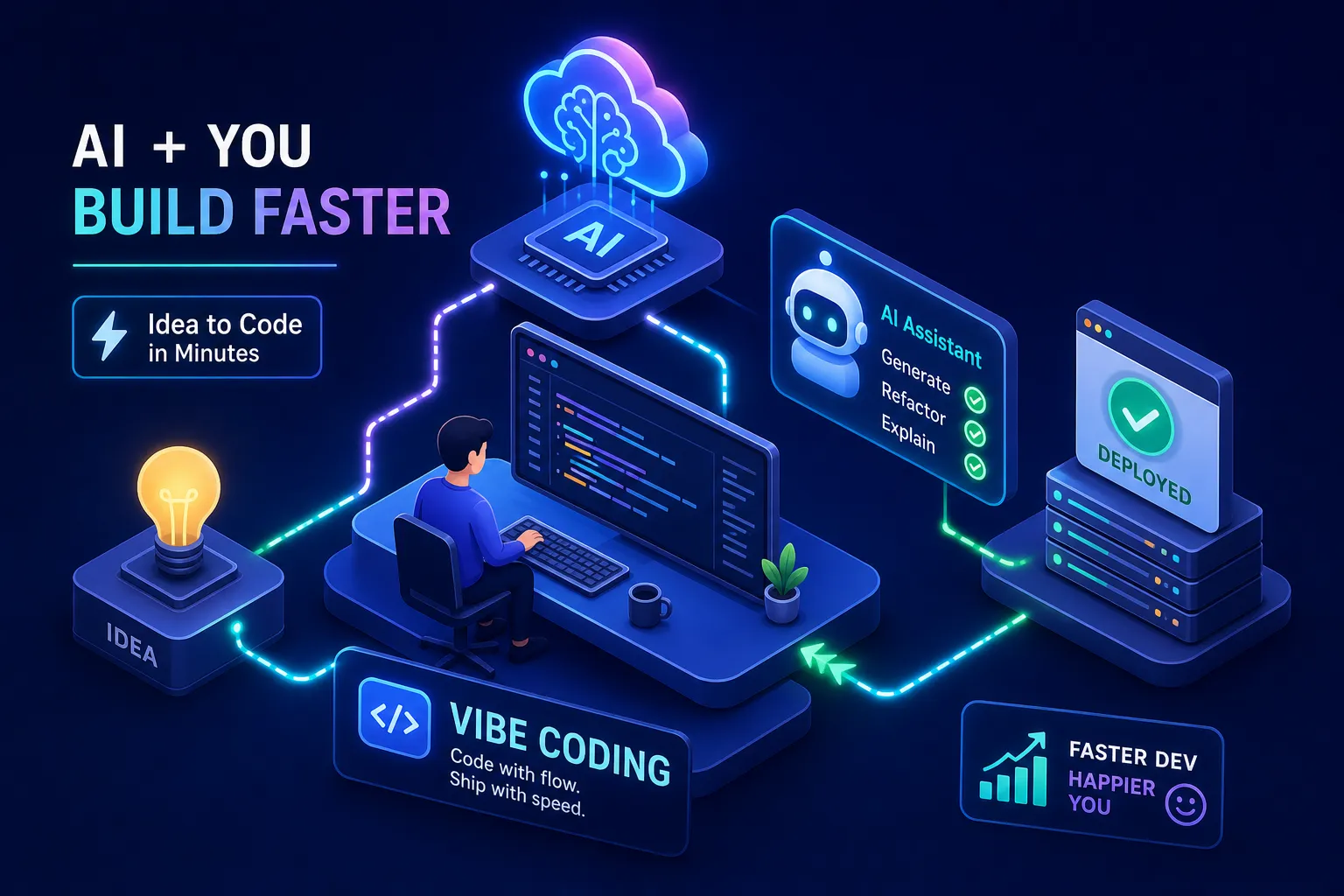
A business owner in Nairobi sits down, types out what she wants, and three days later a WhatsApp bot is live, answering customer queries, confirming orders, and sending M-Pesa payment prompts. No computer science degree. No months buried in YouTube tutorials. No developer on payroll. So what is vibe coding, and how can it help you build software faster? In short, it turns a plain-language description of a problem into working software, and it is gaining traction among freelancers, small businesses, and solo founders across Kenya and the rest of the world.
Vibe coding is a way of building software by describing what you want in plain language, letting an AI model generate the code, reviewing the output, and shipping faster than any traditional development cycle allows. The term was coined by Andrej Karpathy, a co-founder of OpenAI, in early 2025. His framing was direct: describe your intent to a large language model, accept what it generates, test the result, and iterate, without necessarily understanding every line the AI writes. He called it "fully giving in to the vibes."
This is not a theoretical concept. Alvine Otieno, a Kisumu-based freelance developer, has used this approach to ship five live products, including a WhatsApp bot that has processed over 50,000 real events for an active business. This article covers what vibe coding is, what you can realistically build with it, how the workflow runs, which tools to use, the risks you need to manage, and how to decide whether to do it yourself or hand it to someone who has already built that knowledge.
What vibe coding actually means
Vibe coding is not simply using GitHub Copilot to autocomplete a function. That distinction matters. Traditional AI code generation is a precision tool: you direct it to write a specific function, you review it line by line, and you integrate it into code you already understand. Vibe coding is a different mindset entirely. You hand over the architectural decisions, trust the AI to assemble the pieces, and verify that the outcome works rather than auditing how it was built.
Prompt engineering is one component of vibe coding, but not the whole picture. Prompting is about optimising your inputs to get better AI outputs. Vibe coding describes an entire workflow: from problem definition through generation, review, iteration, and deployment. Think of prompting as the steering wheel and vibe coding as the full journey.
For most people building businesses in Kenya, this distinction is what makes vibe coding genuinely useful. Most business owners understand the problem they want to solve. They know their customers need faster responses, their staff waste hours on manual data entry, or their payment process loses people at checkout. What they lack is the syntax. Vibe coding closes that gap. It turns a business requirement into a working prototype without requiring six months of learning JavaScript first.
What you can realistically build without being a traditional developer
The most immediately useful application in the Kenyan context is a WhatsApp AI bot that handles real business volume. Consider a Kenyan event organiser who needs a bot that registers attendees, answers FAQs, sends reminders, and confirms M-Pesa payments. You describe the user flow to an AI tool: what happens when someone messages the bot, what questions it should answer, what integrations it needs. The AI generates the structure. You review and refine. Alvine Otieno built exactly this class of product using a prompt-driven, AI-assisted approach, and the production system has handled over 50,000 events for an active business. This category of product is achievable using vibe coding when paired with disciplined human review.
Automation workflows are another strong fit. A workflow that connects a form submission to a CRM entry, a WhatsApp notification, and a follow-up email can be described in plain language to a tool like n8n and assembled largely without writing code. A clinic in Mombasa automating appointment confirmations and rescheduling requests via WhatsApp is a realistic output, not an ambitious stretch goal. The AI handles the configuration logic; you handle the review and testing.
Web applications also fall within reach. A booking system, a product catalogue, a membership portal: these can be generated from a clear description. AI tools produce working React and Next.js components from plain-language briefs. The developer's role shifts from writing to reviewing and guiding. That shift is exactly what makes vibe coding accessible to people who are not traditional software engineers, while still requiring someone with enough technical judgement to validate what ships.
How vibe coding helps you build software faster: the workflow, step by step
The core loop is: describe, generate, review, ship, iterate. Everything after that is a refinement of the same sequence, applied with more discipline as your projects grow in complexity.
Write a clear brief before you prompt
Start with a problem description, not a feature list. The quality of what the AI builds depends almost entirely on how clearly you define the problem. The difference between a vague prompt ("build me an app") and a structured brief, user persona, core user flow, key integrations, definition of success, is the difference between a confused output and a usable prototype. Before asking the AI to build anything, use it to help you write a simple Product Requirements Document. Describe who the user is, what they need to do, and what a successful outcome looks like. That document becomes your shared reference for every subsequent prompt.
Review and secure AI output before it ships
Review everything the AI generates, every time. This is the non-negotiable step that separates useful vibe coding from a security liability. AI-generated code frequently contains injection vulnerabilities, hardcoded credentials, and broken authentication logic. Treat AI output like a pull request from a junior developer: read it, question it, and test it before it goes near production. Published security audits of AI-generated code indicate that including a security instruction such as "follow best practices for secure code" in your prompts can reduce vulnerabilities by roughly half, though it does not remove the need to review output carefully. The developer's role is not to write code; it is to take responsibility for what ships.
Iterate in small, complete slices. Build one end-to-end feature fully, from the user interface through to the database, before moving to the next. This vertical slice method prevents the common problem of half-finished features stacked on each other. Each slice gets reviewed, tested in a preview environment, and only merged to production once it works cleanly. Case studies of teams using this approach report meaningful development cycle reductions compared with building layer by layer.
Tools that make vibe coding work in 2026
If you are completely new to this, three tools remove the setup friction entirely and give you a working starting point without touching a terminal:
- Replit, browser-based, deploys from the same interface you build in, and its Replit Agent can plan and build a full-stack app from a prompt or a screenshot.
- Bolt.new, handles rapid full-stack prototyping with Figma and Supabase integrations and requires no local installation.
- Lovable, design-first and forgiving for non-coders; you can point at a specific part of a UI and ask for changes in plain language.
For anyone who has already shipped a few prototypes and wants to build at a higher level of sophistication, the tool set shifts. Cursor is a strong choice: it understands your entire codebase rather than just the file you are working on, which matters enormously as projects grow. v0 by Vercel is purpose-built for generating React and Next.js UI components quickly. Claude Code handles complex reasoning tasks where pattern-based generation falls short. These tools suit someone who has a foundation and wants to build production-grade systems rather than prototypes.
The risks of vibe-generated code and how to handle them
Security audits and academic research consistently report that a significant proportion of AI-generated code, estimates range from 40 to 62 per cent across reviewed datasets, contains security vulnerabilities. Common failures include SQL injection from unsanitised inputs, authentication checks implemented on the client side (easily bypassed), API keys hardcoded directly into source files, and imports of libraries that do not exist. Studies comparing AI-generated and human-written code have also found that logic errors appear considerably more often in AI output. These figures are not an argument against vibe coding. They are an argument for always reviewing the output.
The mitigations are straightforward once you know them:
- Run automated security scans (SAST tools) on every pull request before merging to production.
- Store all credentials in environment variables, never in prompts or code files.
- Use Git to create checkpoints so you can roll back if something breaks.
- Validate every library the AI introduces before it goes into your project; a notable share of AI-generated code attempts to import packages that do not exist, some researchers put this figure at around 20 per cent.
The discipline is what makes vibe coding production-ready. Without it, you have a fast way to build fragile software. With it, you have a genuine competitive advantage: faster delivery, lower cost, and quality that holds up under real user load.
When to bring in someone who has already done the learning
Alvine Otieno is a Kisumu-based freelance developer and tech consultant who builds WhatsApp AI bots, workflow automations, and web platforms using an AI-assisted development approach. The process is exactly what this article describes: define the problem clearly, generate the code, review every output, and ship production-ready software. He has five live products in production, and his WhatsApp bot, built on the Meta WhatsApp Cloud API with OpenAI and n8n integrations, has processed over 50,000 real events for an active business. That is not a portfolio entry; it is evidence of a repeatable system.
The services Alvine offers cover the full stack of what Kenyan and diaspora businesses typically need:
- WhatsApp AI bot development using the Meta WhatsApp Cloud API, OpenAI, and n8n.
- Workflow automation using n8n and Make to eliminate repetitive manual tasks.
- Web platforms built on React, Next.js, and WordPress.
- M-Pesa Daraja API and Flutterwave integrations for Kenyan payment flows.
The review discipline, the prompting craft, and the integration knowledge take time to build. If you have a business problem that a bot, an automated workflow, or a web product could solve, and you want it built without spending months acquiring those skills yourself, that is the conversation to start. Reach out via alvineotieno.com and describe what you are trying to build.
The era of waiting months to ship is over
If you have been wondering what vibe coding is and how it can help you build software faster, the answer is now clear. It lowers the barrier to entry dramatically, compresses development timelines, and makes it possible for non-developers to ship real products. Documented case studies show prototyping speed improvements of three to ten times across real teams and solo developers. The technical barrier that once required years of formal training has dropped to a clear problem description and the discipline to review what the AI generates.
The two paths forward are straightforward. You can learn the workflow yourself: start with Replit or Bolt.new, write a structured problem description, review what the AI generates, and ship small slices. Or you can work with someone who has already done the learning and has the production deployments to prove it. Not everyone has the time or inclination to build that knowledge from scratch, and that is a perfectly reasonable position.
Either way, the shift is real. Vibe coding is changing how software gets built, and the question now is simply what you are going to build with it.
Software engineer writing about the craft of building products on the web.