What an AI bot can do for your next large event in Kenya
Discover how an AI WhatsApp bot can streamline event management in Kenya by automating registration, FAQs, M-Pesa payments, and personalized reminders, freeing up your team to focus on critical tasks.
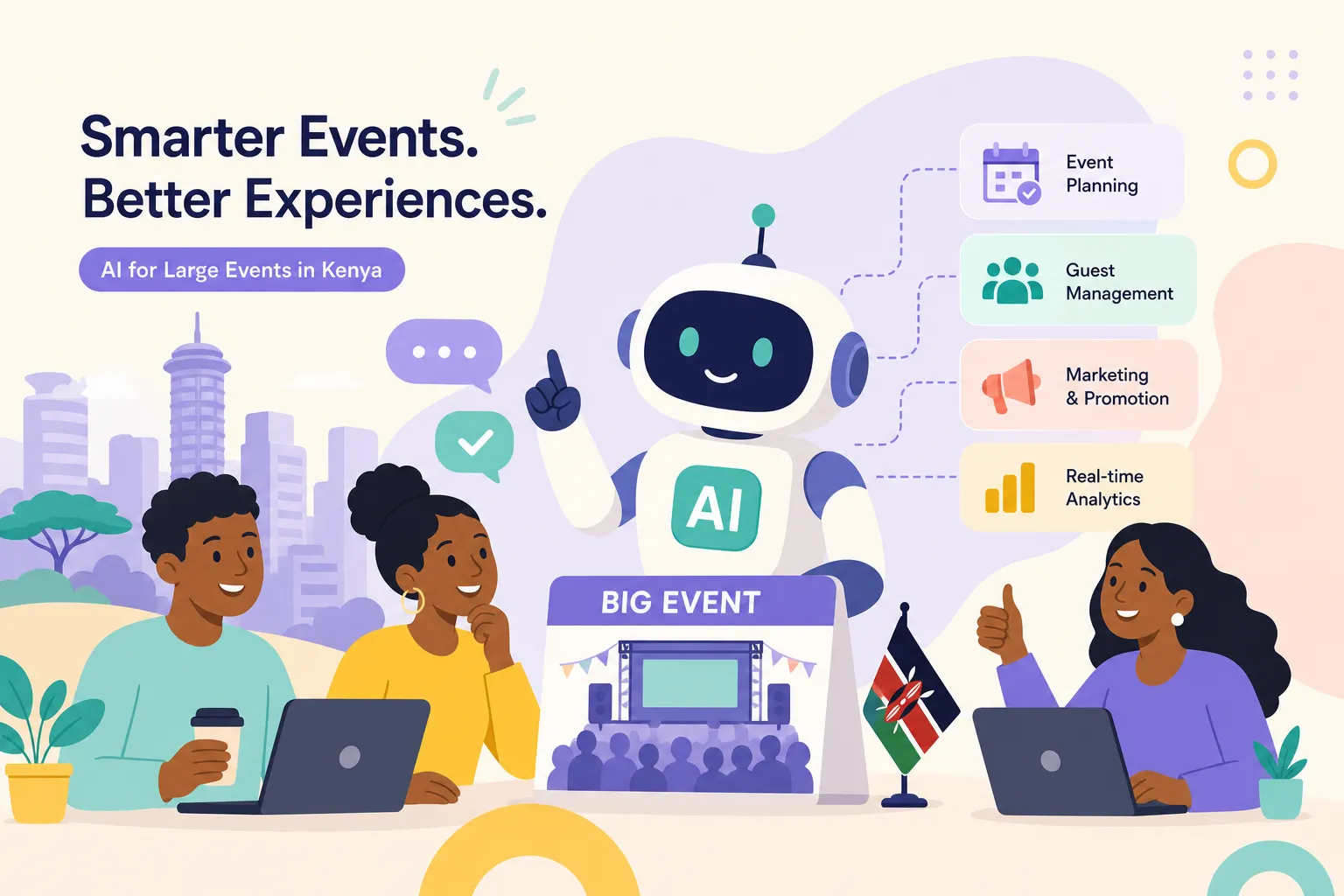
Picture this: 2,000 people registered for your Nairobi conference. Five phone lines ringing simultaneously. A Google Sheet that crashed three hours ago. And 400 WhatsApp messages sitting unread at 11 PM the night before the event, each one from someone who needs their ticket confirmed, wants to know where to park, or is asking whether the dress code is formal. That is the operational reality of running a large event in Kenya without the right systems in place.
So, how can an AI bot help manage a large event in Kenya? The short answer is: by handling the repetitive, high-volume tasks that break your team before the doors even open. Registration, FAQs, M-Pesa payments, personalised reminders, a properly built event chatbot Kenya event planners deploy on WhatsApp manages all of these, routing only genuine edge cases to a human agent. That is not a pitch. It is what a well-architected event bot does in production.
This is a practical guide for event planners in Kenya who want to know exactly which tasks an AI bot handles, which channel to use, what compliance requirements to meet, and how to deploy one before your next event. By the end, you will have a clear picture of the realistic scope, the deployment timeline, and what to build first.
How an AI bot helps manage a large event in Kenya: the core tasks
The value of an event chatbot Kenya organis ers rely on is not novelty, it is volume management. A bot does not sleep, does not tire at hour six of registration, and does not give different answers to the same question depending on who picks up the phone. The core use case is removing manual work from the tasks that scale badly with attendee numbers.
How an AI bot handles registration and RSVPs
A WhatsApp bot captures names, phone numbers, dietary requirements, and attendee role information through a structured conversation flow, without a form link or Google Sheet in sight. Data syncs automatically to a backend system in real time, and confirmation messages go out instantly. For events collecting payment during registration, the bot triggers an M-Pesa STK push prompt directly within the WhatsApp thread. The attendee enters their PIN, payment clears, and the bot delivers a digital ticket or QR code in the same conversation. The entire loop typically takes under ten seconds.
Attendee Q&A, reminders, and day-of logistics support
Roughly 70% of the questions your support team fields before and during a large event are identical: parking directions, dress code, session timings, speaker bios, Wi-Fi access. A well-trained AI check-in assistant handles all of these at any hour, across WhatsApp, without escalation. That alone recovers hours of staff time every day in the run-up to your event.
Reminders are where bots deliver measurable impact on attendance. Personalised WhatsApp messages sent 48 hours out, 24 hours out, and on the morning of the event can reduce no-shows by a meaningful margin compared to unreminded attendees. WhatsApp engagement rates generally exceed email in mobile-first markets like Kenya, which means your reminders are far more likely to be read. On the day itself, the bot becomes an instant broadcast channel: gate changes, transport delays, session room updates, accessibility routing. You push one message and every registered attendee receives it within seconds.
Why WhatsApp is the right channel for Kenyan events
The channel choice matters as much as the bot itself. A web chatbot widget requires attendees to visit a page they may not remember, on a connection that may not cooperate. SMS lacks the interactivity needed for multi-step registration and payment flows. WhatsApp is where Kenyan attendees already live: sharing event links, confirming plans with friends, and expecting businesses to respond. Deploying your AI event assistant on WhatsApp means zero friction to start a conversation.
Keeping M-Pesa, ticketing, and communication in one thread
The advantage of a WhatsApp-first event bot in Kenya is the ability to combine communication, payment, and confirmation inside a single interface. Attendees do not need to visit a separate payment portal, check a different email inbox, or download an app. The bot sends the M-Pesa STK push prompt, confirms payment once it clears through Daraja, and delivers the digital ticket in the same conversation thread where registration began. This reduces drop-off at the payment step, the most common point where attendee registrations fail to convert.
For organisers, every transaction and every interaction sits in one auditable record. Utility messages on the WhatsApp Business API cost approximately KES 0.80 per delivered message, and service messages within a 24-hour window are free. Marketing messages cost around KES 5.20 per message. For a 2,000-person event, those messaging costs are typically far below the staff hours and error-correction effort required by manual coordination, though the exact saving depends on your current staffing model.
Event types where an AI bot works well in Kenya
Kenyan events vary considerably in scale, payment flow, and communication style. Here are three formats where an event chatbot delivers the most practical value, each with different attendee volumes and operational demands.
Conferences and professional summits often range from several hundred to several thousand attendees, with multiple ticket tiers, speaker scheduling, sponsor booth directions, and real-time programme changes. The bot handles tiered registration (VIP, general, press) and sends personalised agendas automatically. Speaker bio requests and complex programme queries are best routed to a human agent for final verification, but the bot can surface the standard information and flag exceptions. Sponsor lead capture works through the registration flow: the bot qualifies attendees by role and company, then forwards structured summaries to sponsors at the close of each registration window.
Fundraisers and harambees run largely on trust and relationship, but the logistics still overwhelm organisers. The bot handles pledge confirmations via M-Pesa, sends donor acknowledgement messages instantly, and tracks giving in real time against a fundraising target. For community gatherings, church events, and NGO beneficiary meetings, the bot manages attendance lists, distributes logistical information in both Swahili and English, and sends location pins automatically to confirmed attendees. Most WhatsApp AI bots can detect which language an attendee uses and respond accordingly, including common English-Swahili code-switching, though bilingual accuracy improves significantly with proper fine-tuning for the specific vocabulary your event uses.
Kenya's data protection requirements for your event bot
Many event planners in Kenya are not aware that deploying a chatbot that collects attendee names and phone numbers triggers obligations under the Data Protection Act 2019. Collecting attendee data via a WhatsApp bot constitutes processing personal data, and the same registration requirements that apply to any data collection method apply here.
Consent, privacy notices, and ODPC registration
The bot must request explicit consent before collecting any data. That consent must be specific to the event purpose, and attendees must be told who is collecting their data and why. The privacy notice, delivered as a short message at the start of the conversation, must include the organiser's identity, the purpose of data collection, attendee rights (including the right to request deletion), and the consequences of declining to provide data. Where the event involves automated eligibility screening, attendees have the right to human review of that decision.
ODPC registration is likely mandatory for event organisers, regardless of size, because event organisation falls under the hospitality sector, which is explicitly listed as a non-exempt category. Registration fees range from KES 4,000 for micro-organisations to KES 40,000 for large entities. Data storage must include at least one copy of attendee data on a server or data centre located in Kenya. If a breach occurs, the ODPC must be notified within 72 hours.
Before going live, there are three compliance steps worth completing early. First, conduct a Data Protection Impact Assessment if you are collecting sensitive data at scale. Second, embed the consent request into the bot's opening message flow so it cannot be skipped. Third, designate a named person to handle data access requests during and after the event, this is a requirement, not a suggestion.
Step-by-step: deploying your AI event bot before event day
For a 1,000 to 10,000 attendee event, the realistic deployment window for a full production system is four to eight weeks. That window covers WhatsApp Business API approval, M-Pesa Daraja registration with Safaricom, FAQ training, Swahili language configuration, and human escalation setup. A basic version with STK push payment handling and AI-generated replies can be ready in three to seven days using a pre-configured platform, but it will lack the robustness you need for a large event.
What to build first and how long it takes
Start with the FAQ document before you touch any technology. Write out 20 to 30 questions grouped into four categories: registration, venue, transport, and schedule. This document becomes the foundation for training the bot's knowledge base, and building it forces you to clarify information that your team often answers inconsistently. Once that document exists, the technical build has clear inputs to work from.
The deployment sequence runs as follows:
- Build and finalise your FAQ document (Week 1)
- Select your platform and configure WhatsApp Business API access (Weeks 1 to 2)
- Register for M-Pesa Daraja and set up the STK push integration (Weeks 2 to 3)
- Train the bot with your FAQ, programme, and venue guide (Weeks 2 to 4)
- Build the escalation path to human agents and configure bilingual support (Weeks 3 to 5)
- Test, test, and test again (Weeks 5 to 7)
- Go live with QR codes on event signage and a mention in your confirmation emails (Week 7 to 8)
Testing, staffing, and what to do when the bot fails
Have ten different people attempt to break the bot before you go live. Ask the same question five different ways, probe every edge case, and simulate peak registration traffic. The most common failure points at large events are broken escalation paths (where the bot traps attendees in a loop without routing them to a human), context loss (the bot forgetting what an attendee already provided earlier in the conversation), and hallucinated answers (the bot inventing policies that do not exist). Each of these is preventable with the right build decisions upfront.
Two staffing roles are needed at launch: a technical monitor watching the live dashboard for drop-off spikes and error loops, and a human agent team ready to handle escalations the bot routes their way. When the bot escalates, the full conversation transcript must go with it so the attendee does not have to repeat themselves. On the contingency side: async message queuing absorbs traffic spikes without crashing the system; a direct contact number gives attendees a fallback if the bot goes offline; and deduplication logic prevents attendees from receiving duplicate payment confirmations during peak registration windows. All three should be in place before go-live.
Your next event does not have to be a coordination crisis
If you have been wondering how an AI bot can help manage a large event in Kenya, this guide covers the practical answer across five functional areas: registration, Q&A, reminders, payments, and day-of logistics. A well-built virtual event concierge running on WhatsApp is not a luxury for tech-savvy organisers, it is a practical operations tool that removes the manual bottlenecks that break large events. The combination of WhatsApp and M-Pesa is a particularly strong fit for the Kenyan context: payments are authorised through the Daraja STK push flow, confirmations return to the same thread, and the entire attendee journey stays in one place. No separate portal. No missed email. No unanswered message at midnight.
If you are planning an event in Kenya, reach out through alvineotieno.com. Alvine Otieno offers WhatsApp AI bots with M-Pesa Daraja integration and Swahili language support, built specifically for the Kenyan market, contact directly for case studies and to discuss what a bot can realistically deliver before your next event day.
Software engineer writing about the craft of building products on the web.