WhatsApp vs SMS: The Kenyan Business Messaging Guide 2026
Explore the critical differences between WhatsApp and SMS for business communication in Kenya. Learn about reach, engagement, costs, and compliance to make informed decisions for your customer messaging strategy in 2026.
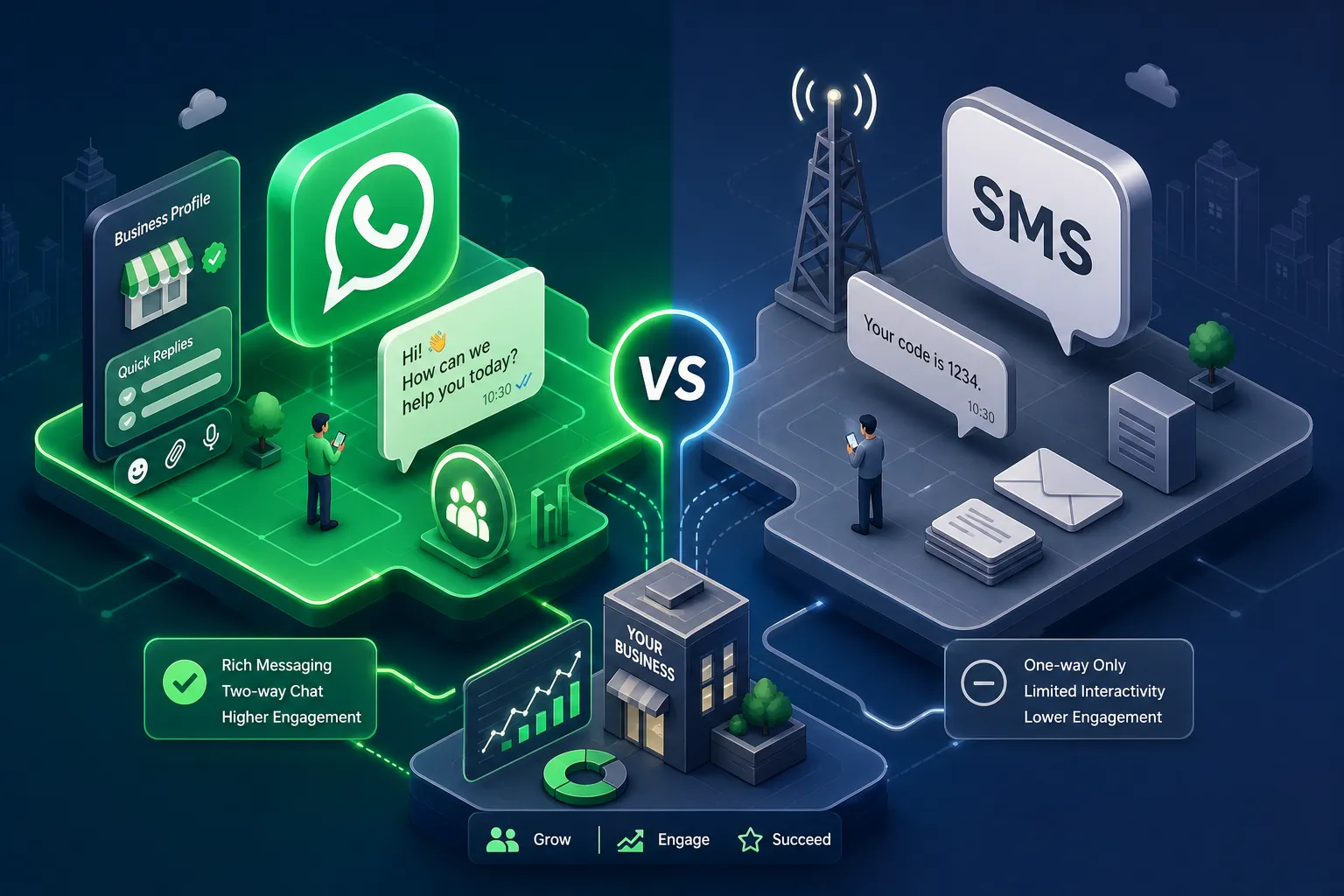
Is WhatsApp better than SMS for customer communication in Kenya? Picture this: you run a mid-sized retail business in Nairobi, and you need to push a promotional offer to 5,000 customers before the weekend. Do you send an SMS blast or a WhatsApp broadcast? The decision feels simple until you start doing the maths on delivery rates, cost per click, and what actually converts. Get it wrong and you've spent money on a campaign that nobody acted on. Get it right and you've added a scalable communication layer to your business.
This is not a preference debate. It's a question with real financial consequences, and the answer depends on who your customers are, what you need them to do, and where they live. Alvine Otieno, a Kisumu-based tech consultant who has built WhatsApp automation systems for Kenyan businesses and handled over 50,000 bot events in live deployments, breaks down the data so you can make an informed call. This guide covers adoption figures, engagement metrics, pricing, use cases, compliance rules, and a short implementation checklist to get you started.
How Kenyans Actually Use WhatsApp and SMS in 2026
Any channel decision starts with reach. If your customers aren't on a platform, the best engagement rates in the world won't help you.
WhatsApp Reach Among Connected Kenyans
As of Q1 2026, WhatsApp is used by 96% of Kenyan internet users, with 53.9% of all mobile subscribers active on the platform. That slight dip from 54.4% in Q4 2024/25 reflects growing competition from TikTok and Facebook, but among internet users the penetration is near-saturated. According to Q1 2026 usage data, approximately 96% of Kenyan internet users access WhatsApp at least once daily, making it a high-attention environment for business messages when you can reach someone there.
SMS and the Feature Phone Reality
Despite the smartphone surge, 62.2% of all connections as of December 2025, nearly 37.8% of devices in Kenya are still feature phones. SMS remains the only reliable way to reach those users. In rural areas, data connectivity is inconsistent, meaning a WhatsApp message may simply never arrive. For businesses serving customers across urban and peri-urban Kenya, SMS coverage is a real operational consideration, not a theoretical one. In urban centres such as Nairobi and Mombasa, transactional SMS delivery success rates typically run between 95, 99.7%, though rural delivery can fall sharply, in some areas below 50%, due to network coverage gaps.
The Smartphone Shift Changing Business Messaging
Today, 98.2% of Kenyan internet users access the web via smartphone, which means WhatsApp's functional reach is expanding rapidly. The underlying trend is clear: whether WhatsApp outperforms SMS for customer communication in Kenya increasingly comes down to geography and device mix rather than platform quality alone. Businesses that build their WhatsApp infrastructure now are positioning themselves ahead of the curve, not chasing it.
Is WhatsApp Better Than SMS for Customer Engagement? What the Numbers Reveal
Open rates and click-through rates tell very different stories for each channel. The gap between the two is larger than most business owners expect, and understanding it is essential before you allocate any budget.
SMS: Fast Delivery, Low Action
SMS achieves open rates of 95, 98%, typically within one to three minutes of delivery. That number looks impressive until you look at the click-through rate, which sits at 1, 6%, with response rates rarely exceeding 1, 4%. The structural reason is straightforward: SMS is a passive channel. Customers read and close. There's no easy path to action from a text message without copying a URL or dialling a number, and most people don't bother.
WhatsApp Engagement: Where the Real Numbers Live
WhatsApp open rates run between 75, 90% in Kenya, slightly lower because they depend on an active internet connection. The click-through rate, however, tells a completely different story: 35, 60%, with response rates of 15, 50%. That's a 6, 10x improvement over SMS on both metrics. WhatsApp messages are interactive by design. Customers can tap a button, reply in a chat thread, or click a link without leaving the app, and that design shows up directly in conversion data.
Reading the Numbers Correctly for Your Business Goal
If the goal is guaranteed delivery to every customer regardless of device or data access, SMS wins on open rate. If the goal is sales conversion, appointment confirmations, or any action that requires a response, WhatsApp wins decisively on CTR and response rate. These are not competing channels in absolute terms. They solve different parts of the communication problem, and the strongest businesses in Kenya are using both strategically.
What Messaging Customers Actually Costs in Kenya
Cost per message is the wrong number to focus on. Cost per outcome is what matters, and the two channels look very different once you do that calculation.
Bulk SMS Pricing: Volume Is Everything
Transactional SMS through Safaricom's direct bulk programme (via CSP partners) ranges from KES 1.06 per message at the 25,000, 124,999 volume tier down to KES 0.11 at volumes above 10 million. Mid-volume SMEs buying through aggregators like Afrokatt (KES 0.35) or Reach Messaging (KES 0.60, 0.80) pay more for the convenience of multi-network delivery and a single API. Factor in the one-time Sender ID registration fee, which varies by operator and CSP, typically ranging from KES 4,400 to KES 7,500 plus VAT per network, a mandatory cost for branded SMS campaigns on Kenyan networks. Confirm the exact figure with your chosen CSP before budgeting.
WhatsApp Business API: Per-Message Pricing from Mid-2025
Meta moved from per-conversation to per-message pricing in July 2025. Current wholesale rates for Kenya are approximately USD 0.0040 (roughly KES 1.12) for utility messages such as order updates and OTPs, and USD 0.0225 (roughly KES 3.53) for marketing messages. Local Business Solution Providers (BSPs) add a service margin on top of these base rates, and some bundle the costs into monthly platform fees. Confirm the final rate directly with your BSP, as Meta adjusts pricing periodically.
The Cost-Per-Outcome Calculation That Changes the Comparison
A KES 0.50 SMS with a 3% CTR means you spend roughly KES 16.67 to generate one click. A WhatsApp marketing message at KES 3.53 with a 45% CTR costs roughly KES 7.84 per click, and that's before accounting for the richer media formats and button interactions that WhatsApp supports. Run this calculation for your own volume and use case rather than comparing cost-per-message in isolation, because cost-per-outcome is the metric that actually determines whether a channel is worth the spend.
Is WhatsApp Better Than SMS for Your Specific Business Use Case?
The right channel depends on what you're asking customers to do. A booking confirmation has different requirements to a flash-sale promotion, and the channel should match the action.
Appointment Reminders and Booking Confirmations
SMS is reliable for appointment reminders because it delivers even without data, reducing no-shows across customers in mixed connectivity zones. WhatsApp adds real value when confirmation requires a customer action, such as tapping "Confirm" or "Reschedule", because that interactive element removes the back-and-forth that would otherwise require a phone call. The ideal setup for clinics, salons, and service businesses is an SMS reminder 24 hours out, followed by a WhatsApp confirmation request the same morning.
Order Updates, Delivery Notifications, and M-Pesa Payment Confirmations
Order and payment updates work well on both channels, but WhatsApp wins when the update includes a link, a tracking URL or receipt, or requires a customer response. SMS is preferable when the notification is purely informational and the customer may be in a low-connectivity area at the point of delivery. For M-Pesa-integrated workflows, both channels can be triggered automatically via API, but WhatsApp supports richer formatting including order details, product images, and action buttons that SMS cannot replicate.
Promotions and Marketing Campaigns
WhatsApp outperforms SMS on every engagement metric that leads to a sale: CTR (35, 60% versus 1, 6%), response rate (15, 50% versus under 4%), and the ability to include product catalogues and CTA buttons in a single message. SMS promotional campaigns still reach a broader raw audience including feature phone users, making them useful for broad awareness plays. For conversion-focused campaigns targeting smartphone users, WhatsApp is the stronger channel by a wide margin.
Compliance Rules Kenyan Businesses Must Follow
Kenya has real legal exposure in this area, and the penalties are not theoretical.
Opt-In Requirements and the Do Not Disturb Registry
Kenya's Consumer Protection Regulations 2025 classify sending unsolicited direct marketing without prior consent as a criminal offence. All SMS and WhatsApp marketing must be based on an explicit, documented opt-in. Businesses must also verify recipient numbers against the national Do Not Disturb (DND) registry before sending any promotional message. Using an opt-out model, where customers are subscribed by default, is specifically prohibited.
Data Protection Act 2019 Obligations
Mobile numbers are classified as personal data under Kenya's Data Protection Act 2019. Businesses processing numbers for direct marketing must register with the Office of the Data Protection Commissioner (ODPC), maintain documented audit trails of consent, and provide a clear, free opt-out mechanism in every message. This applies equally to SMS campaigns and WhatsApp broadcasts via the Business API. Registration is completed through the ODPC's online portal, and certificates are valid for 24 months.
Time Windows, Sender ID Rules, and Message Content Restrictions
The Communications Authority of Kenya (CAK) restricts promotional SMS to a 7:00 AM to 7:00 PM window. Messages sent outside those hours require prior express consent from the customer for off-hours delivery. All businesses must register their Sender ID with mobile operators through a licensed CSP, as generic IDs are blocked by carriers. WhatsApp template messages submitted to Meta must include a clear unsubscribe path, for example, "Reply STOP to opt out", in line with both Meta's template guidelines and ODPC requirements for opt-out mechanisms. Content restrictions prohibit gambling, adult material, and hate speech across both channels.
Moving to WhatsApp Automation: What the Next Step Actually Looks Like
For businesses that have identified WhatsApp as the right channel for their core use cases, the logical next step is automation. Manual WhatsApp management hits a ceiling fast.
When WhatsApp Automation Makes Business Sense
Many businesses find automation worthwhile once monthly message volumes and manual support load, typically hundreds of messages per month, make individual handling inefficient. When you're copying and pasting responses, chasing unread confirmations, and manually tracking opt-outs, that overhead becomes a bottleneck faster than most owners expect. WhatsApp bots built on the Meta WhatsApp Cloud API handle these workflows 24/7 without adding headcount, and they integrate with payment systems like M-Pesa via the Daraja API for fully automated transaction flows.
What 50,000+ Events Teaches You About Deployment
Alvine Otieno has built and deployed WhatsApp bots currently handling over 50,000 events for Kenyan businesses, integrating OpenAI for intelligent response handling, n8n for workflow automation, and the Meta WhatsApp Cloud API as the messaging backbone. The consistent lesson from that scale: businesses that define their use cases precisely before building get better results faster than those who build broadly and refine later. A well-scoped first bot, one that handles a single workflow end-to-end, can go live in weeks, not months.
A Short Checklist to Get Started Without Breaking What Already Works
- Audit your current messaging workflows and identify the top two or three use cases (reminders, order updates, support FAQs).
- Register your WhatsApp Business account and apply for API access via a local BSP, consult your BSP's onboarding documentation for step-by-step guidance.
- Register your Sender ID with your chosen CSP and document your opt-in process to satisfy Data Protection Act requirements, referencing ODPC registration guidelines.
- Build and test a single automated flow, for example, an appointment confirmation with a "Confirm / Reschedule" button, before scaling.
- Measure response rate and cost-per-outcome for four weeks, then decide whether to expand to additional use cases or retire your SMS campaigns for that particular workflow.
Frequently Asked Questions
Is WhatsApp better than SMS for customer communication in Kenya overall?
For smartphone users in urban and semi-urban areas, WhatsApp delivers significantly better engagement, conversion rates, and two-way communication. SMS remains essential for reaching feature phone users and customers in low-connectivity rural zones. Most Kenyan businesses benefit from running both channels strategically rather than replacing one with the other outright.
Do I need a WhatsApp Business API to automate customer messages?
Yes. The standard WhatsApp Business app does not support automated messaging at scale. You need the WhatsApp Business API, accessed through a registered BSP, to send template messages programmatically and integrate with your existing systems.
What are the main compliance risks for bulk SMS in Kenya?
The primary risks are sending without documented opt-in consent, failing to screen numbers against the DND registry, sending outside the 7:00 AM, 7:00 PM window, and operating without ODPC registration. Each of these carries legal consequences under the Consumer Protection Regulations 2025 and the Data Protection Act 2019.
The Decision Framework in Plain Terms
So, is WhatsApp better than SMS for customer communication in Kenya? The honest answer is: it depends on who you're reaching and what you need them to do. SMS reaches everyone and delivers reliably, even on feature phones in low-connectivity zones. WhatsApp drives engagement, conversion, and two-way conversation at a scale SMS cannot match. For most Kenyan businesses serving a smartphone-heavy customer base, WhatsApp is the stronger channel for anything requiring a response.
SMS remains a smart fallback for broad reach and offline customers. The clearest path forward is to run both channels strategically, automate the WhatsApp side, and let the data from your own use cases guide which channel carries more weight over time. If you're ready to set up that WhatsApp automation layer and want it built properly from the start, Alvine Otieno is available for a consultation. Reach out through the contact page and bring your top two use cases. That's enough to get started.
Software engineer writing about the craft of building products on the web.