Why developers across Africa keep building on Replit
Explore why African developers are increasingly adopting Replit. This post delves into how Replit overcomes hardware limitations, simplifies setup, and streamlines deployment, making it an ideal platform for building and shipping software
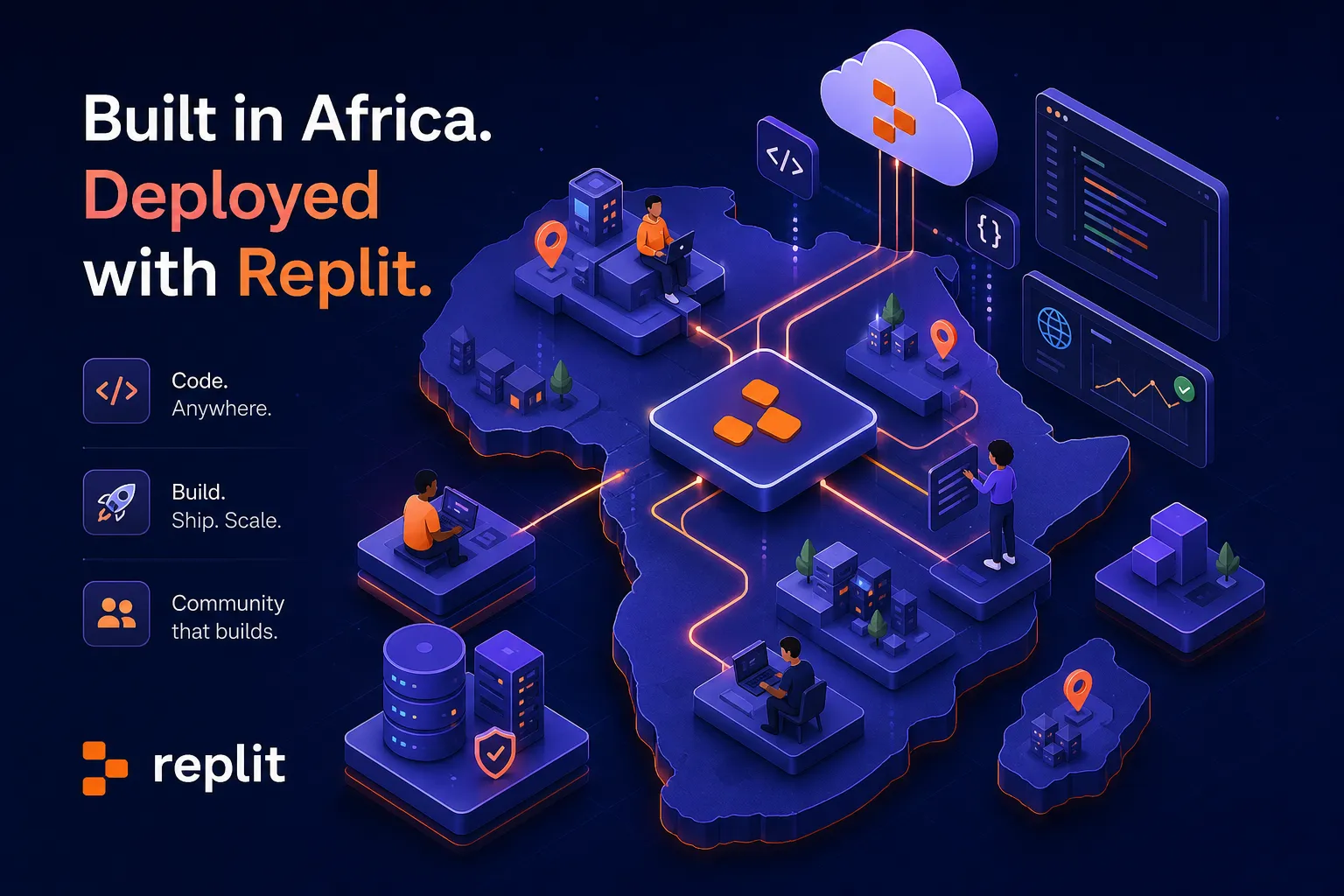
Why do developers in Africa use Replit for building projects? Because building software on the continent often means fighting your environment before you write a single line of code. Your machine is slow, your local setup is fragile, and the tutorial you're following assumes hardware you simply don't have. That's not a personal failing; it's the reality of working as a developer in a region where the tools were mostly built for someone else's context.
Replit doesn't solve all of that. But it removes enough of the friction that it has become the default starting point for an enormous number of developers across Kenya, Nigeria, South Africa, and the rest of the continent. Not because it's the most powerful cloud IDE available, but because it meets you where you actually are. By 2021, Replit was already the developer tool of choice in several African markets, growing its user base before many Western alternatives had even considered entering these regions. That trajectory wasn't accidental.
This is an honest developer's take, not a sponsored one. As someone who builds WhatsApp bots and workflow automations for clients daily, I've seen firsthand how the right development environment can either slow a project down or get it shipped. The wrong setup costs you hours you don't have. Read on for an honest breakdown of why Replit for African developers has earned a real place in that conversation.
The hardware barrier that shapes why developers in Africa use Replit
Most programming tutorials assume a machine with 8 to 16 GB of RAM, a solid-state drive, and a stable local environment. That assumption excludes a significant portion of developers across the continent who are working on shared machines, older laptops, or devices that struggle to run a modern IDE alongside a local database, a Node.js server, and a browser at the same time. It's not a hardware complaint; it's context that most tutorial writers don't carry with them.
Replit's cloud IDE changes this at the architectural level. When you open a Repl, the code runs on Replit's servers, not your machine. The browser is just the interface. Your laptop's RAM, CPU, and storage become almost irrelevant to the actual execution. As one bootcamp instructor in Nairobi described it, students join sessions from Chromebooks or budget laptops, and the instant multiplayer with live app preview works regardless of device. That's not a marginal improvement; it's a completely different relationship between the developer and their hardware.
How Replit Agent removes local hardware as a bottleneck
Replit Agent extends this further. Instead of configuring your environment manually, you describe what you want to build in plain language and Agent handles the scaffolding: installing dependencies, generating the project structure, and writing initial code (all server-side). The two features that most fundamentally remove local hardware as a bottleneck are the cloud IDE and Agent. Everything else, multiplayer, one-click deploy, is valuable, but those two are the foundation.
Zero setup means the code starts before the frustration does
Any developer who has spent two hours debugging a Python virtual environment on a new Windows machine, or fought Node version conflicts on a shared Linux box, knows exactly what's at stake. Local development setup is a genuine time tax, and for anyone trying to prototype quickly or learn without a formal environment to fall back on, it can kill a project before it starts. The momentum loss is real and consistently underestimated.
Replit eliminates this entirely. Pick a language or framework and the environment is ready in seconds, no package manager errors, no missing dependencies, no PATH variable confusion. The configuration step simply doesn't exist. For newer developers especially, the ability to start writing actual code in under a minute rather than spending the first session on setup is a meaningful shift in how learning feels. It's one of the clearest reasons so many use Replit as an online code editor for first projects and Replit for education contexts alike.
There's a bandwidth dimension to this that matters specifically in Africa. When internet connectivity is limited or metered, spending data downloading Docker images or npm packages locally is a genuine cost, financially and in time. Replit moves those dependency pulls to its own infrastructure. You're not burning your data plan on setup; you're using it to build. That distinction carries real weight in markets where mobile data is priced per gigabyte.
Deploying a live app without touching a server
Traditionally, getting a working application in front of a client or collaborator meant provisioning a server, configuring DNS, setting up SSL certificates, and managing deployments, none of which is straightforward for a solo developer or early-stage project. The distance between "code that works locally" and "link I can send someone" has historically required a separate skillset and a separate bill.
Replit collapses that entirely. You write the code in the browser-based IDE, click deploy, and receive a live URL. No separate hosting account, no terminal commands to a remote server, no Nginx configuration files. For developers building prototypes for clients or pitching an MVP, this is a significant speed advantage that compounds across a project's lifecycle.
The practical difference for freelance and client work is worth making explicit. If you're building a small web app, a bot webhook, or a landing page backend, the ability to show a live, working version within the same session you started coding is genuinely powerful. Instead of sending a screenshot or a recorded walkthrough, you're sending a working link. That changes how clients engage with early-stage work and shortens the feedback loop in ways that matter for project momentum.
Replit Agent and what it means for developers without powerful machines
Replit Agent lets you describe what you want to build and generates the starting project structure, installs dependencies, and writes initial code, all in the cloud, without requiring local processing power. For someone on a lower-spec machine who wants a working skeleton up quickly, this means the heavy lifting happens server-side. You're directing, not computing.
Compared to GitHub Copilot, the distinction is worth understanding clearly. Copilot is an inline code assistant: it accelerates writing within a codebase you're already managing, but it doesn't scaffold a full application, configure hosting, or deploy to a live URL. Replit Agent is an autonomous builder that takes you from a prompt to a deployed application without requiring you to manage the environment steps. For full-stack scaffolding without local hardware, Agent sits in a different category. Tools like Glitch and Gitpod offer some overlap, browser-based editing and collaborative features, but neither combines AI scaffolding, zero-setup environments, and one-click deployment in the same workflow.
I use Replit as part of my own workflow, particularly when I want to test an idea quickly or validate logic before integrating it into a production build. For the work I do, building WhatsApp bots and n8n automations for clients, the ability to spin up a quick environment, test webhook logic, and iterate without touching my local machine is genuinely useful. It's not a replacement for a full development environment, but as a prototyping and testing layer in an AI-assisted workflow, it earns its place.
The honest cost breakdown for developers in Kenya
Replit's free Starter plan includes limited daily AI credits and one published app. For serious prototyping, you'll hit those limits quickly and get nudged toward the Core plan at $20 per month on annual billing. At current exchange rates, that's roughly KES 2,600 to 3,500 per month. For an individual developer, that's not trivial, particularly with no regional pricing and no M-Pesa payment option. You need an international card to subscribe, which is its own barrier. A practical workaround is to use a virtual Visa card through services that support M-Pesa top-up, such as those offered by certain Kenyan fintechs, to access the Core plan without a traditional credit card.
Alternatives worth knowing about:
- GitHub Copilot Individual: $10 per month (~KES 1,300), integrates directly into VS Code, and is free for verified students through GitHub Education.
- CodeSandbox Pro: $15 per month (~KES 1,950), with a more generous free tier for public projects and PayPal support.
- Cursor paired with a local or hosted model: A more cost-effective long-term setup once initial configuration is handled, with no recurring credit costs.
Replit's pricing works best when the zero-setup and deployment convenience genuinely saves you time that translates into client value. For rapid prototyping and short turnaround work, the convenience is worth the cost. For long-term production work where you're running the same environment daily, a different stack will likely serve you better on cost.
Where Replit fits and where it runs into limits
Replit requires a continuous, stable internet connection. There is no offline mode. If your connection drops, your session pauses. On a shared Wi-Fi or mobile hotspot with inconsistent signal, this is a real operational constraint, not a theoretical one. The free tier also includes a 10 GiB monthly outbound data transfer cap, which matters if you're building anything that serves files or handles moderate traffic volumes.
One practical workaround: switch your account's server region to the continent closest to your location rather than defaulting to the US. Selecting a nearby region reduces latency and improves session stability meaningfully. Configuring your DNS to use a public resolver such as Google DNS (8.8.8.8) or Cloudflare (1.1.1.1) can also help if you're experiencing loading issues on a specific network.
Replit is excellent for learning and teaching, rapid prototyping, building MVPs you need to demonstrate quickly, small bots and webhooks, and any project where starting immediately matters more than fine-tuned performance. It's less suited for production applications requiring consistent uptime guarantees, memory-intensive workloads, or projects with specific compliance and security requirements. Knowing that distinction helps you use Replit where it's strong rather than pushing it into contexts where a different tool would serve better.
Why African developers choose Replit, and where it still falls short
Replit resonates with developers across Africa not because it's the most powerful tool available, but because it removes the most common practical barriers: hardware constraints, environment setup, deployment friction, and the learning curve of managing a local stack from scratch. Those aren't small problems. For many developers working in this context, they are the problems that determine whether a project gets built at all. That is ultimately why developers in Africa use Replit for building projects at a rate that has outpaced adoption in regions with far better-resourced developer environments.
The real limitations are worth naming clearly. The cost at $20 per month, with no regional pricing or mobile money support, is a genuine barrier for individual developers. The platform's full dependency on a stable connection means it's not a reliable primary environment anywhere connectivity is inconsistent. And Replit Bounties, while functional in principle, do not yet have verified evidence of cash-out to African developers; that feature is still pending in terms of documented, accessible payouts to this region.
The practical takeaway is this: if you're prototyping, learning, or trying to get something in front of a client without spending half a day on environment setup, Replit is worth the friction it saves. For production work, pair it with a fuller stack.
If you're building something and want to think through the right tools for your specific use case, whether that's a WhatsApp bot, an automation workflow, or a web platform, that's exactly the kind of conversation worth having. Reach out through Alvine Otieno and we'll work through it together.
Software engineer writing about the craft of building products on the web.