Workflow Automation in Kenya: Quick Wins for Local SMEs
Discover how workflow automation can transform Kenyan SMEs by eliminating repetitive tasks, saving time, and boosting efficiency. Learn practical strategies for automating WhatsApp, M-Pesa, and lead capture.
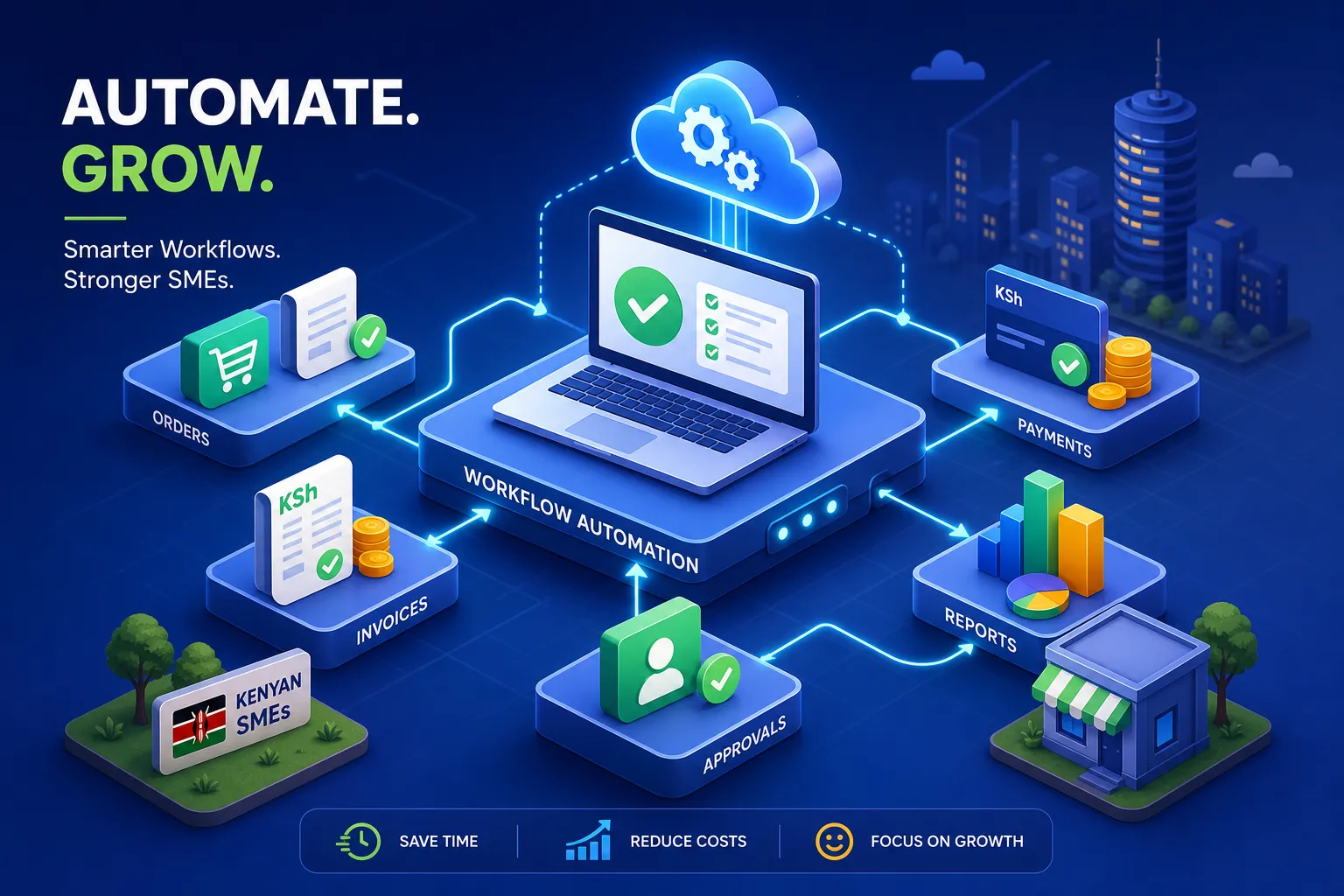
Workflow automation Kenya, the phrase is becoming shorthand for how small businesses are finally clawing back time. It is 9 pm in Nairobi. A business owner is copying WhatsApp messages into a spreadsheet, chasing three overdue invoices, and trying to remember which warm leads never got a follow-up this week. The business is growing, the work is multiplying, and the owner is the bottleneck. This scenario plays out every night across many Kenyan SMEs, and every hour spent on it is an hour not spent on sales, strategy, or rest.
The good news: every task in that paragraph can run automatically. Business process automation in Kenya has moved far beyond the corporate IT department. Tools like n8n and Make have brought production-ready automation within reach of many small Kenyan businesses. Alvine Otieno, a freelance software developer and tech consultant based in Kisumu, has been building these exact systems for Kenyan businesses, eliminating repetitive work and giving owners their time back. This guide covers which processes to automate first, what it realistically costs, and how to get your first workflow live.
The manual tasks quietly draining your business every week
Most business owners underestimate how much time disappears into tasks that follow a fixed rule every single time. Typing the same WhatsApp reply to a pricing question, chasing an invoice that is three days overdue, logging a new enquiry from a DM into a spreadsheet: none of these tasks require judgement. They just require time, and that time adds up fast.
Across the SME clients Alvine has worked with, teams routinely spend somewhere between 20 and 50% of working hours on tasks that can run automatically, a range consistent with wider industry observations on automatable work. For a five-person team working a standard 40-hour week, that is 8 to 20 hours per employee per week on work that produces no new revenue. Across a month of four weeks, you are looking at roughly 32 to 80 hours of lost capacity per person.
Three areas account for the biggest losses. Invoice and M-Pesa reconciliation is typically the heaviest drain: processing 200 invoices a month takes 15 to 25 hours manually but under 30 minutes when automated. WhatsApp customer service is the next significant time sink, where a properly built chatbot can handle 60 to 80% of routine support queries without involving any staff. Lead follow-up sequences complete the picture, with businesses that automate these reporting 20 to 40% more conversions within 60 days. These figures come from businesses operating in the same local environment as yours, including systems Alvine has built and maintained for Kenyan clients.
Three workflow automation wins delivering real results in Kenya
Automating WhatsApp follow-ups and lead capture
A WhatsApp automation workflow works like this: a potential customer messages your business number, the bot qualifies them with two or three short questions, logs the lead into your CRM, and triggers a follow-up sequence at set intervals, all without anyone touching their phone. The customer gets a fast, professional response. Your team gets a warm lead already categorised and tracked.
Alvine has built this type of system for Kenyan businesses using n8n and the Meta WhatsApp Cloud API. One WhatsApp bot deployed for a client has handled over 50,000 events, running consistently without manual intervention, a scale at which the time and staffing savings typically recover the setup cost within the first few months of operation.
Invoice reminders and M-Pesa reconciliation
An automated invoicing workflow fires a payment reminder on day one, day three, and day seven after an invoice falls due, a common cadence used by local developers, though timings can be adjusted to suit each business. No one has to check a spreadsheet or remember who owes what. When payment comes in via M-Pesa, the transaction data is automatically matched against the outstanding invoice and the record is updated, with the audit trail maintained throughout.
Finance teams using this approach consistently report saving 40 to 60 hours a month. For a small business, that is the equivalent of recovering more than a full working week every month from a single automation. The cost of building the system is typically recovered within 60 to 90 days through labour savings alone.
Lead capture from web and social channels
Every contact form submission, Instagram DM, or Facebook enquiry that does not get an immediate response is a warm lead cooling off. Automated form-to-CRM pipelines capture that enquiry, log it, and trigger an instant acknowledgement message while routing the lead to the right person on your team. Clients who have implemented this type of pipeline report a sharp drop in leads lost to inbox delays, in some cases, response rates improving from hours to under two minutes. Businesses stop losing enquiries to inbox chaos and start working a system where nothing falls through the gap.
The tools powering workflow automation in Kenya
n8n and Make: where most of the work happens
n8n is open-source and self-hostable, which means a business can run it on a server costing under KES 1,000 a month and own the system entirely. You are not paying per automation run, and your data does not live on someone else's platform. The trade-off is that initial setup requires a developer or someone technically comfortable with a Linux server. For businesses that want full control over their data and plan to run high volumes of automations, n8n is the stronger long-term choice.
Make (formerly Integromat) is cloud-based, visually intuitive, and far more accessible for non-technical teams. Its free tier is generous enough to test a basic workflow, and its paid Core plan runs around KES 1,400 a month at current exchange rates. Both platforms integrate natively with WhatsApp Business API, Google Sheets, Gmail, and M-Pesa via the Daraja API. Many Kenyan implementers, including Alvine, work across both tools, selecting between them based on a client's technical comfort level and volume needs, with n8n often preferred when the business wants to own its infrastructure long-term.
Other platforms worth knowing
Zapier is powerful and has an enormous library of app connectors, but its pricing in USD makes it significantly more expensive than the alternatives at scale. Barawave is a locally built platform offering an all-in-one ERP, CRM, and automation suite designed specifically for Kenyan SMEs, worth evaluating if you want a single platform rather than a custom stack. Bubble works well when you need a custom front-end alongside your automations, particularly for businesses building client-facing portals or internal tools.
The practical starting point for most Kenyan businesses is straightforward: begin with Make or n8n, prove the value on one workflow, then expand. Bringing in additional platforms should be driven by a specific gap, not by enthusiasm for new tools.
What workflow automation realistically costs in Kenya
One-time setup costs and what drives them
A single-workflow automation, such as a WhatsApp follow-up sequence or an invoice reminder system, typically costs KES 10,000 to 40,000 to set up with a local developer, depending on complexity. A multi-process system covering invoicing, lead capture, and customer support together runs KES 50,000 to 120,000. Enterprise-level builds with custom integrations sit above KES 200,000. The biggest cost driver is not the tool itself but the complexity of connecting it to existing systems, particularly local ones like the M-Pesa Daraja API or a business's existing point-of-sale system.
Timeline follows complexity in the same way. A focused single-workflow build takes 2 to 4 weeks from scoping to go-live. Multi-process systems run 4 to 8 weeks. Build a 30% buffer into any estimate to account for data inconsistencies and integration surprises that are common when working with local systems.
Monthly running costs and when you break even
Most Kenyan SMEs running n8n on a self-hosted server alongside one or two other tools spend under KES 15,000 a month on subscriptions, covering server costs and any paid tool licences. Managed services from local agencies run KES 40,000 or more monthly but include ongoing support, maintenance, and workflow adjustments as your business changes.
The return on investment maths is straightforward. A 30% reduction in manual workload saves KES 36,000 to 50,000 a month for a typical SME. At a KES 40,000 setup cost, you recover the investment in under two months. Finance teams saving 40 to 60 hours a month on reconciliation alone are looking at payback periods measured in weeks, not quarters. Most businesses hit breakeven within 60 to 90 days of going live.
How to choose your first automation and get it running
Finding the right process to start with
The filter for your first automation is simple. Look for the task your team performs most frequently, which follows the same predictable rule every single time, and which involves moving information from one place to another. Invoice reminders, lead logging, and appointment confirmations almost always pass this test. Start with one process, not five. Build from a working foundation rather than an ambitious blueprint that takes months to deliver.
A focused first build takes 2 to 4 weeks from scoping to go-live. That timeline gives the team confidence, produces a measurable result quickly, and creates a template for the next process. The businesses pulling ahead right now are running three or four automations that work consistently and deliver measurable output every day, not twenty that were built in a rush and require constant attention.
DIY versus hiring a local automation developer
Make's drag-and-drop interface is accessible enough for business owners without a coding background to build and test basic workflows. The free tier supports simple automations connecting two or three apps, and it is a reasonable way to validate whether a workflow is worth building properly. If your first test saves time and the logic is clear, you have a strong case for a production build.
Anything involving API connections, including M-Pesa via Daraja, WhatsApp Business API, or a custom database, requires a developer. This is where working with a specialist like Alvine Otieno makes a measurable difference. A developer who understands both the technical stack and the Kenyan business environment, including M-Pesa payment flows, local user behaviour, and low-bandwidth considerations, delivers a system that works in practice, not just in a demo.
Workflow automation Kenya: start with one process, measure everything
Workflow automation Kenya is not a future investment. The tools exist, local expertise exists, and the cost of staying manual, measured in hours lost and leads missed each week, is already higher than the cost of building the first automation. The majority of Kenyan SMEs still operating manually are not saving money by waiting; they are handing a compounding advantage to competitors who have already made the switch.
Pick one high-frequency task this week. Run it through the filter: does it happen often, follow a consistent rule, and involve moving information between systems? If yes, that is your first automation. Choose a platform that matches your technical comfort level, build something small and functional, and measure the result after 30 days. The numbers will tell you exactly where to go next.
If you want to skip the learning curve and get a production-ready system built by someone who has already done it for Kenyan businesses, Alvine Otieno builds exactly these kinds of automations: WhatsApp bots, invoice workflows, M-Pesa integrations, and full business process automation stacks. Reach him directly at alvineotieno.com, he has already built these systems for Kenyan businesses and can have yours running from day one.
Software engineer writing about the craft of building products on the web.